
Yascha Mounk
Jeff and Cal Leonard Fellow, 2016; Senior Fellow, Political Reform
Angela Merkel is TIME鈥檚 2015 Person of the Year. In many ways, she deserves the accolade. Leading a party that has long been deeply uncomfortable with immigrants in general, and Muslims in particular, she has committed Germany to a surprisingly generous policy toward the millions of refugees fleeing the Middle East. This makes Merkel a powerful symbol of what the political process can still achieve鈥攐f the fact that, even in this day, rational and open-hearted policies can prevail against ignorance, prejudice and hate.
And yet, to paint 2015 as the year of Angela Merkel is a little akin to calling 1928 the year of Wall Street or 2006 the year of the Blackberry. Merkel may be the star of her class鈥攖he centrist, establishment political leader who has showcased what centrist, establishment politics is capable of鈥攂ut that star is rapidly fading. Across the world鈥檚 established democracies, from Berlin to Washington, and from Delhi to Budapest, 2015 has shown that far-right populists are now a real, lasting threat to liberal democracy. Over the past twelve months, they have matured from a worrying symptom that hinted at some underlying problems to a full-blown disease.
The most infamous populist to storm the stage in 2015鈥攁nd probably the most entertaining鈥攈as been Donald Trump. A cartoonist commissioned by a Communist propaganda ministry to invent a capitalist arch-villain would have been proud to come up with The Donald. The prospect that Trump might actually snag the Republican Presidential nomination, turning a far-right populist with no political experience into the de facto leader of one of the two dominant parties in the world鈥檚 most powerful country, seems far less remote now than it did a few months ago. Even if his fate should reverse, as it probably shall (though a ), his rise demonstrates two deeply disturbing truths about the state of democracy.
The first is that hatred of the other can be a phenomenally powerful political force. If anger at immigrants and religious minorities can upend the political system in the United States, a country that鈥攗nlike a large majority of the world鈥檚 democracies鈥攈as long conceived of itself as a land of immigrants, its force is even more universal than we might have feared a year ago.
The second may be still more worrying. Citizens have always distrusted establishment politics to some degree. But in the past, most citizens had some establishment party or politician they did trust, or at least trusted more than the others. 国产视频 appeal is different. His selling point is not so much that he is the one politician whom voters can trust to be beyond self-interest鈥攂ut rather that he is the one politician who frankly admits to pursuing his self-interest. That鈥檚 why it was so disarming when, asked why Hillary Clinton had been at his wedding, he insinuated that it served his private interests: 鈥淵ou know why? She had no choice, because I gave.鈥� 国产视频 line has become an instant classic of presidential debates鈥攚hich makes it easy to forget that the depth of popular cynicism about the political system which it revealed should be nothing less than frightening.
What Trump shows about the appeal of populism is more eye-opening than Trump himself. For all of his knack for channeling the people鈥檚 darkest instincts, he is likely to remain a short-lived sideshow, in good part because he lacks political experience and a real political organization. But the same cannot be said for many other far-right populist leaders. They have been busy building a loyal support base well before Trump entered politics鈥攁nd are likely to influence politics long after he goes back to his core business of building tall towers and organizing beauty pageants.
The most extreme examples are far-right heads of government in semi-established democracies who are busy engineering a form of 鈥渧ertical鈥� or 鈥渋lliberal鈥� democracy. In 2015, the two most prominent representatives of this movement鈥攁nd Turkey鈥檚 Recep Erdogan鈥攆aced a potentially dangerous surge of discontent with their increasingly authoritarian style of government. Both responded by doubling down on their hatred of minorities and their disregard for constitutional democracy. Both came out looking all the more powerful.
After losing parliamentary elections in June, Erdogan took his government on a course of extreme confrontation with Kurds鈥攕upplemented by an increasingly ruthless crackdown on independent journalists. On the brink of civil war, frightened Turks returned his party to office with a comfortable majority in new elections in November. Similarly, after sinking in the polls in the early part of the year, Orban took his government on a course of extreme confrontation with both refugees and the European Union鈥攕upplemented (of course) by an increasingly ruthless crackdown on independent journalist. Hungarians thanked him with a significant boost in support.
These developments demonstrate that there need not be any inbuilt limits to illiberal democracy. Faced with crises, illiberal leaders have radicalized rather than moderated. Adept at stoking and exploiting fears, this radicalization has served to boost rather than to undermine their popularity. Once far-right populists are elected, there is no guarantee that high office will pull them back towards the center. India or Poland, where leaders with deeply illiberal attitudes , might well follow suit in the coming years.
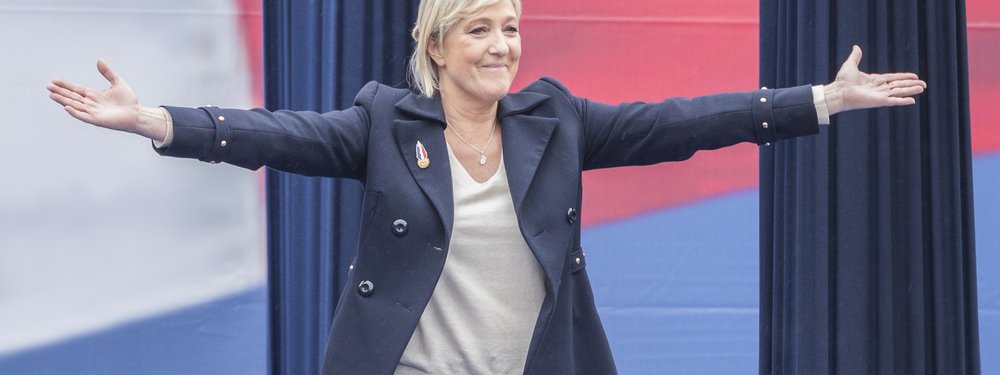
To be sure, Turkey and Hungary are extreme examples, in part because democracy there had taken root more recently than elsewhere. But far-right leaders in more established democracies have started to emulate the playbook of illiberal leaders. Take Marine Le Pen, who managed to establish the Front National as France鈥檚 strongest party in the first round of recent regional elections (though an informal coalition of establishment parties dealt her a in the second round). More disciplined and experienced than Trump, Le Pen now has a real chance of conquering the Elys茅e Palace in France鈥檚 rapidly approaching presidential elections. Widespread opposition to mass immigration and an increasingly deep-seated fear of Islamist terrorism are her means. But in many ways her ultimate end resembles that pursued by Orban and Erdogan: a vertical democracy that advantages an ethnically homogenous majority at the expense of marginalized minorities.
But to return to Merkel: Germany is still far from Hungarian, or even from French, conditions. The only major established democracy with proportional representation in North America or Western Europe to have kept far-right populists out of its national parliament so far, the country has long seemed like a comforting case of political stability. And yet, the year has been unusually ugly even there. It began with fractious protests at which tens of thousands took to the street to protest the supposed 鈥淚slamization of the West.鈥� Over the summer, it produced heartwarming images of ordinary citizens welcoming newly arrived refugees鈥攂ut it also witnessed more than two hundred arson attacks on homes for refugees. Now, it ends with Alternative for Germany, an increasingly radical protest party, at unprecedented strength in opinion polls鈥攁nd Merkel鈥檚 popularity at record lows, in good part because of her courageous embrace of refugees.
Establishment politics is not yet dead. But at the end of this year, its enemies look more formidable than ever. 2015, TIME tells us, was the year of Angela Merkel鈥攚hich is to say, the year that showed why, at its best, the liberal-democratic establishment may be worth preserving. There is something to that. And yet, 2015 was also the year of Donald Trump and Marine Le Pen and Victor Orban and Recep Erdogan鈥攚hich is to say, the year that showed us just how tenuous the hold of liberal-democratic values has grown.
Jeff and Cal Leonard Fellow, 2016; Senior Fellow, Political Reform


