
A Conversation with Paul Tough, Author of ‘Whatever It Takes’

With Waiting for Superman, movie-goers this fall got a close-up view of the disparities in educational opportunities for children who grow up in poverty. But to many people in early education, the documentary the inequities in learning opportunities that poor children experience from as soon as they are born up through the early grades of elementary school.
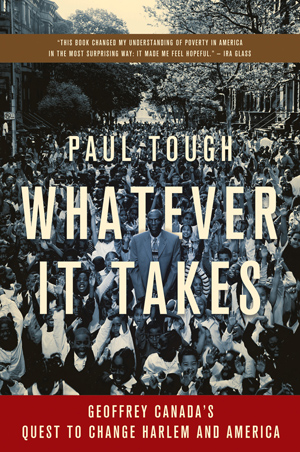
In , which was published in 2008 and is now out in paperback, readers get a broader picture. The book tells the story of how Geoff Canada, the founder of the Harlem Children鈥檚 Zone, has tried to halt the cycle of poverty through a series of support programs including parenting services, early childhood programs and the Promise Academy charter schools in a 97-block section of New York City.
Last month, I had a chance to talk with , the author of Whatever It Takes, about the Zone’s early childhood programs, the Promise Neighborhood program started by the Obama administration, and his reaction to Waiting for Superman. Here is an edited transcript of our conversation:
What is remarkable about Whatever it Takes is the level of access that you were given, enabling you to have a front-row seat at some of the most tumultuous times for Promise Academy and some of the most personal moments for the soon-to-be-parents participating in Baby College. 聽Which personal stories continue to resonate with you the most and what do they tell us about the impact of Harlem Children鈥檚 Zone?
Certainly Geoffrey Canada鈥檚 personal story, which was a big part of what drew me to his work, but also the stories of the families in Baby College stuck with me the most. As a journalist, I was compelled by the fact that those parents were so open, interesting, candid and thoughtful about what they were going through.
What struck me was the extent to which cultural forces and a person鈥檚 upbringing can shape parenting. Recount for me one of those stories from Baby College 鈥�what was going on in the room, for example, when the leaders of Baby College were talking with the teenage parents about time-outs?
The thing that I found most surprising was the fact that the parents were so willing to take on new information. I thought there would be much more resistance or silence, but there was really lively dialogue, especially in the discipline classes. What [Baby College] was suggesting was so different than what these parents had experienced themselves. In every discipline class I went to, 100 percent of the parents 鈥� when asked about their own experience as kids 鈥� had experienced corporal punishment. And yet Baby College was saying: Never use corporal punishment. It was a 180-degree difference in message. And most of the parents in those classes had started from the point of view that corporal punishment was necessary.
There are a couple of scenes where there are real arguments between the instructor and the parents who say how crazy it is to think about not using corporal punishment. One young man, Victor, a teenage father, couldn鈥檛 believe that they were saying never pinch your daughter or son. But in talking to Victor and some of the other parents afterward, I found that this process of really being listened to and being able to voice their opinion 鈥� hearing the opposite opinion and having a chance to yell about it 鈥� really did have a big effect on them. I think all of the parents really thought about it differently by the end of class.
Are you still in contact with Victor?
I did stay in touch with Victor and Cheryl [his girlfriend]. They were still together when I last talked to them, about year ago, and their baby was a toddler. But I don鈥檛 have up-to-date information on them.
With the Promise Neighborhoods program getting started, I鈥檓 wondering what the expectations are considering the tough budget situation now and the sense that there鈥檚 no new room for new programs. Can these programs survive? Can聽 they continue to flourish?
Earlier this year I wrote an for the New York Times about Promise Neighborhoods funding. I think that it will be a real shame if the Senate approves the much-reduced budget that went through the Senate committee.
[President Obama requested $210 million for fiscal year 2011, but subcommittees in the House and Senate set the amount at 60 million and $20 million respectively 鈥� and it is still unclear whether these amounts will mean anything because Congress has still not passed a budget. For more, see the comparison chart in .]
I think that on the whole if you look at the money 聽we鈥檙e spending on education and services in low-income neighborhoods, this will be a lot more cost-effective. And unlike a lot of federal money that gets spent, this money gets leveraged. Already it has produced tens of millions of dollars in philanthropic commitments. This seems like such an opportunity for the federal government to try something very new in communities where the federal government has been pouring all sorts of resources for decades. 聽This is a way to try a different partnership with a high likelihood of success.
But I鈥檓 not super optimistic because this next Congress is not going to be more likely than this last Congress to spend money on new initiatives. So yes, I鈥檓 pretty worried about it.
In the book you talk about 鈥渢he conveyor-belt model鈥� for helping children succeed. This concept has been lifted up in the early childhood community for years 鈥�the idea of providing a seamless system for children, starting prenatally and at the very youngest ages and carrying children through preschool and up through a high-quality elementary school. 聽But it鈥檚 not exactly a sexy education reform topic. Do you agree? Can it gain traction among the education reform community?
I definitely think it can gain traction. We鈥檙e at a moment of trying to figure out what the education reform community is and is all about. So whether this would be part of education reform or will happen separately 鈥搕hat鈥檚 one question. But as to whether it can happen 鈥揑 sure hope it happens. I think it makes so much sense. It鈥檚 why Promise Neighborhoods makes so much sense to me as a model. the — it shows that Head Start works for a year and a year later it doesn鈥檛 work. And it seems to me that the main reason for that is that kids go on to elementary schools that aren鈥檛 that good. We now know that an average public school in a year can erase the positive gains of Head Start. We should be thinking about how to make Head Start better, but it also seems so obvious that we ought to be thinking about how to improve the schools.
If we tie those things together 鈥揳 great pre-k program with a great elementary school 鈥搘e鈥檙e going to get so much more bang for our buck.
Geoffrey Canada鈥檚 ideas got a lot of play in the documentary Waiting for Superman, though we didn鈥檛 see much in the movie about the Harlem Children鈥檚 Zone model. What was your reaction to the movie?
I have mixed feelings about it. As a movie, it鈥檚 well-made and incredibly powerful. So my hope is that at the very least it is affecting millions of people who wouldn鈥檛 be focused on these issues of educational equity and the difficulties for parents in low-income neighborhoods to get a good education for their kids.
It鈥檚 giving people an emotional connection with that that I think and hope is very powerful, and I hope that will translate into a long-term commitment to the issue.
My worry is that by oversimplifying the issue or allowing the issue to be oversimplified, the movie is defusing that potential political engagement at the same time that it is creating it. What has to happen politically is that people have to feel like this is their issue. It doesn鈥檛 often feel like that, like it鈥檚 an overall American issue.
But suggesting that the answer is all about teachers unions and charter schools 鈥搕hat gives people an easy way out. They come away with the idea that it鈥檚 not that complicated and that it鈥檚 not that hard to fix 鈥搕hat if we just got everybody in line we wouldn鈥檛 have these schools and poverty would end. 聽And at the same time, it鈥檚 also provided an opportunity for a backlash 鈥揻or opponents of the movie to take an equally simplistic counter-argument of just saying that charter schools aren鈥檛 really any better than regular schools and that there鈥檚 nothing we can do about it.
For me, I feel like the reality is much more complicated. There are some charter schools that are doing really important work for finding a new model for educating poor kids, and that鈥檚 incredibly important. I think some of their results are incredibly powerful. That鈥檚 the discussion we should be having: How do you educate poor kids to that level of success? The fact that we鈥檙e not having that conversation 鈥搕hat in the public sphere the conversation is just about teacher contracts and charter schools 鈥搃t seems like a real missed opportunity.
In the book you offer an intellectual history of the quest to ameliorate poverty in the United States. 聽Are you seeing signs of anything changing since you wrote the book in 2008?
What鈥檚 promising is how much more central it has become. The President is talking about education 鈥� talking about it in more complex and interesting ways, and he鈥檚 talking specifically about the Harlem Children鈥檚 Zone and weaving programs together. The basic idea is that education is a way to give poor kids a way to get out of poverty 鈥揳nd people are thinking about it in practical terms instead of as just as slogan. That鈥檚 a big and new deal.
Also, I鈥檓 working on a new book that has me back out visiting a lot of schools, and I鈥檓 interested in the so-called non-cognitive aspects of persistent poverty and educational opportunities that help people escape from poverty. 聽I鈥檓 looking at how 鈥揵oth at the preschool level and also the high school level 鈥搃nterventions may focus on aspects of character or personality or executive function. For me personally that鈥檚 the most interesting thing going on out there. It鈥檚 really early and less connected and less well-formed as an argument than what I was writing about in Whatever it Takes, but it contains the germ of having new ways of thinking about poverty and what is going on in the lives of poor kids and what kinds of interventions might get them out of poverty.
was about , a pedagogical approach and curriculum for teachers in pre-k and kindergarten that focuses on improving children鈥檚 executive function skills by providing outlets for role-play. Is this new book tackling programs like that?
Yes. Tools of the Mind is one of the examples of programs that is being explicit about non-cognitive pathways. I was just out in Cape Cod talking with a researcher who is doing a much more ambitious study of Tools of the Mind than has ever been done before.
But that鈥檚 just one part of it. Another part is at the high school level, where people talk about these issues without necessarily calling it 鈥渆xecutive function.鈥�
When will the new book be out?
It is supposed to come out in the fall of 2012.
Great. I鈥檓 looking forward to it. Speaking of older kids 鈥�in Whatever it Takes, 聽I sensed by the seventh chapter that you were conflicted over whether it made sense for Geoffrey Canada to be putting so much emphasis on the middle-school years and Promise Academy when he was seeing much more success in the early years and in elementary school scores. Is that a fair assessment?
Yes, to a certain degree. I think part of the issue with the middle school was just that they made specific organizational errors in those first few years. When I look at how some other charter schools start 鈥搕hey 聽hiring a team a year early and have them work out these problems a year before any kids arrive. Harlem Children鈥檚 Zone didn鈥檛 do that. 聽I think it is working much better now.
But yes, I did have difficulty reconciling those two things. One of the things I was trying to do in that chapter is talk about that. To Geoff Canada, taking these two approaches together made sense to him. He saw it not as a conflict 鈥搕hat these strategies make perfect sense together. I still am drawn towards the idea of a conveyor belt, the idea of starting early, but he is coming from the point of neighborhood transformation. And there just isn鈥檛 that much data on neighborhood transformation. His theory is that you need an intensive pipeline for kids AND that you have to surround that with less targeted approaches to teenagers and young adults. It makes sense, but we don鈥檛 have a lot of evidence yet. It鈥檚 what makes Harlem Children鈥檚 Zone continually interesting to me.
I think we do know well how early childhood works. But how to change teenagers? And change a school? And change neighborhoods? That鈥檚 really up in the air. I do hope that with Promise Neighborhoods we get a chance to test these ideas out, because there is a lot to learn there.
What did you think about the by Russ Whitehurst and Michelle Croft that came out this summer that the impact of the Harlem Children鈥檚 Zone? It showed that children at many other charter schools in New York were doing better than those from the Zone鈥檚 Promise Academy. The authors took this as evidence that the parenting classes, nutritional services and other community support programs were not having much impact.
That op-ed I wrote this summer 鈥搃t was also in response to that report. There were three conceptual problems I had with it. Russ Whitehurst was mostly looking at the middle school data, which is less useful than the elementary school data, and he was comparing that data to some really high-performing charter schools. I think it鈥檚 definitely true that Promise Academy generally doesn鈥檛 have scores as high as KIPP schools. (I think the elementary schools have been up there with some of the KIPP schools in Harlem over the past few years 鈥搊r at least comparable.)
But to suggest, as that report is doing, to say that we have the answer already, and it鈥檚 KIPP schools 鈥揑 think that was really premature. I think KIPP schools are great. But they are two very different models and they are tiny drops in the bucket of how we run education in this country, especially for low-income kids. 聽To me these are two very promising models that we need to study more. 聽But to stop the conversation now seems like a mistake.
And my other conceptual disagreement: I get the idea that it鈥檚 worth looking at Harlem Children鈥檚 Zone results to judge Promise Neighborhoods, but I think the President and the people in the Department of Education have been pretty clear that it鈥檚 an inspiration for this idea but there are different inspirations as well. There鈥檚 lots of evidence out there that suggests that tying programs together makes a lot of sense and might leverage lots of programs in a more cost-effective way.
So [I don鈥檛 buy] the idea that we shouldn鈥檛 test this out 鈥搕hat we shouldn鈥檛 spend this relatively small amount of money to try to solve this problem. It seems like an idea that is worth experimentation. If there鈥檚 a government system that鈥檚 working, then you can make the case that you shouldn鈥檛 try anything too different. But I don鈥檛 think anyone can make the case that we鈥檝e solved the problem of how to educate poor kids in this country. And so I think it really is a moment of crisis in that realm. And when you鈥檙e in a moment of crisis, you鈥檝e got to try new things. And the fact that we鈥檝e got a couple of programs that are pretty small 鈥揌arlem Children鈥檚 Zone and the KIPP model 鈥搘here things can be tested and tried, that鈥檚 exactly what we should be doing. To me that seems like a smart great investment of money. So the fact that the Brookings report was saying, well, we know the answers to these questions, no point investing any more study or investing in anything new, that seemed to me to be really short-sighted.
Issues
Programs/Projects/Initiatives
Related

Federal Early Education Update: March 2026

A Bureaucratic Shakeup Threatens Future Child Care Research
