
Kevin Carey
Vice President, Education & Work
Note: This article was published on April 6, 2021. Since then, members of Congress have introduced a of the America' s College Promise Act. It includes changes from the previous version referenced below. In the new version, the "tuition-to-spending ratio" no longer modifies the federal share of each state's grant. That changes the grant amounts and effective match rates described in the fifth and sixth columns of Table 1 in this article. It remains the case that requiring states to charge $0 tuition substantially decreases the effective match rate for high-tuition states. You can read more about that . The parts about different levels of community college enrollment and per-student spending in different states are all still true. –KC
“Free Community College” is an appealing idea. Its plain language meaning is clear: No tuition or fees at any public college that focuses on two-year degrees.[1] Because community colleges are seen as local, no-frills institutions that serve economically diverse students, free tuition feels less like a giveaway for the privileged and more like extending the widely-cherished American promise of universal education access to the two years beyond high school–the bare minimum given the premium the labor market places on skills and credentials in the modern economy.
But a look at how the American higher education system is actually structured shows that this notion is much more complicated than it sounds. Ultimately, it underscores how hard it is to base good higher education policy on institutional and degree classifications instead of outcomes. There’s a simpler, better way to achieve the free community college promise. This analysis explains why.
In general, people underestimate how much variance there is among the states in the way public higher education is structured and financed. In 2018-19, public colleges and universities granted approximately 1.34 million bachelor’s degrees and 915,000 associate degrees.[2] But as the chart below shows, that ratio differs widely at the state level, from less than one to more than three.
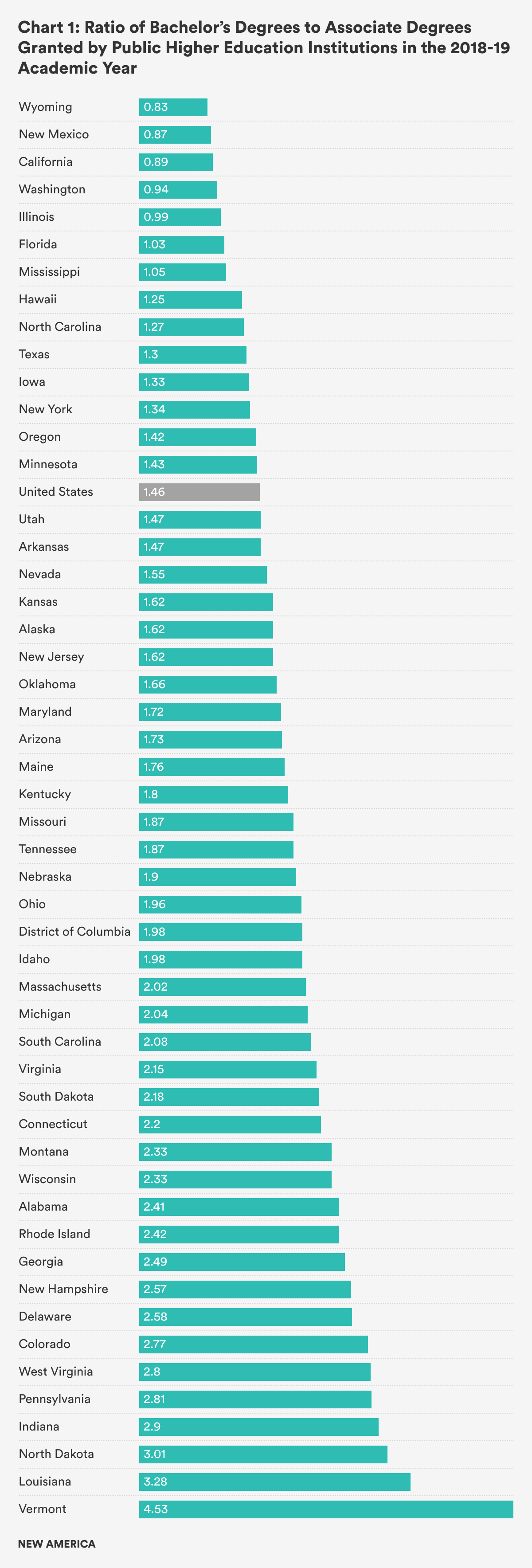
Compare, for example, Georgia and North Carolina. Each state has almost exactly the same overall population (approximately 10.5 million people.) Each state’s public higher education system produces almost exactly the same number of bachelor’s degrees (approximately 41,000 per year). But North Carolina produces twice as many associate degrees (33,000) as Georgia (16,000). Why?
The answer is structure. Georgia has a system of technical colleges that focus on job-oriented associate degrees and a smaller number of two-year community colleges. While North Carolina’s community colleges also offer technical degrees, the state enrolls a significantly larger number of students in A.A. programs that are designed for transfer into bachelor’s programs at four-year universities. North Carolina awards over 16,000 general liberal arts A.A. degrees per year, Georgia only about 6,000.
In other words, two states of identical size with identical outcomes in terms of bachelor’s degree production would be treated very differently by a program that only funds community colleges, failing to recognize that state higher education systems are not all the same.
This isn’t an isolated example. While California, home of the classic three-tiered public higher education ziggurat, grants fewer than one B.A. per A.A., Pennsylvania grants nearly three times as many. Michigan, Virginia, Wisconsin, Indiana, and Massachusetts are among the 20 states with B.A. to A.A. ratios greater than 2-to-1. Each would be significantly disadvantaged by a free community college program built around two-year institutional and degree classifications.
Some states also rely more than others on state-financed financial aid programs to give students access to private non-profit colleges. While “private college” may evoke images of wealthy prepsters, most private colleges are neither wealthy nor especially selective, and make important contributions to higher education accessibility. Private Historically Black Colleges and Universities in particular play this role.
Sorting this out would be complicated enough if two-year degrees were confined to two-year institutions. But they’re not. In fact, almost five percent of all public associate degrees are granted by four-year universities, not community colleges.[3] This also varies enormously across the country — in twelve states, more than 10 percent of public two-year degrees are granted by four-year universities. In Alaska, it’s all of them, because the state doesn’t have any community colleges. Utah and Montana are both over 50 percent, while Idaho and Arkansas are over 25 percent. Only ten states are at zero. The University of North Georgia, for example, produces nearly 1,000 associate degrees per year, but would not qualify for funding because it’s not a community college.
In Florida, many of the colleges that grant most of the state’s associate degrees have remade themselves as institutions that also produce hundreds of bachelor’s degrees. At the same time traditional Florida public universities produce thousands of associate degrees. This kind of adaptation is a good thing, creating more cooperation and coordination within the public higher education system, spurring institutions to specialize in specific industries and fields and helping students transfer credits among colleges. But it also underscores the fact that there is no single definition of “community college” that encompasses all of the public higher education we want to support.
Which means a federal policy that confines “free” to “community college” will be confronted with intractable classification problems. Is any public institution that offers associate degrees a community college? If not, what threshold would survive criticism as arbitrary? If so, what would prevent every cash-strapped public university (that is, most of them) from spinning up new associate programs to be eligible? Public colleges and universities are what states choose to say they are. If there’s federal money on the line, they’ll say something different.
This could be addressed by changing the program to “Free Associate Degrees.” But here again we should expect states and institutions to act rationally in response to financial incentives — by, for example, simply granting every bachelor’s-seeking student an A.A. automatically once they meet the 60-credit threshold by whatever means, and then claiming federal dollars to match.
And that’s before we get to the issue of state funding.
The easiest way to create “Free Community College” is to give states a dollar for every dollar they’re currently charging in tuition. This is arguably the only way to do it that would fully keep the promise that the exceptionally specific and appealing slogan “Free Community College” appears to make. But here the problem is that states have adopted widely differing approaches to how many tuition dollars they want to collect. The chart below shows the ratio of net tuition collected by public community colleges to state and local funding for the same colleges in each state.
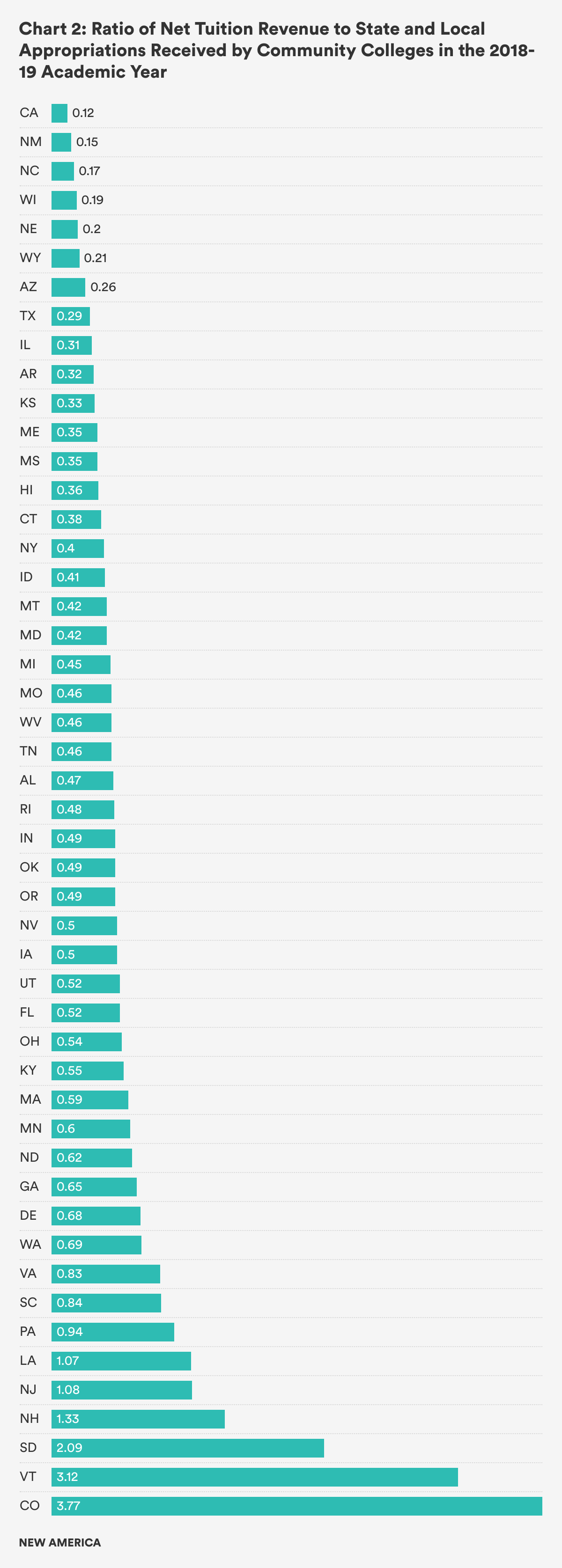
Here again we see the laboratories of democracy at work. California collects 12 cents in tuition from each community college student for every dollar the state provides in funding. Most community college students in California pay no tuition at all. Wisconsin collects $0.19, Texas $0.29, Illinois $0.31. In Colorado, at the other end of the spectrum, students pay $3.77. Louisiana, New Jersey, and New Hampshire are over $1.00. Some states are strongly committed to making community colleges affordable for everyone. Others, not as much.
The (ACP), a widely supported free community college plan, addresses this problem by treating states equally. Instead of giving each state enough money to make its own community college system free, it gives states a grant equal to “for each eligible student…a per-student amount that is at least 75 percent of…the average resident community college tuition and fees per student in all States.”[4]
Total tuition and fee revenue at those institutions nationwide divided by total 12-month FTE enrollment is $2,367.[5] Seventy-five percent of that is $1,775. The bill also says the formula should be such that it “accounts for the ratio between a State’s… funding per full-time equivalent (FTE) student at public colleges and universities and the average net price at State public four-year colleges and universities, in such a way as to reward States that keep net prices for students low while maintaining their investment in higher education.”
The bill says that the state share shall be “the amount needed to pay 25 percent of the average community college resident tuition and fees per student in all States” — in other words, the remaining 25 percent of $2,367, or $592. But the bill also says that “as a condition of receiving a grant…the total amount of community college resident tuition and fees charged to an eligible student shall be $0” and that “no amount of financial assistance for which an eligible student qualifies may be applied to such tuition or fees” i.e. this is not a so-called “last-dollar” grant.
So, to be eligible, the state match under ACP is effectively not 25 percent. It’s the greater of 25 percent or whatever amount of money is needed to bring tuition down to zero, after subtracting the $1,775 per student. The second column of the table below shows how much money that is for each state. The third column shows that amount as a percentage of $2,367.
| State | $ Needed for $0 CC tuition | $ Needed for $0 CC tuition as pct of total | Adjusted ACP Ratio | ACP Grant w/ Ratio | Adjusted $ Needed for $0 CC tuition as pct of total |
| AK | N/A | N/A | 3.43 | $ 6,089 | N/A |
| AL | $ 783 | 33% | 0.81 | $ 1,444 | 47% |
| AR | $ 453 | 19% | 1.54 | $ 2,726 | -21% |
| AZ | $ 261 | 11% | 0.58 | $ 1,036 | 42% |
| CA | $ (818) | -35% | 1.16 | $ 2,064 | -47% |
| CO | $ 3,636 | 154% | 0.05 | $ 84 | 225% |
| CT | $ 1,677 | 71% | 1.47 | $ 2,606 | 36% |
| DC | N/A | N/A | 3.94 | $ 7,000 | N/A |
| DE | $ 4,044 | 171% | 3.77 | $ 6,688 | -37% |
| FL | $ 131 | 6% | 1.45 | $ 2,582 | -29% |
| GA | $ 960 | 41% | 1.23 | $ 2,179 | 23% |
| HI | $ 1,624 | 69% | 1.76 | $ 3,130 | 11% |
| IA | $ 1,825 | 77% | 0.88 | $ 1,563 | 86% |
| ID | $ 1,263 | 53% | 1.45 | $ 2,570 | 20% |
| IL | $ 975 | 41% | 0.94 | $ 1,672 | 46% |
| IN | $ 732 | 31% | 0.67 | $ 1,196 | 55% |
| KS | $ 1,047 | 44% | 1.10 | $ 1,948 | 37% |
| KY | $ 328 | 14% | 0.84 | $ 1,496 | 26% |
| LA | $ 1,347 | 57% | 0.64 | $ 1,141 | 84% |
| MA | $ 2,680 | 113% | 0.48 | $ 852 | 152% |
| MD | $ 2,677 | 113% | 1.37 | $ 2,424 | 86% |
| ME | $ 319 | 13% | 1.21 | $ 2,149 | -2% |
| MI | $ 2,188 | 92% | 0.61 | $ 1,074 | 122% |
| MN | $ 1,596 | 67% | 1.04 | $ 1,838 | 65% |
| MO | $ 822 | 35% | 0.96 | $ 1,712 | 37% |
| MS | $ (1) | 0% | 1.10 | $ 1,947 | -7% |
| MT | $ 1,598 | 67% | 1.04 | $ 1,844 | 65% |
| NC | $ (359) | -15% | 1.82 | $ 3,234 | -77% |
| ND | $ 2,268 | 96% | 1.17 | $ 2,072 | 83% |
| NE | $ 381 | 16% | 1.65 | $ 2,931 | -33% |
| NH | $ 5,159 | 218% | 0.41 | $ 735 | 262% |
| NJ | $ 2,183 | 92% | 0.83 | $ 1,477 | 105% |
| NM | $ (189) | -8% | 2.91 | $ 5,163 | -151% |
| NV | $ 915 | 39% | 1.45 | $ 2,569 | 5% |
| NY | $ 1,518 | 64% | 2.22 | $ 3,935 | -27% |
| OH | $ 1,685 | 71% | 0.65 | $ 1,163 | 97% |
| OK | $ 824 | 35% | 0.73 | $ 1,301 | 55% |
| OR | $ 2,428 | 103% | 0.80 | $ 1,414 | 118% |
| PA | $ 2,566 | 108% | N/A | N/A | N/A |
| RI | $ 803 | 34% | 0.65 | $ 1,145 | 61% |
| SC | $ 1,720 | 73% | 0.43 | $ 758 | 116% |
| SD | $ 4,442 | 188% | 1.02 | $ 1,819 | 186% |
| TN | $ 468 | 20% | 1.20 | $ 2,126 | 5% |
| TX | $ 355 | 15% | 1.09 | $ 1,932 | 8% |
| UT | $ 728 | 31% | 1.35 | $ 2,395 | 5% |
| VA | $ 1,691 | 71% | 0.65 | $ 1,154 | 98% |
| VT | $ 7,851 | 332% | 0.19 | $ 340 | 392% |
| WA | $ 1,747 | 74% | 0.65 | $ 1,162 | 100% |
| WI | $ 1,410 | 60% | 1.30 | $ 2,303 | 37% |
| WV | $ 453 | 19% | 0.72 | $ 1,287 | 40% |
| WY | $ 1,146 | 48% | 3.54 | $ 6,280 | -142% |
In a state like Alabama, which has pretty typical per-student funding levels for community colleges, the effective match rate (the amount needed to bring tuition to $0 in order to be grant-eligible) is 33%, which is fairly close to 25%.[6]
In California, tuition is so cheap that $1,775 is far more than enough to pay tuition down to zero. So it shows a negative match rate. But since the law requires a 25% match, what this effectively means is that California would be required to spend more state money for the purposes enumerated in the bill for any money left over after bringing tuition down to zero, which include more programs, better programs, and making four-year public universities cheaper.
In Colorado, by contrast, community college tuition is unusually expensive. Colorado would need to spend $3,636 per student to achieve $0 tuition, an effective match requirement of 154%.[7]
°ճÙ’s before the formula is adjusted for the tuition-to-spending ratio. The next three columns show what happens after.[8]
One could “account for” the ratio by simply multiplying it by the state’s base per-student grant. But the average ratio nationwide isn’t 1.00 because spending and tuition aren’t the same. So the “Adjusted ACP ratio” in column four is each state’s ratio divided by the national average ratio. In other words, the average state’s grant is not adjusted at all.
Since states that tend to spend less money on public higher education generally and charge more tuition at their public four-year universities are highly correlated with states that underinvest in community colleges and charge more tuition in the two-year sector, what we see in column five is that the adjustment ratio provision tends to make the already-substantial spread of effective match rates larger still.
California wouldn’t be able to spend less because 25% is effectively a floor on the match rate. Instead it would get a lot more federal money because its adjusted ratio is greater than 1.0. Other states that show a negative effective match rate include Florida and Delaware along with North Carolina, New Mexico, New York, and several others.
Colorado’s grant, meanwhile, utterly collapses because it has essentially privatized its four-year higher education system to charge full market rates to out-of-state students. This is an extreme example, but the overall phenomenon is clear: Applying the adjustment ratio pushes the effective match rate in states including Washington, Vermont, South Dakota, South Carolina, Oregon, New Jersey, New Hampshire, Minnesota, and Massachusetts above 100%.
Any large new federal program that provides direct grants to improve college affordability should create strong incentives for states to invest in their public higher education systems. But incentives are delicate: push too hard, or in the wrong way, and they can have the opposite of the intended effect. Under NFIB v. Sebelius, states have broad discretion to opt out of federal programs. Every state implicitly has a match requirement threshold that would trigger non-participation, based on some combination of available resources and political will. It’s not the same in every place, but there always is one. So the question is how to calibrate the requirements to maximize participation.
The ACP adjustment ratio is well-intentioned. But the numbers show that, given how much state spending on higher education already varies, any policy that makes $0 tuition a condition for receiving a standard per-student grant already has a strong incentive effect, to the point where some states would probably be unable or unwilling to participate. Would Vermont choose to spend $78 of its own money in order to receive $18 of federal money? It might not.
The adjustment ratio puts this phenomenon on steroids by essentially multiplying it by itself. The result would be a program that almost mathematically excludes a significant number of states. “Free Community College” would be an instant non-starter in large parts of the country.
There’s a better way to implement the goals of Free Community College, one that is simpler, more fair, more inclusive, and compatible with Senate rules. Instead of the hopeless task of designing one federal program to fit 50 different state higher education structures, one that would get bogged down in classification debates and likely alienate a large number of states before and after enactment, do this: Provide a standard per-student grant to any college that agrees to charge $0 tuition.
°ճÙ’s it. °ճÙ’s the program.
States that have large numbers of students in community colleges would still benefit, especially those that have invested to keep tuition affordable. If the grant is more than the amount needed to bring tuition to $0, colleges can use the money to pay their faculty more, upgrade facilities, and offer a wider selection of high-quality programs. States would be required to maintain public funding for these colleges at previous levels.
States that have opted to structure more of their students into affordable, open-access four-year public universities would no longer be disadvantaged. Those institutions would be eligible, too. So would private non-profit colleges with an access mission. (For-profit colleges would not be eligible.) For some, this would extend the benefits of free college all the way up to the bachelor’s degree, which remains the gateway credential for many well-paying careers.
The combination of existing state funding differences and a baseline maintenance-of-effort (MOE) requirement would create strong incentives for states to invest their own money in higher education. But because the program would fund individual colleges that opt in to the system, the enormous problem of whole states declining to participate would be eliminated. Students wouldn’t be denied the promised benefits of free community college just because they happen to live in a state with the wrong structure, funding system, or political leadership.
This straightforward program would fit with the Senate budget reconciliation process, because it requires very little in the way of supplemental policy language. (Additional requirements that participating colleges engage in credit-transfer partnerships and meet benchmark levels of performance for graduation and employment outcomes could be added if the parliamentarian allows.) It could also be supplemented by increased funding for reconciliation-friendly federal programs designed to stimulate state spending on need-based financial aid, which would help more colleges participate.
This approach would be more flexible, more fair, attract more political support, provoke less political opposition, and be easier to pass through Congress. The Biden Administration and lawmakers in Congress should consider it as an option.
Enjoy what you read? Subscribe to our newsletter to receive updates on what’s new in Education Policy!
Footnotes:
[1] Some would reasonably argue that “free” should encompass books and materials, which can exceed tuition charges, but free at least means tuition.
[2] Digest of Education Statistics 2020, Table 319.10
[3] Author’s calculations from IPEDS. Public community colleges defined as CONTROL=1 and Carnegie Classification 2018 Basic as 1-14 & 23. Public four-year universities defined as CONTROL=1 and Carnegie Classification 2018 Basic as 15-22.
[4] The bill defines “community college” as “a public institution of higher education at which the highest degree that is predominantly awarded to students is an associate’s degree.” This analysis defines community colleges as those classified by IPEDS as CONTROL=2 and Carnegie Classification 2018 Basic=1-14 & 23.The bill defines an eligible student as one who “attends the community college on not less than a half-time basis.” This analysis uses FTE counts which, depending on the attendance intensity of students, could overestimate or underestimate the number of eligible students at an institution. Since the America’s College Promise formula is built on how much states spend relative to one another, this should not materially change the analysis.
[5] Tuition and fee revenue = F1819_F1A, 12-month FTE enrollment = DRVEF122019.
[6] The bill defines an eligible student as one who “attends the community college on not less than a half-time basis.” Depending on the attendance intensity of students, FTE could overestimate or underestimate the number of eligible students at a college. But FTE should serve for the purposes of this analysis since the ACP formula is built around how much states spend per student relative to one another.
[7] Assuming of course that it doesn’t just cut tuition and not replace the lost dollars. Given how generally underfinanced community colleges are this is some combination of unlikely and unwise.
[8] Except in Pennsylvania, which is excluded because of a quirk in the way its public-but-not-really-but-really institutions report financial data to IPEDS. Given that Pennsylvania is a low-public-spending / high-tuition state, it’s a safe bet that their effective match rate would substantially increase.
Vice President, Education & Work