
Sara Hendren
Program Fellow, Education Policy; National Fellow, 2018
Adapted from What Can a Body Do: How We Meet the Built World by Sara Hendren published on August 18, 2020 by Riverhead, an imprint of Penguin Publishing Group, a division of Penguin Random House LLC. Copyright 漏 2020 Sara Hendren
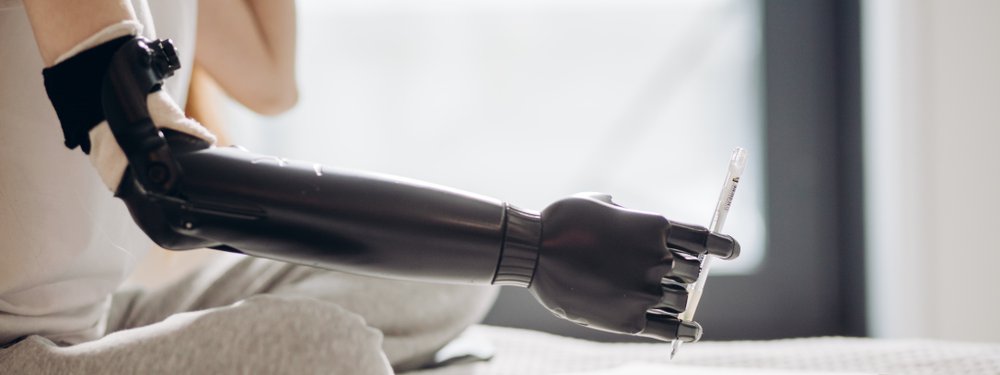
Mike is forever talking about his prosthetic arm, whether he wants to or not. At any dinner gathering with acquaintances, the subject will eventually come up, because people find his body, extended with its machine parts, to be an irresistible enigma. Strangers glimpse it and thank him humbly for his nonexistent military service. He鈥檚 an unintentional sensation at airport security. Mike is tall and an unhurried talker, affable, like a high school athletic coach in the off- season, with an open face and thinning short blond hair. He has a flesh arm, the dominant one, on his right and wears a prosthetic arm as its match on the left: a forearm, wrist, and hand sheathed in a semi-transparent hard plastic housing, pearly gray and smooth and contoured in the shape of a recognizable arm and hand, with each finger articulated as though in a full-length glove. There are seams where the wrist meets the hand, and tiny screws that bind the parts together, and beneath the outer 鈥渟kin鈥� you can see the inner circuitry. When the wrist or digits move, the motors make a faint whirring sound, and the entire structure has a mechanical sentience about it that strikes a dramatic departure from the conservative blue button-down shirts that Mike wears most days: the human body and its mixed assemblage.
Mike had visited my classroom at Olin College as a guest lecturer on his experience with prosthetics, but I wanted to see his tools and his life outside the context of engineering. I wanted to sidestep the impulse to see Mike鈥檚 limb as it鈥檚 portrayed in popular culture鈥攁s a fantastical curiosity, the stuff of so many breathless cinematic narratives. So I arranged to visit him at his home in a suburb outside Boston. I wanted to talk to him about the small archive of four arms that he鈥檚 variously used for decades as the material culture of his life. 鈥淲here I am right now is so different from when I was fourteen, and at twenty-two, and at thirty-six,鈥� he told me. 鈥淎nd it鈥檒l be different five years from now.鈥�
People say to Mike all the time: 鈥淭hat鈥檚 the coolest thing I鈥檝e ever seen.鈥� His prosthetic arm is a popular subject of conversation because his body looks so much like the future, or what you might imagine it to be. People want to know: Can he pick up just anything with that arm and hand? Does it ever hurt? How does he put it on and take it off? Encountering him, they exhibit an overwhelming impulse to see him as nearly superhuman in his hybridized state, to speak of him in the imprecise slang of a 鈥渂ionic man,鈥� a creature that emerged from science fiction into real life. Its apparent qualities of simulacrum and enhancement are what give Mike鈥檚 prosthetic its power: a designed object that looks so similar to the body in form, and so much like expensive machinery in function. The lifelike hand, with all its digits faithfully replicated, looks comprehensive and replete and therefore persuasive as an object, as though it might be strapped on at a moment鈥檚 notice, taking the body into the future in a smooth exchange of this-for-that.
An amiable disposition, a comfortable professional life in sales, and longtime fatherhood have made Mike an easy conversationalist. When the questions arise, he is inclined to humor his dinner companions or the airport security staff. 鈥淚 think as the technology has advanced, public perception has improved, and public curiosity has improved,鈥� he said. So, now, rather than avert their eyes, the curious walk right up. 鈥淒oes that give people permission to ask?鈥� Mike said. 鈥淚t does for me. I think that鈥檚 okay.鈥� But he鈥檚 been wearing a prosthesis for forty years, he reminded me: 鈥淚t would be different for someone else.鈥� Depending on how probing the questions become, he鈥檒l both indulge the fascination and explain the very real limitations that come with even this impressive, complicated object鈥攁 conversation that, in Mike鈥檚 life, has become a ritualized social exchange set in motion by prosthetic parts.
Mike is an amputee, someone who lost a limb well after learning to navigate his world in a two-handed body. At fourteen, he got a diagnosis of epithelioid sarcoma in his left hand. Doctors had caught it early, but it required drastic action, at least in those days, because it鈥檚 a cancer that easily metastasizes and spreads to other parts of the body. He and his parents made the difficult decision to amputate his arm just below the elbow joint. In the days that followed the surgery and recovery, Mike started the long process of occupational therapy to relearn manual activities, now outfitted with the 鈥渂ody-powered鈥� model of prosthetic arm that was standard in its day and is still worn by many people in the world. It was a mechanical limb extension, anchored in a harness around the torso and tethered to the elbow, with a double-hook hand at the end that opened and closed only with shoulder shrugs and direct manipulation by the wearer; it had no added electronics to boost its capacities. The hooked ends wielded a bigger, blunter gesture than five fingers could usually accomplish, but it operated enough like an opposable thumb and finger that it could grip some objects in a relatively secure hold, with workarounds and adjustments.
There is an unspoken but persistent fear: that a 鈥渟mart鈥� arm like Mike鈥檚, with its mechanical cleverness, suggests a comparative inferiority of the human body, and by implication, a fundamental passivity in the human being.
Needless to say, adolescence wasn鈥檛 the ideal time to acquire a suddenly conspicuous body, and Mike had to assimilate not just to new tasks of carrying and gripping but also to a new identity. He resisted going to the beach near his hometown in those early months of recovery; it took time for him to internalize the 鈥渘ew normal鈥� of the way he looked. He spent years with an undercurrent of worry that he鈥檇 never have a girlfriend. He weathered the unfortunate college nickname of 鈥淐lubber.鈥�
In Mike鈥檚 kitchen that afternoon, I took a picture of his life鈥檚 set of four prosthetic arms neatly lined up in a row鈥攁 catalog of the technology available to a middle-class person with ready access to modern health care. The prosthetic Mike wears most often now鈥攖he one that evokes all the comments at the dinner table鈥攔epresents an impressive leap in engineering and a similar leap in expense: a myoelectric model, its motions directed by the electrical signals naturally built into the body鈥檚 muscles, the ones that tell an ordinary flesh elbow how to bend or the wrist how to rotate. Myoelectrics create automated, more fluid motion for an artificial limb that results from this connection. They鈥檙e designed to combine and amplify the range of movements a prosthesis can accomplish, ones that better replicate the fine-motor grasping or turning motions that are everyday moves for a flesh arm and hand but were laborious or impossible with previous generations of body-powered mechanical models.
Mike broadly enjoys the progression of technology that has brought him to the present day鈥攈e says he went, in other people鈥檚 eyes, 鈥渇rom Captain Hook to the Bionic Man, overnight鈥濃�攂ut the functional improvements that reentered his manual lexicon with the new technology are both less grand and more interesting than the average observer might imagine. He can now proceed through a buffet line, for example, by turning his prosthetic wrist to provide leverage for holding a plate while serving himself food with his flesh hand, in a relatively seamless interaction. Attending a ribbon-cutting for the new wing of a local hospital, he found that he could clap his hands together in applause along with the other attendees for the first time since he was fourteen. That was a big deal鈥攂eing able not only to reach or grasp or carry, but also to participate in a social ritual, using the reciprocity of his palms in an everyday gesture that he鈥檇 only distantly remembered.
In the twenty-first century, the conversations that greet someone like Mike at the dinner table often contain the word cyborg, a catch-all term for human bodies that are aided or augmented by artificial parts. The word carries a variety of connotations, depending, Rorschach-style, on who鈥檚 using it. Cyborg can signal a shorthand for the simple reality of contemporary life鈥攆lesh and automated systems operating together, from literal extensions like mobile phones to the more subtle automation created by birth control pills, in reciprocal relationships that make bodies and external parts nearly indistinguishable. Or the word can carry a more charged speculation about the future of human life with technology, functioning as an index of a person鈥檚 relative optimism about the future of the body intertwined with machines. Is the cyborg-self an ominous sign of a coming world under machine rule, or a promising fix for the frailty and idiosyncrasy of skin and bones? Where does the machine start and the human stop? Does the distinction matter? These have long been favorite questions for enthusiasts of the posthuman, amateur and expert philosopher alike.
Donna Haraway, one of the cyborg鈥檚 most notable theorists, named long ago what many of us unconsciously sense in the presence of high-tech tools: 鈥淟ate twentieth-century machines have made thoroughly ambiguous the difference between natural and artificial, mind and body, self-developing and externally designed, and many other distinctions that used to apply to organisms and machines. Our machines are disturbingly lively, and we ourselves frighteningly inert.鈥� It鈥檚 this liveliness of Mike鈥檚 latest high-tech arm that makes it such a draw, and the disturbance that his hybrid body brings along with it arises from an unspoken but persistent fear: that a 鈥渟mart鈥� arm like Mike鈥檚, with its mechanical cleverness, suggests a comparative inferiority of the human body, and by implication, a fundamental passivity in the human being.
But talk about the body and its cyborg future tends toward speculation and even fantasy, and it can cloud the quietly extraordinary dynamism of a body in its immediate world. Mike鈥檚 prostheses tell a story that isn鈥檛 primarily about the machines; they are evidence of an endlessly plastic and adaptive human body鈥攈uman person鈥攚ho survived illness in adolescence and has moved through marriage and children and jobs in adulthood, attended by these extensions as Mike found workarounds to whatever situations arose. The arms are a partial snapshot of Mike鈥檚 body, the material culture of his back-and-forth relationship with the shapes of his external world. That鈥檚 why the term assistive technology is easy short-hand but ultimately both redundant and misleading鈥攂ecause assistance is universal whenever we talk about tools. The way the body and machine work together is much more aptly expressed by another name for prosthetics: adaptive technology. Tools don鈥檛 run the show; they work together with bodies in a mutual exchange of adaptation.
Program Fellow, Education Policy; National Fellow, 2018


