Sophie Nguyen
Senior Policy Manager, Higher Education
Americans are losing faith in the value of college. Or so we are told.
As many colleges grapple with declining enrollment and intense political criticism, sagging public support for higher learning has become a journalistic given, the kind of as-we-all-know fact that can be simply asserted as context before advancing an argument or presenting the news of the day.
But many of these articles are getting the story wrong. The polling data that form the basis for the narrative of college declinism is far more limited and nuanced than this framing suggests. Much of the data don鈥檛 actually measure changes over time. News accounts routinely confuse people鈥檚 attitudes toward colleges as political and cultural institutions with their desire to attend college or to send their children there. They also ignore basic demographic and economic trends.
Here are five things you need to know about what higher education public opinion polls actually say, and what they mean.
In the last year, both the and have run lengthy, almost identically titled articles asserting that Americans 鈥渁re losing鈥� or 鈥渉ave lost鈥� faith in the 鈥渧alue of college.鈥� These are clear statements of fact about sentiment changing over time. Both articles rely on the same few public opinion polls because only a small number of valid and reliable measures of changes in higher education opinion exist. Gallup conducted the most often-cited in 2015, 2018, and 2023.
Gallup has been conducting versions of this poll by telephone since the 1970s to gauge the public鈥檚 confidence in institutions that have been a pillar of American society. The poll asks Americans whether they have 鈥渁 great deal, quite a lot, some, or very little鈥� confidence in each of these institutions: big business, the military, public schools, Congress, the police, organized labor, newspapers, big tech firms, the Supreme Court, banks, churches, and the health care system.
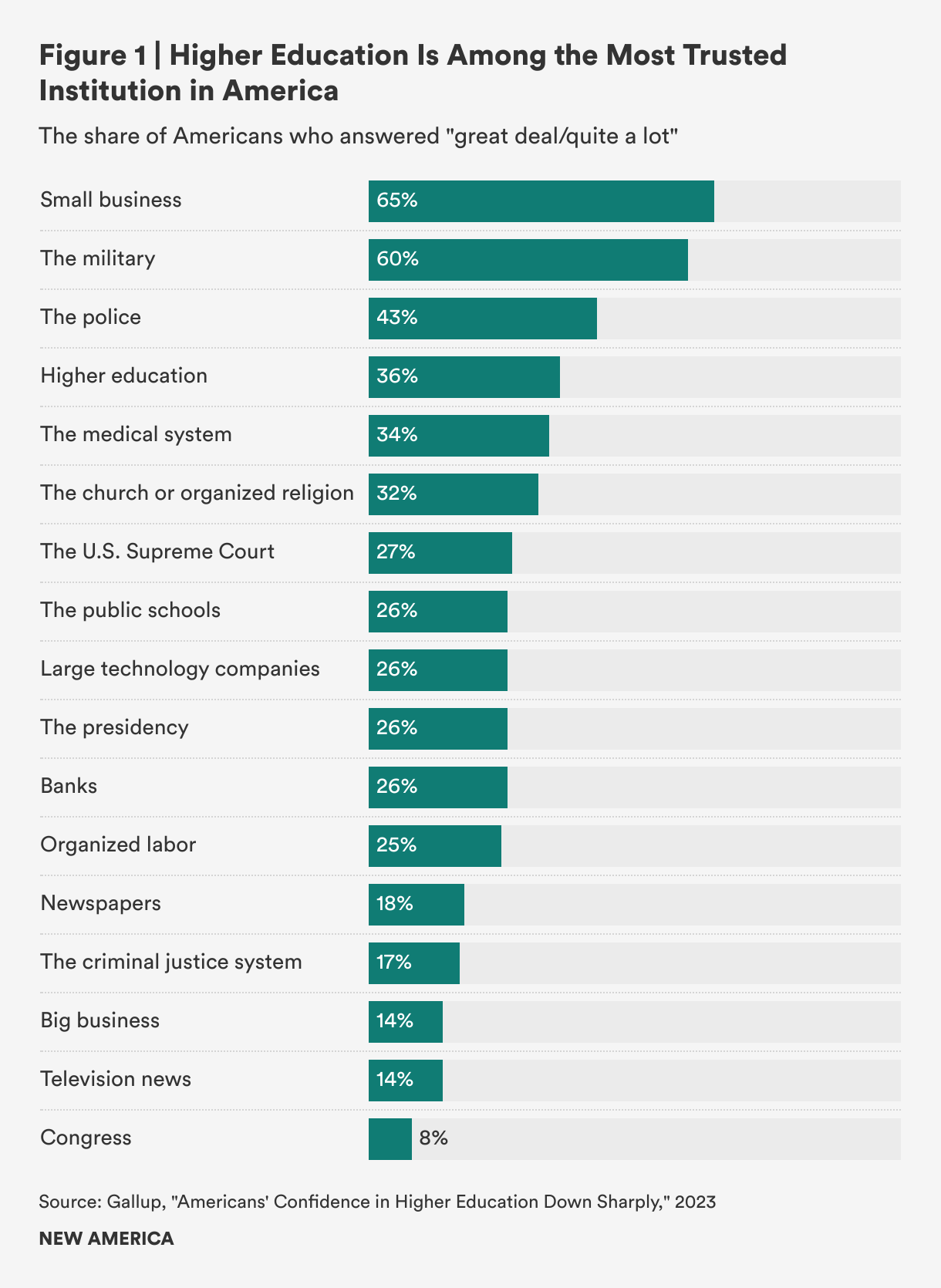
Gallup didn鈥檛 add 鈥渉igher education鈥� to the list until 2015. That year, 57 percent of people said they had 鈥渁 great deal鈥� or 鈥渜uite a lot鈥� of confidence in higher education. Only 9 percent said 鈥渧ery little.鈥� By 2023, the first two categories had dropped to a combined 36 percent, while 鈥渧ery little鈥� rose to 22 percent. These results, more than any others, have driven the story that Americans are losing faith in the value of college.
Note that Gallup did not actually ask people what they thought about the 鈥渧alue鈥� of college. Value, faith, and confidence are all different ideas. Value is a calculation of the exchange of money for services. Faith and confidence are sentiments, states of an ongoing psychic relationship. And the most important thing to understand is that Americans are losing confidence in all kinds of institutions, not just colleges.
According to Gallup, public confidence in the large majority of major American institutions reached record lows in 2022 or 2023. There have been exceptions, but for some pretty obvious historical reasons. Confidence in the military was lowest in 1981, less than a decade after the end of the Vietnam War. Banks hit rock bottom in 2012, a few years after reckless lending and financialization plunged the world into the Great Recession. The health care system looked the worst in 2007, back when 鈥測ou can鈥檛 have health insurance because you need health insurance鈥� was still a thing. But the police, the presidency, schools, churches, courts, Congress, and companies have never been held in lower regard than they are today.
Notably, colleges are still among our most trusted institutions. In the latest Gallup poll, only small business and the military registered 鈥渁 great deal鈥� or 鈥渜uite a lot鈥� of confidence from the majority of Americans. Higher education ranked fourth overall, with more than one-third of Americans expressing high levels of confidence (see Figure 1).
Americans are stressed out, bummed out, and aggravated, for understandable reasons. Recent years have been a lot. Colleges have been swept up in the general souring of public confidence. Looking at polling data for higher education in isolation misses this crucial context.
We rely on colleges and universities for many things: job training and acculturation, research and scholarship, sports entertainment. The decisions we make about what to study and what to teach are decisions about what kind of society we want to be. That makes them unavoidably subject to controversy. College campuses also serve as high-profile public squares for debate on some of the most difficult and divisive issues of our time.
All of this makes higher education vulnerable to larger forces of ideological polarization. For many decades, there was not a strong statistical relationship between people鈥檚 political preferences and their level of education. People with college degrees voted for Republicans and Democrats in roughly equal numbers. Bill Clinton won the presidency twice in part because of his appeal to voters who lacked a college degree. As late as the 2012 presidential election, Barack Obama鈥檚 positive margin among the college educated was .
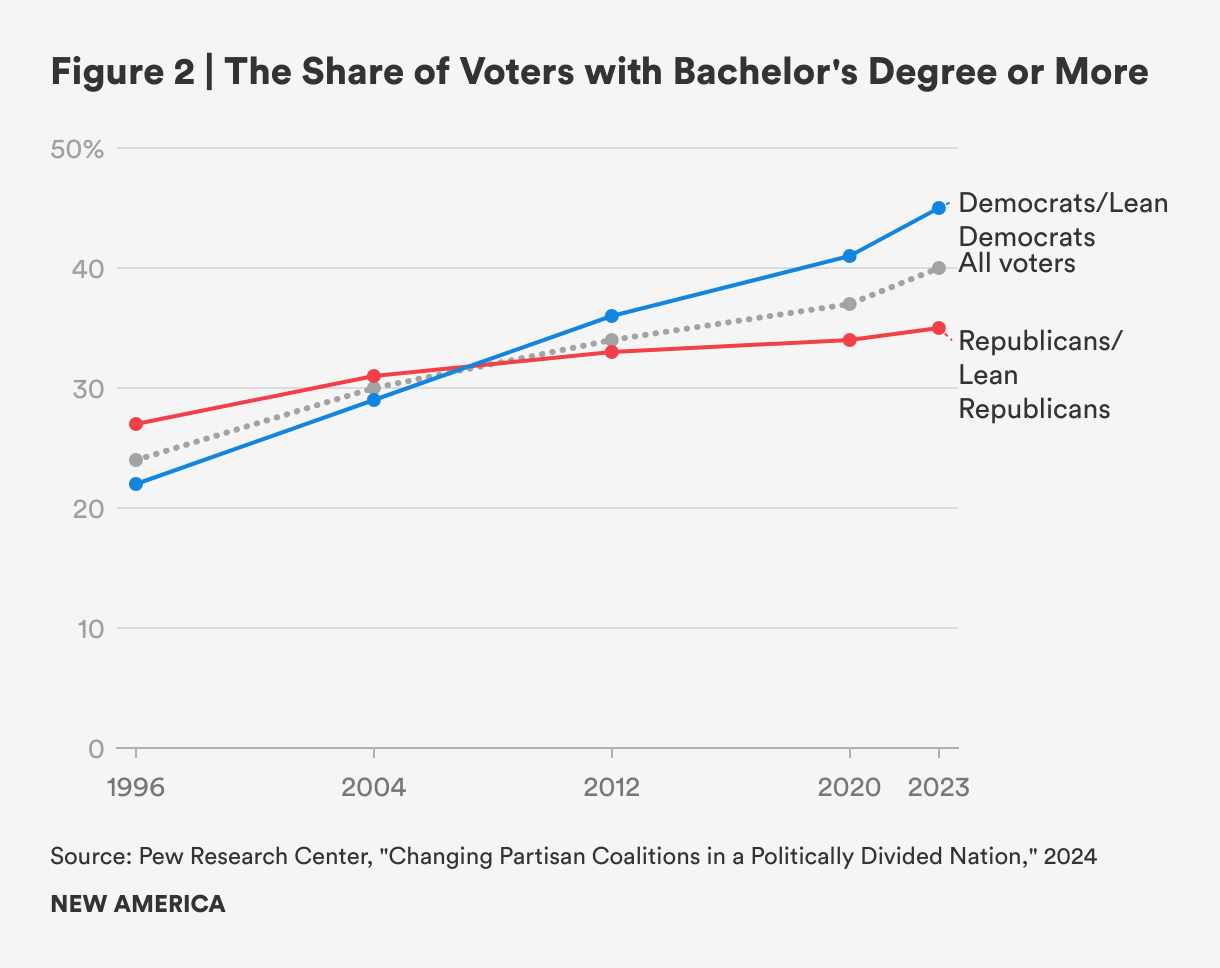
But that lack of correlation began to rapidly change with the election of Donald Trump in 2016. People with a bachelor鈥檚 degree or higher 43 percent of Hillary Clinton voters, but only 29 percent of Trump voters. The American electorate is realigning around educational attainment. According to a from Pew Research Center, the share of voters with a bachelor鈥檚 degree or more has risen significantly: from 24 percent in 1996 to 40 percent in 2023 (see Figure 2). The rise is more pronounced for Democrats than Republicans, however. The percentage of Democrats with a bachelor鈥檚 degree has more than doubled since 1996, from 22 to 45 percent. Republicans were more likely than Democrats to have bachelor鈥檚 degrees in 1996, at 27 percent, but that percentage has only risen to 35 percent today.
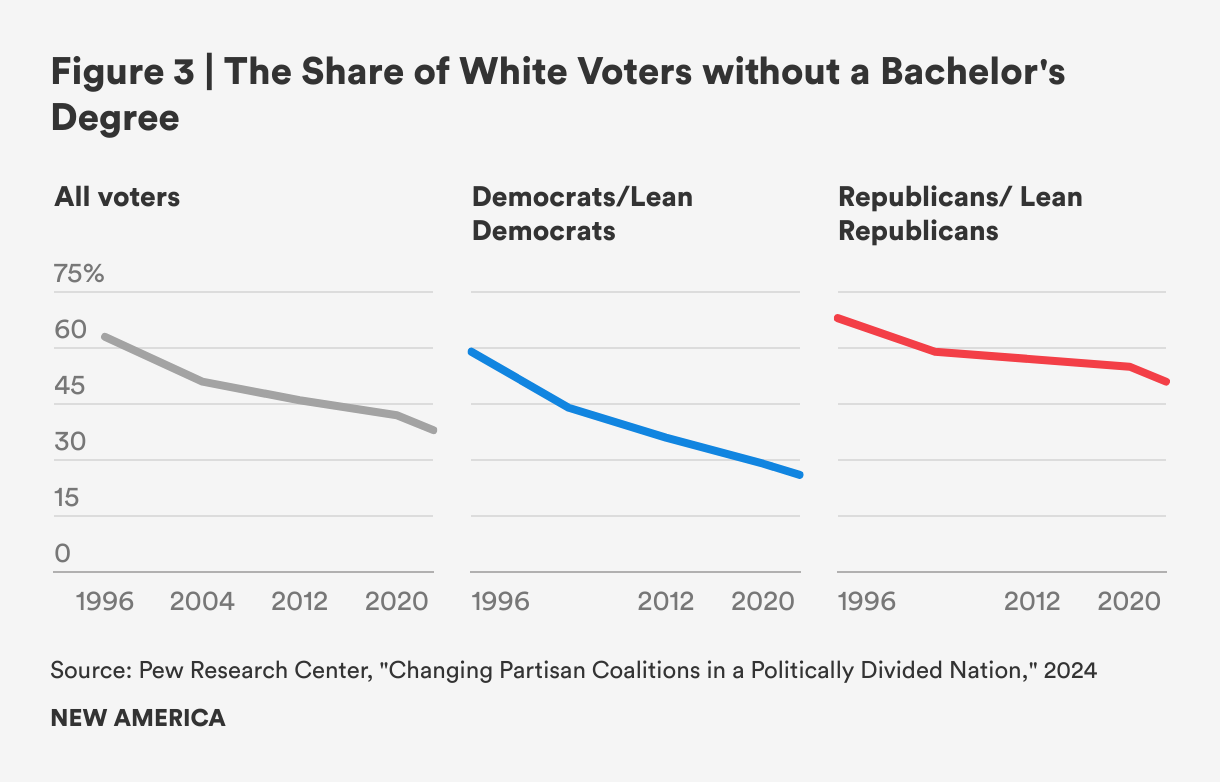
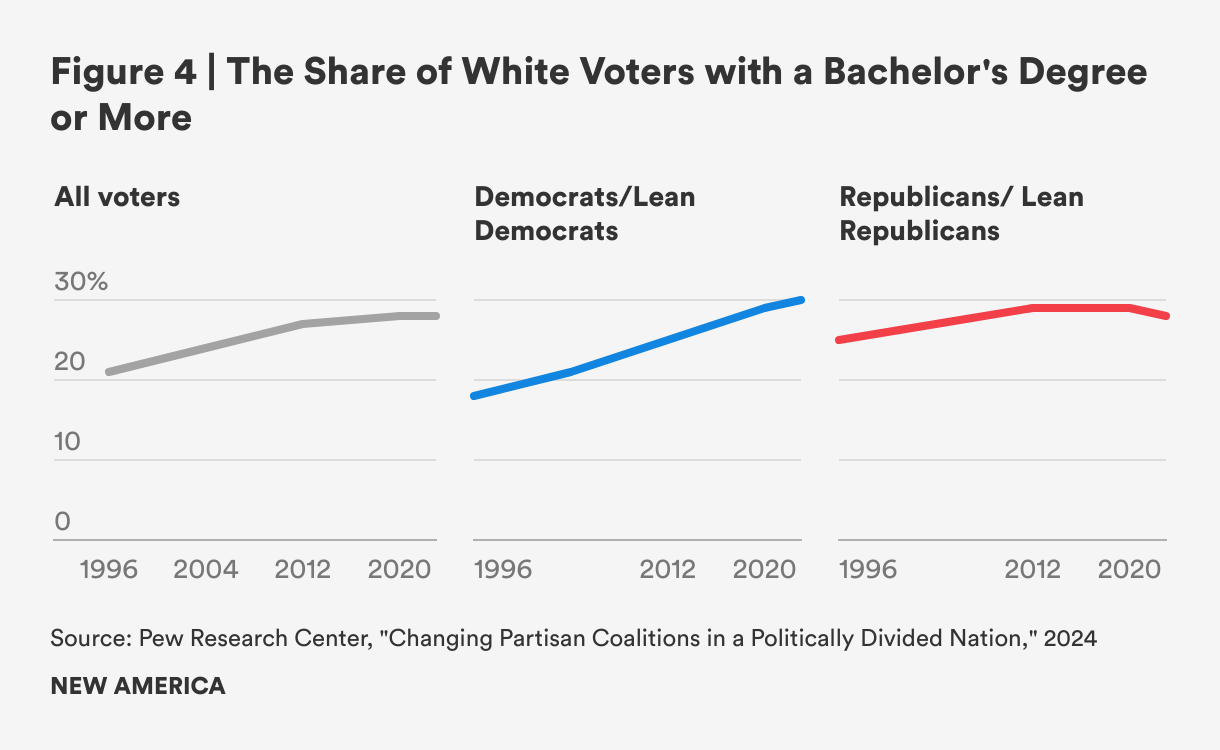
The difference between Democrats and Republicans is when looking specifically at white voters (see Figures 3 and 4). Despite shrinking gradually since the 鈥�90s, the group of white voters without a bachelor鈥檚 degree still make up a plurality of voters (38 percent) overall when both education levels and race are considered. This especially holds true for Republican voters, in which white voters without a bachelor鈥檚 degree made up half of its electorate in 2023 (down from 68 percent in 1996). Among Democrats, however, this group only accounts for 26 percent in 2023 (down from 60 percent in 1996). White voters with a bachelor鈥檚 degree are shaping up to be the largest group among Democrats, accounting for 30 percent of voters in 2023 (up from 18 percent in 1996).
The discrepancy in educational attainment between Democrat and Republican voters has left higher education much more exposed to negative partisanship. If you ask people their opinion of sandwich shops, they will base their response on whether they can reliably purchase a tasty sub. But if 鈥渟andwich shops鈥� become defined among a larger complex of ideas and institutions that are coded as ideologically threatening and repulsive, confidence in sandwich shops will decline, regardless of the sandwiches. A shows that from 2012 to 2019, the percentage of Democrats who think colleges and universities have a negative impact on the country was statistically unchanged, dropping from 19 to 18 percent. Among Republicans, it increased from 35 percent to 59 percent.
In their narrative of higher education deterioration, members of the news media often pair the public鈥檚 declining confidence in colleges as institutions with claims of sagging demand for college services. They鈥檒l highlight that overall enrollment has dropped, for example, or that small, private colleges are going bankrupt at an alarming rate. Et cetera.
These things are true. But they are happening in significant part because of larger demographic and economic trends. Fewer people are going to college but that is because there are fewer people to go to college. In 2008, there were 4.4 million American 17-year-olds, the peak of the millennial demographic wave. It was the largest class of high school seniors in the nation鈥檚 history, and there鈥檚 a good chance there will never be as many prospective college students again. Even as the millennial cohort began a gentle decline in size, birth rates for the next generation plummeted immediately after the Great Recession, and they have never recovered.
Not only were there record numbers of college-age people in the last 2000s, but the rate of college attendance peaked as well. The hollowing out of the blue-collar labor market steadily pushed the of recent high school graduates who enrolled in college up from roughly 50 percent in the 1970s and 鈥�80s to around 65 percent in the early 2000s. The catastrophic increase in joblessness caused by the 2008 global financial meltdown drove still more people to take refuge in college, joined by older laid-off workers looking for new skills. The college-going rate exceeded 70 percent for the first time in 2009. It has never been that high again.
Fortunately, there have been no major recessions since. At the end of the 2010s, and again after the job market recovered from the short and unusual pandemic disruption, wage growth and demand for working-class and service-sector jobs have been very strong. This is good news for millions of people and is helping to reverse decades-long trends of widening income inequality. But it means that fewer people are seeking refuge in college and, as a result, less selective colleges are facing stiffer competition for the time, money, and attention of prospective students. Because there are fewer college-age people, and those people are less likely to matriculate, college-going rates have declined to where they were in the 1990s and early 2000s.
The nuances of demographic change are also important. Most of the small private colleges threatened by bankruptcy were founded in the 19th and early 20th centuries, when the nation鈥檚 population was concentrated in the Northeast and Midwest. No longer. Today, these are the regions where birth rates are declining the fastest, immigration rates are the lowest, and people are most likely to leave for other parts of the country.
As many observers have noted, rising tuition prices and justifiable fears of burdensome student debt are no doubt affecting the cost-benefit calculus driving student enrollment decisions. These are major policy problems that have yet to be solved. But they are distinct from demographic, economic, and labor market trends, over which colleges have no control. A smaller freshman class is not, on its face, conclusive evidence that people value college less. It mostly means there just aren鈥檛 as many people.
A polling question asking people about their confidence in higher education as an institution is a direct measure of something meaningful. Feelings of confidence are what they are. But other often-cited polling questions venture into empirical issues and reflect biases and misconceptions among the general public.
For example, the Wall Street Journal includes on its list of declinist evidence the fact that 鈥渘early half of parents not to send their children to a four-year college.鈥� This, of course, is another way of saying that more than half of parents (54 percent, in this case) do prefer to send their children to a four-year college. That number might seem shockingly low to paid subscribers of the Wall Street Journal, among whom the percentage who want their children to get a four-year-degree is likely 100. But the figure is very much in line with reality. At the time the poll was administered, of Americans over age 25 had a four-year-degree, a higher percentage than at any other time in American history, and higher than nearly all other industrialized nations.
Notably, the Gallup poll does not purport to show any kind of decline at all. It is not the latest in a series of polls showing answers to the same questions over time. It鈥檚 disingenuous to use a survey question that has been asked only once as evidence of a trend.
It鈥檚 also instructive to examine the preferences of the 46 percent of parents who don鈥檛 want to send their offspring to get a bachelor鈥檚 degree. Here鈥檚 what they want their children to do immediately after high school instead:
Right away we can see the effect of adding the phrase 鈥渋mmediately after high school鈥� to the question. Presumably the 4 percent in 鈥渢ake time off to travel鈥� can be safely added to the 鈥渁ttend four-year college鈥� category, since that鈥檚 what people usually do after bumming around Europe for a year on their parent鈥檚 dime. So too with volunteering, serving on a mission, getting an internship, or 鈥減ursuing other interests.鈥� The percentage of parents who want their children to immediately pursue a four-year degree, or grow up a little and then pursue a four-year degree, probably exceeds 60 percent. Also, many people enter the military so they can afford college by using their G.I. Bill benefits.
That still leaves 8 percent of parents who would like their children to attend a two-year college, and another 15 percent preferring that their offspring take part in some kind of structured job training for a vocation, technical skill, or apprenticeship. This is where the polling data show that some people鈥攗nderstandably!鈥攄on鈥檛 know exactly how job training works. Many of the people who pursue skills-based training do so at a community college. Indeed, 8 percent plus 15 percent is 23 percent. In 2021, of all undergraduate students were enrolled in public two-year institutions.
Why the confusion? The word 鈥渃ollege鈥� is legally defined but also socially constructed. From the federal government鈥檚 standpoint, community colleges are definitely colleges (it鈥檚 right there in the name). But in our culture, 鈥渃ollege鈥� often has a narrower definition, to mean really just a four-year residential institution where young adults go to live and learn. 鈥淐ollege鈥� is also a crucial element of the American social status hierarchy, and community colleges are understood to be low-status institutions. Parents may not want to say that they 鈥渙nly鈥� want their children to attend a community college. But when they say 鈥渢raining to learn a specialized technical skill,鈥� community college is effectively what they mean.
When we add up all of the answers that lead toward higher education in different ways, the percentage of parents who want to send their children to college is closer to 90 percent. Yet this poll is cited as evidence that people are turning away from higher education.
The narrative of college declinism has taken root for several reasons, all of them opportunistic in some way. Journalists can鈥檛 say no to the easy friction of 鈥渂eloved institution beloved no longer鈥� as a way of sparking interest in a story. There鈥檚 also a strong element of 鈥淪ee, I told you鈥� in the many essays and articles using declinist polling numbers to re-air various long-standing grievances about higher learning related to political bias, free speech, elitism, legacy admissions, relevance to the labor market, and the football coach鈥檚 salary last year.
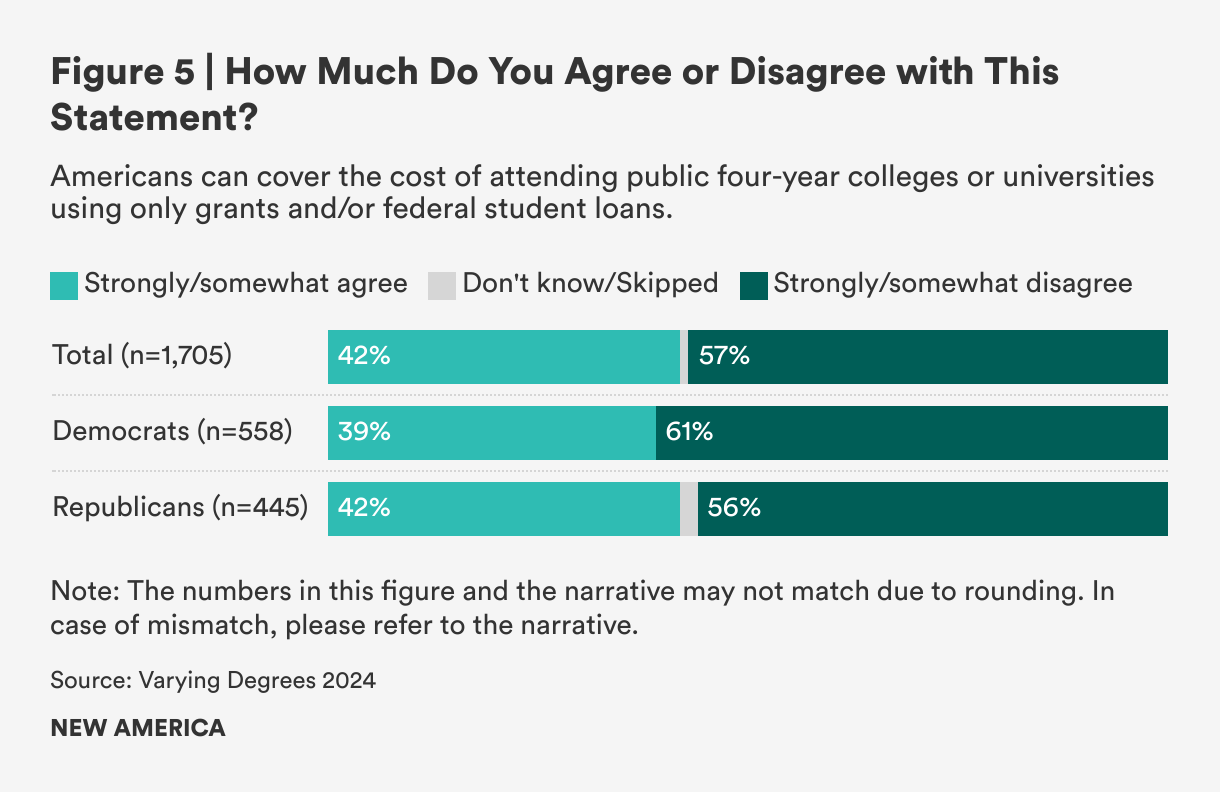
The one universal critique of college is about its cost. The latest edition of Varying Degrees, 国产视频鈥檚 annual survey on higher education, shows that four in five Americans think that the cost of college is the biggest factor that blocks any individual from enrolling, and only 42 percent think Americans can cover the cost of attending public four-year colleges using only grants or federal student loans. The survey reveals that Democrats and Republicans often differ on their opinion of higher education but are aligned when it comes to cost: about two out of five Democrats (39 percent) and Republicans (42 percent) think that Americans can cover the cost of public four-year colleges with only grants and student loans (see Figure 5). Concern about paying for college costs is not new. In a Pew survey published , three in four Americans didn鈥檛 think college was affordable.
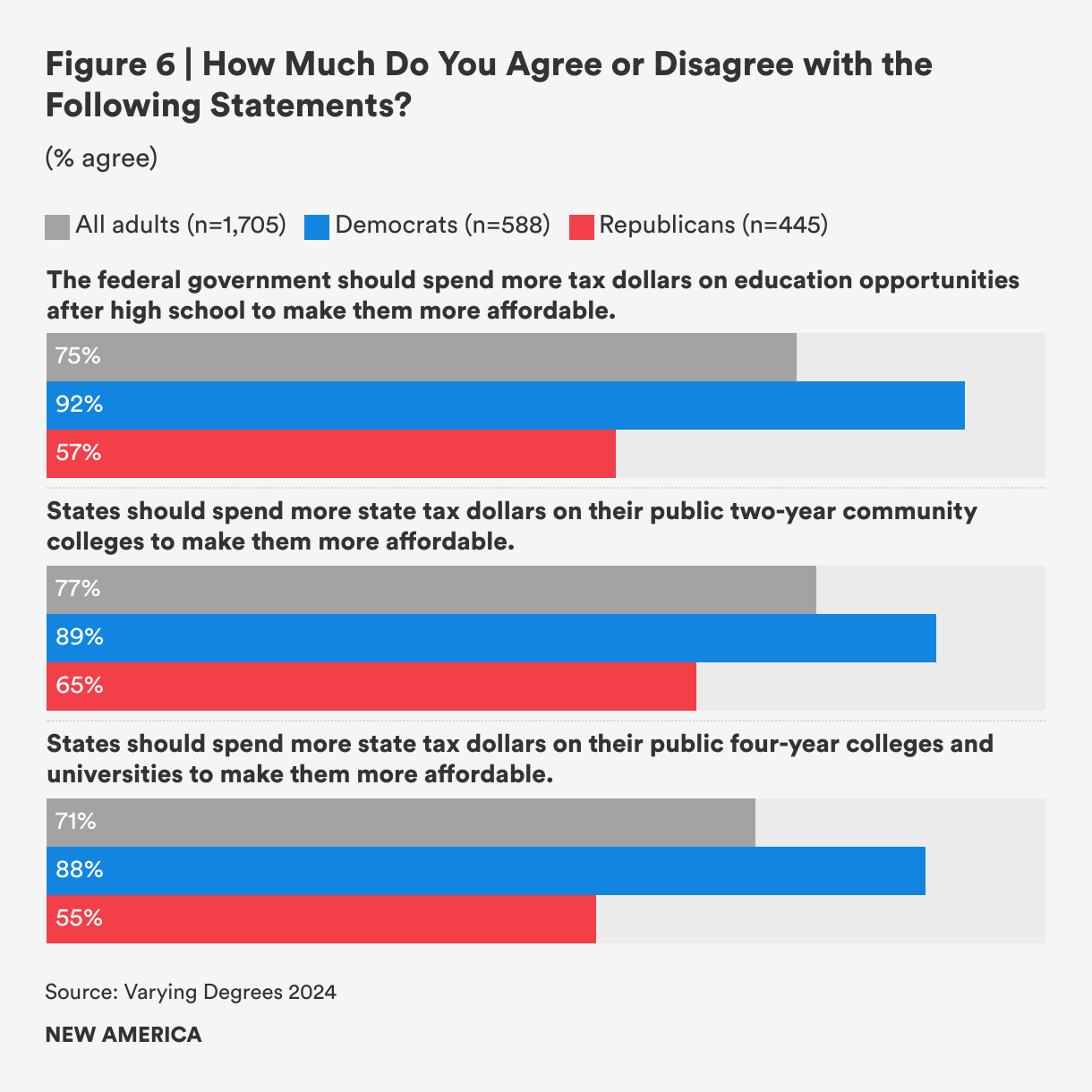
Counter to the long-term trend, the inflation-adjusted price of college has in the last few years. This is not because demand for college has collapsed. It鈥檚 because inflation briefly hit multi-decade highs because of pandemic supply shock and other factors that have since subsided. More spending on state and federal grant programs and tax credits have also helped. Some colleges may have less pricing power in a market with fewer students. But addressing college affordability is undeniably still top of mind for Americans. Varying Degrees shows that more than 70 percent of adults surveyed believe that state and federal governments should 鈥渟pend more tax dollars on education opportunities after high school to make them more affordable鈥� (see Figure 6). There鈥檚 divergence between the political parties, but despite growing negative partisanship, a significant share of Republicans want more public spending on college affordability.
Some advocates have called for doubling the Pell Grant, which is the largest federal student aid program offered for undergraduates with financial needs, or creating more robust loan forgiveness and income-driven repayment plans. But these policy solutions do little to directly curb the rising price of college. In 2021, the Biden administration supported federal legislation called the America鈥檚 College Promise Act, which would have created a partnership between the federal and state governments to make community colleges tuition-free for all students and significantly reduced the cost of attending the first two years at historically Black colleges and universities and other minority-serving institutions. But Congress failed to pass the bill.
There is a difference between expecting more from an institution and abandoning it. Despite their various dissatisfactions, Americans overwhelmingly still want to send their children to some form of education and training after high school, and they strongly believe that the government should spend more money to make that education affordable. People may be less confident in higher education than they used to be, more questioning of its value, and more annoyed by its many faults. But their belief in college as a bedrock public institution, and their desire for their children to become college-educated, remain.
Senior Policy Manager, Higher Education
Vice President, Education & Work