Amid Mixed Messages, Department of Education Announces Loan Counseling Experiment

Yesterday, the US Department of Education聽聽a new experimental initiative that would give a select group of 聽institutions the ability to require additional loan counseling for borrowers before they receive a student loan.
This opportunity, which the Department announced on the last day of the National Association of Financial Aid Administrators鈥� (NASFAA) annual conference, will likely be of interest to many institutions that feel that their hands were tied by聽聽from the Department reminding them that they could not require additional loan counseling. For those who are selected to participate in the experiment, the leeway to require additional counseling will give administrators an extra tool to help students manage their debts. But for everyone else, confusion about the tools financial aid administrators do–or do not–have to help borrowers make more informed decisions has resulted in some frustration. As a result, frustrated financial aid administrators have been pushing Congress to give schools the authority to directly control student borrowing.
Loans are an important entitlement that provide access for those who would not otherwise be able to afford college. Therefore, students are able to borrow the full amount of aid for which they are eligible, and it is intentionally very hard for schools to deny or reduce a student鈥檚 loan award. But unlike other federal entitlements including grant aid, there are risks to the student of taking on too much debt. There are also risks to the institution. If too many students default on their debt, the institution can lose access to all federal financial aid. For these reasons, schools are interested in helping ensure that students are borrowing what they need and no more and, critically, no less.
With this goal in mind, one way to help students manage their debt is to provide students with a 鈥渞ecommended鈥� borrowing amount, while still making clear to students that they may be 聽entitled to a greater sum. The Department of Education鈥檚 own model award letter,聽, includes recommended loan amounts. This seems straightforward enough, but many colleges are unclear whether they are allowed to聽do this.
During a presentation at NASFAA鈥檚 conference this week, 国产视频 asked an audience of over 70 financial aid administrators from around the country whether they thought they had the authority to provide recommended borrowing amounts to students. This is what they said:
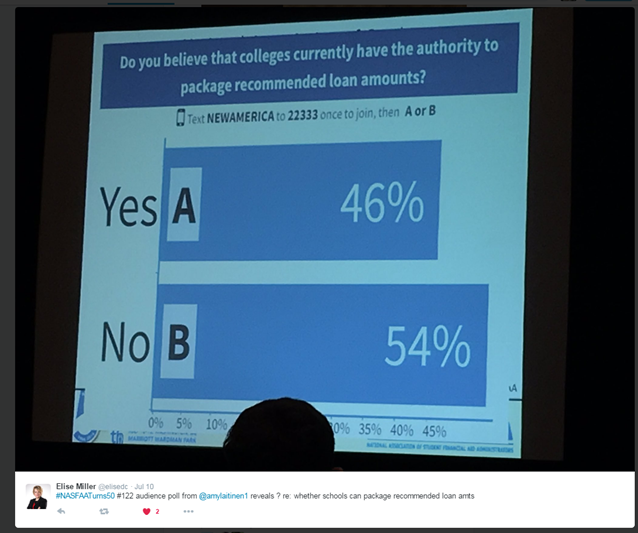
More than half thought they were not allowed to replicate the Department鈥檚 鈥渞ecommended鈥� language. This seems odd…until you hear about conflicting information coming from the Department itself.
According to several schools we have spoken with, Department officials have told them that they cannot require students to take any additional steps that might make it harder for students 聽to receive a loan. And as stated in a letter from the Department sent to all financial aid offices last year, 鈥淭he amount and scope of the additional [loan counseling] material… may not be administered in a manner that unreasonably impedes a student鈥檚 ability to borrow.鈥� 聽In that light providing recommended amounts, which requires students to then take an additional step of asking for more money, could be viewed as making it harder for students to get their maximum entitlement. The Department is sending mixed messages, as the results of our snapshot make clear.
The confusion around whether a school can offer recommended amounts and the inability to mandate additional loan counseling for students are just two sources of frustration that have contributed to schools asking Congress for permission to limit loans for certain categories of students. NASFAA has been on the record with this聽聽for years. The Chairman of the Senate HELP Committee, Senator Lamar Alexander (R-TN) has said that he may introduce legislation responding to this call. While we understand why schools want more institutional flexibility to directly limit student borrowing, we also recognize that there are dangers to this approach (something we will be exploring on Ed Central over the coming weeks and months).
Aside from giving schools the authority to directly limit loan awards, there may be better ways to give schools the flexibility they need to help ensure students are borrowing the appropriate amounts. Allowing for recommended borrowing amounts could be one. Testing the impact of additional mandatory counseling as the Department has just set out to do may be another. The Department鈥檚 newly-announced experimental site could be a first, important, step to addressing some of these concerns. We hope it isn鈥檛 the last.
More 国产视频 the Authors

Amy Laitinen
Senior Director, Higher Education
Issues
Programs/Projects/Initiatives
Related

What Was Supposed to Save Taxpayers Hundreds of Millions Will Instead Cost Billions: New College Accountability Rules

For Most Renters, Eviction Threat Falls with Age. Not for Older Student Parents.

A Cheat Sheet to the Trump Accreditation Overhaul