
Baltimore’s Triumph over Silence
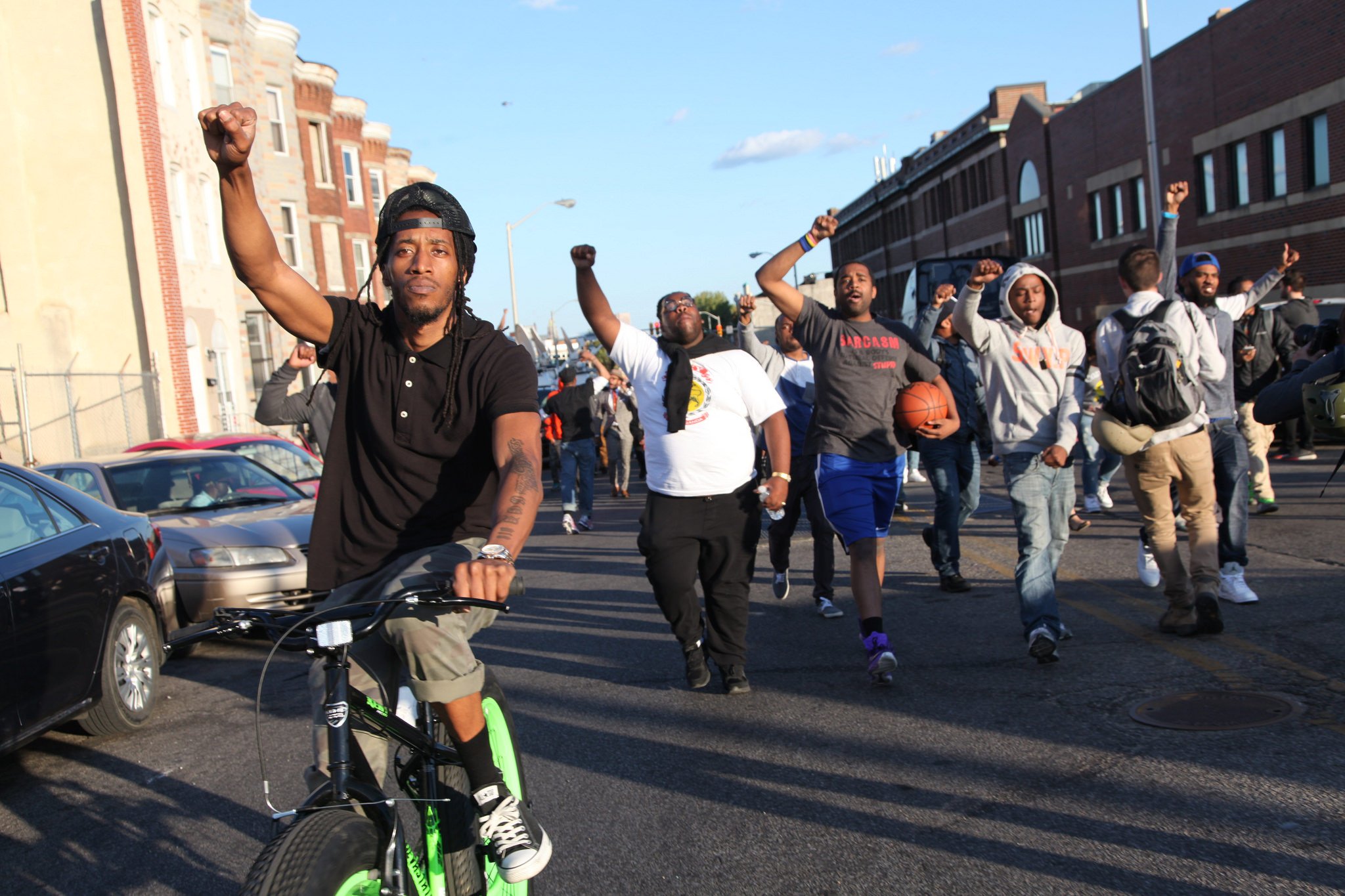
Four days after protests in Baltimore turned violent, I found myself looking into every black face I saw as I made my way through Pittsburgh International Airport, wanting to say something huge-hearted and restorative. My eyes were wet, my chest full but also empty, as if a balloon were lodged there and about to pop. I looked at all the white faces, too, thinking, Don鈥檛 you know me? Don鈥檛 we mean something to each another?
My emotional state surprised me, but then again it didn鈥檛. I鈥檇 spent the night before talking about race with my brother and his family, talking about Baltimore, about what it means to be the mother of black sons, even in a town with a black mayor. I felt vulnerable, disappointed. I also felt complicit, as if somehow I, in speaking only in the safe setting of family about the nature of my own fears, had become part of what I now sensed to be the problem.
I am a writer not because I am seldom at a loss for words, but rather because it is language itself that alerts me to what I think and believe. So how could it be that I鈥檇 kept so quiet about a topic of such urgent intensity, such relevance to someone exactly like me?
Our sense of race shapes the ways we explain ourselves to ourselves, and, by extension, what we tell ourselves about everyone who isn鈥檛 us. And yet, how often does the centuries鈥� old knot of race鈥攁 knot you can set out with every intention of unraveling, even as someone standing directly behind you gets to work tying the thing right back up again鈥攔ender even the most expressive among us hopelessly tongue-tied?
What should have been our nation鈥檚 shared burden of collective failure was borne instead by those who had been failed.
There are numerous ways to connect the dots linking the three white cops, the three black cops, Freddie Gray鈥檚 severed spinal cord, his ensuing death, weeks of outcry from black community members, police cars destroyed, and a pharmacy looted and burned. But practically all the news outlets summed up the unrest in largely black communities as rioting, a label that gave some viewers permission to frown upon it, condemn it, hold it up as evidence of black barbarism and self-destruction鈥攁s proof of why inequality exists in the first place. The term rioting let those of us watching from a safe distance and buffered by privilege or sheer luck off the hook. What should have been our nation鈥檚 shared burden of collective failure was borne instead by those who had been failed. I don鈥檛 think I ever caught myself using the word 鈥渞ioting,鈥� but how many times did I turn away from images of that frenzy, the mess of those streets?
But if what happened in April 2015 in Baltimore was indeed rioting, then I would wager that so were the uprisings in Paris, Mexico City, and Prague in 1968鈥攖umultuous unrest that cemented for citizens the world over the absolute value of democracy. If citizens who took to the streets of Baltimore in April 2015 were rioters, then so was UC Berkeley undergraduate Mario Savio, who helped galvanize upper-middle-class, white, educated American youth around the Free Speech movement in 1964 with this admonition:
There鈥檚 a time when the operation of the machine becomes so odious, makes you so sick at heart, that you can鈥檛 take part! You can鈥檛 even passively take part! And you鈥檝e got to put your bodies upon the gears and upon the wheels鈥pon the levers, upon all the apparatus, and you鈥檝e got to make it stop!
The visceral quality of that machine metaphor conjures the physical nature of conflict, of vulnerability, in such moments of all-out commitment. It invokes our sense of Civil Rights activists 鈥済oing limp,鈥� the lynched bodies hanging from the branches of American trees, the bodies made to march under the weight of guns, made to take aim at other bodies in the name of war. And the relevance of those terms to the events happening only days ago in Baltimore makes me feel foolish鈥攐utright delusional鈥攆or having once thought the many decades separating us in our 21st-century now from that awful then might keep us鈥攁nd not just those of us who are black, but all of us鈥攕afe.
The beliefs we hold, whether they are expressed or not, live inside of language, even private language. Years ago, when the news was filled with stories of Somali pirates holding passenger ships and international cargo ships hostage, I wrote a poem called 鈥淩ansom.鈥� It began:
When the freighters inch past in the distance
The men load their small boats. They motor out,
Buzzing like mosquitoes, aimed at the iron
Side of the blind ship as it creeps closer.
I wasn鈥檛 an avid reader of stories that trucked in the romantic, swashbuckling pirate clich茅s, but I could sense that the particular anger incited by stories about the Somali pirates, even in me, was not remote from a racially charged subtext.
My poem, though I didn鈥檛 know it until after it was finished, was an act of empathy, an attempt to pull myself away from the facile nature of the prevailing narrative鈥攖he one about depraved African villains preying upon innocent westerners. I shocked even myself when I found my way to these lines late in the poem:
The white men scramble. Some fight back.
When one is taken, the whole world sits up
To watch. When the pirates fall, the world
Smiles to itself, thanking goodness. They
Show the black faces and the dead black bodies
On TV.
The explicit verbal acknowledgment of the complicated things race causes us to think and fear and feel is a necessary counterbalance to the race-based disregard (or worse) that so often infects our views of one another. Sometimes it seems that the words we live with and by do little more than delineate a line separating a constantly shifting Us from Them, solidifying the barrier between what we are comfortable claiming and what we can see, but haven鈥檛 yet learned to name, let alone admit.
When I caught the news of Marilyn Mosby鈥檚 decision to bring charges against the six police officers involved in the death of Freddie Gray鈥攎oments after my flight had landed鈥擨 gave myself over to tears. In Mosby鈥檚 charges, I heard someone saying no to Freddie Gray鈥檚 assailants, no to the false terms that too often trick us into letting not just bad cops but ourselves, too, off of the hook. Terms like 鈥渢hug,鈥� like 鈥渟uspicious activity,鈥� like 鈥渟tand your ground,鈥� like 鈥済hetto.鈥� Even the milder but no less dangerous statements (鈥減laying the race card,鈥� 鈥測ou鈥檙e so articulate,鈥� 鈥渁ngry black woman鈥�) that give a toehold to a breezy, glib self-satisfaction that allows us to get away, too much of the time, with telling ourselves that we鈥檝e got one another all figured out.
When I am content to be an American, it is because, for the most part, we have developed the capacity to live beside one another without much gawking and pointing, or worse鈥攁nd because, when we fail in this regard, we sometimes find ways to talk about it. But when I am truly humbled by America鈥攚hen I find myself ecstatic with gratitude and hope鈥攊t is because someone has made the difficult choice to address the failure of our silence in language that complicates things rather than simplifying them, that urges contemplation rather than pat summation, that invites the listener to join in the difficult work of grappling with and admitting to the many nuanced and sometimes troubling layers of private feelings each of us houses. It is because, no matter what might be waiting to render the attempt futile, someone has lent a set of hands and pair of able eyes to the task of teasing apart that troublesome knot.
This article originally appeared in , a national conversation hosted by the and Z贸calo Public Square.
More 国产视频 the Authors
Related

鈥淧eace Through Strength鈥� Is Hard to Read

“Getting the Golden Ticket”: Participants’ Perspectives on Lexington’s First Assembly

Civic Assemblies: A Framework for Community Colleges
