
That Beautiful Barbed Wire
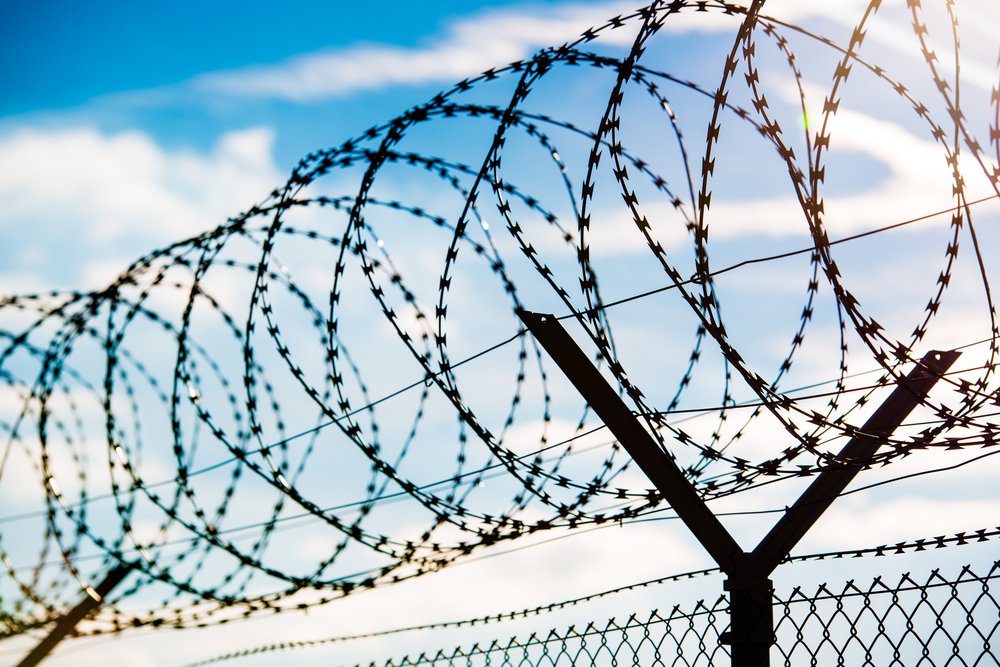
American troops are on the U.S.-Mexico border stringing concertina wire, a type of barbed wire and often used to create an obstacle in war, to stop a caravan of refugees that鈥檚 still thousands of miles away. In the absence of much else in the way of visual interest to illustrate the story, media outlets ran images of soldiers unspooling wire and spotlighted the word wire in their headlines. On Saturday, at a rally in Montana, President Trump : 鈥淚 noticed all that beautiful barbed wire going up today. Barbed wire used properly can be a beautiful sight.鈥� His audience cheered.
It makes sense that Trump mentioned barbed wire in Montana. In typical Trump fashion, he鈥檚 put his finger on the perfect symbol to activate his base鈥攑robably without even really knowing why. (Barbed wire is such a rich symbol that it鈥檚 spawned multiple , though if Trump has read one of them, I鈥檒l eat a cedar fencepost.) Although some Trump opponents along with the president鈥檚 words, barbed wire鈥檚 meanings鈥攙iolent enclosure, permanent control鈥攚ere first laid down in the American West.
Ohioan Lucien Smith in 1867. Joseph Glidden patented the in 1874, a dozen years after the passage of the Homestead Act. Even in its infancy, long before its uses on battlefields and concentration camps, this technology was far from politically neutral. Barbed wire, Reviel Netz writes in , 鈥渋s contagious鈥� because of the very fact that barbs face inward and outward, enclosing a rancher鈥檚 herd but also wounding any other cows that might try to encroach upon that land. 鈥淏y enclosing a space,鈥� Netz points out, 鈥淸barbed wire] is thereby automatically present in all areas bordering on that space.鈥� It鈥檚 a tool of violence and surveillance. The 1885 Glidden Journal, a publication of the barbed wire company headed by Joseph Glidden, described its fence: 鈥淚t watches with eyes the inside and outside, up, down, and lengthwise; it prevents the 鈥榠ns鈥� from being 鈥榦uts鈥�; and the 鈥榦uts鈥� from being 鈥榠ns鈥�; watches at day-break, at noontide, at sunset and all night long.鈥� People who put up barbed wire fences when the technology was new were making statements about the nature of landowning in the West鈥攄efining the boundaries of their property with the permanent potential for violence.
As with so many Trumpian symbols, barbed wire鈥檚 darkest meanings are fascist: the domination of the powerless by the powerful.
The West鈥檚 enclosure via barbed wire had its victims. In 1947, historian Wayne Gard the resistance to barbed wire in Texas, which came from ranchers whose cattle couldn鈥檛 access water because so much open range was now fenced, as well as cowboys who were rendered obsolete by the new technology. When the fences first went up, owners of livestock that were using them to keep animals off the tracks, seeking to hold the corporations liable for the damage the cows sustained. The blizzards of the mid-1880s concentrated tens of thousands of cows against new barbed wire fences in Texas, where they died of starvation or cold. The first generations of fences had larger, sharper barbs. The cows bashed against the fences and got wounds, which would get infested with .
But eventually, white settlers in the West learned to appreciate the way the fences allowed them to dominate far-flung spaces. The barbed wire companies helped them along. In a Trumpian spectacle of violent control, , a salesman of barbed wire working for the Washburn-Moen Company, came up with the gimmick of erecting a corral in Military Plaza in San Antonio in 1876 and putting a bunch of longhorns, green to the barbed wire concept, inside of it. The cattle tried to get out, slashing themselves against the fence, until they finally stopped trying. The crowd was convinced, and Gates brought in 鈥渙rders for more wire than the factory could produce,鈥� Sidney A. Brintle writes. Trump would also have approved of Gates鈥� later path: The showy salesman left Washburn-Moen, started a new barbed wire company where he made millions from wire manufactured using a patent of questionable legality, and turned the profits from that work into oil money.
Companies promoting barbed wire fencing used imagery in their promotional materials that played on familiar prejudices of the day, making sure the farmers and ranchers interested in buying knew that they could keep Native Americans, black people, children, beasts owned by others, and poor people out with the new invention. In their , Lyn Ellen Bennett and Scott Abbott find copious textual and visual examples in company literature: a barbed wire fence lining a field of watermelons while a salivates outside; a child in raggedy clothes caught on a fence, stolen apples spilling out of his pockets; a city-born 鈥渄ude鈥� dressed up in fancy gear, finding himself 鈥減ricked on barbs of steel.鈥� The 1887 Glidden Barb-Fence Journal wrote of the idea of using barbed wire to fence out Native people: 鈥淭he government should by all means adopt for this purpose the Glidden 鈥楾hick set.鈥� It makes the best 鈥榟og fence鈥� in the world. It might scratch the deviltry out of Geronimo and his gang.鈥�
The barbed wire industry鈥攑rescient capitalists鈥攅nvisioned that the uses for this fencing would go far beyond farming. An image of 鈥淏ase Ball Grounds, enclosed with 鈥楤arb Armed鈥� Fence鈥� showed how a sports promoter could make sure only paying spectators got the good seats.
The barbed wire fence was, in a word, patriarchal. 鈥淭he character of a man may be known by a glance at his surroundings,鈥� Bennett and Abbott quote an 1887 edition of the Glidden Barb-Fence Journal. 鈥淚f the farmer鈥檚 buildings be snug 鈥� his stock sleek, well fed and kept in their proper places by good fences, you may be morally certain he is a prosperous, well-to-do and influential man in his community. You may also be certain that he used the Glidden wire.鈥� The respectable farmer who used a barbed wire fence could make all things conform to his will. 鈥淭he Barb Fence is the only means for obliging every body and every thing to enter a man鈥檚 premises by the same way that he himself enters,鈥� Washburn & Moen and I.L. Ellwood in an 1876 booklet. That beautiful, beautiful barbed wire.
Reviel Netz argues convincingly that the history of the technology鈥檚 development in the American West has to be seen in relationship with barbed wire鈥檚 later period, when the industry supplied armies and occupying forces with roll upon roll of the stuff to use for defense and imprisonment: 鈥淏oth can be considered, at a certain level of abstraction, as expressions of the same relations: space being brought under control; flesh being brought under the violence of iron.鈥�
During World War I, the industry boomed鈥擴.S. Steel alone produced 2.8 million miles of wire, according to Netz. Even if not all of it was intended for the western front, Netz argues, 鈥渋t would not be far wrong to say, as a rough estimate, that every day for the duration of the war, an amount of barbed wire equivalent to the entire length of the front was laid.鈥� The wire was not, like a castle wall, a complete defense, but rather slowed men down as they tried to advance, making them into fodder for the newly available machine guns. The wire could be laid down fast, and so the fields of battle were covered in drifts of it. There are some horrible passages of memoirs of soldiers that touch on the effects of barbed wire. Netz quotes a passage from Erich Maria Remarque, who remembered seeing an advancing soldier shot while in a wire tangle: 鈥淗is body collapses, his hands remain suspended as though he were praying. Then his body drops clean away and only his hands with the stumps of his arms, shot off, now hang in the wire.鈥�
In the next war, when it was used to enclose concentration camps, Netz writes that 鈥渂arbed wire reverted to its original function of controlling weak living beings, depriving them of their last powers so that total control could be gained.鈥� As with so many Trumpian symbols, barbed wire鈥檚 darkest meanings are fascist: the domination of the powerless by the powerful. The fact that those meanings are also tied up with the dream of the West鈥攖o own land, and a lot of it; to be sure that nothing happens on that land that you cannot control; to inflict violence on those who threaten the dream鈥攎akes it the perfect fence for the moment.
This article in , a collaboration among , 国产视频, and .
More 国产视频 the Authors
Related

Disability in the United States at 250

From 鈥楻isky Business鈥� to 鈥楳ission: Possible鈥�: Why ECE Learning Cohorts Work

State Education Budgets in Turbulent Times
