
Is Betsy DeVos a Mainstream Candidate for Secretary of Education?
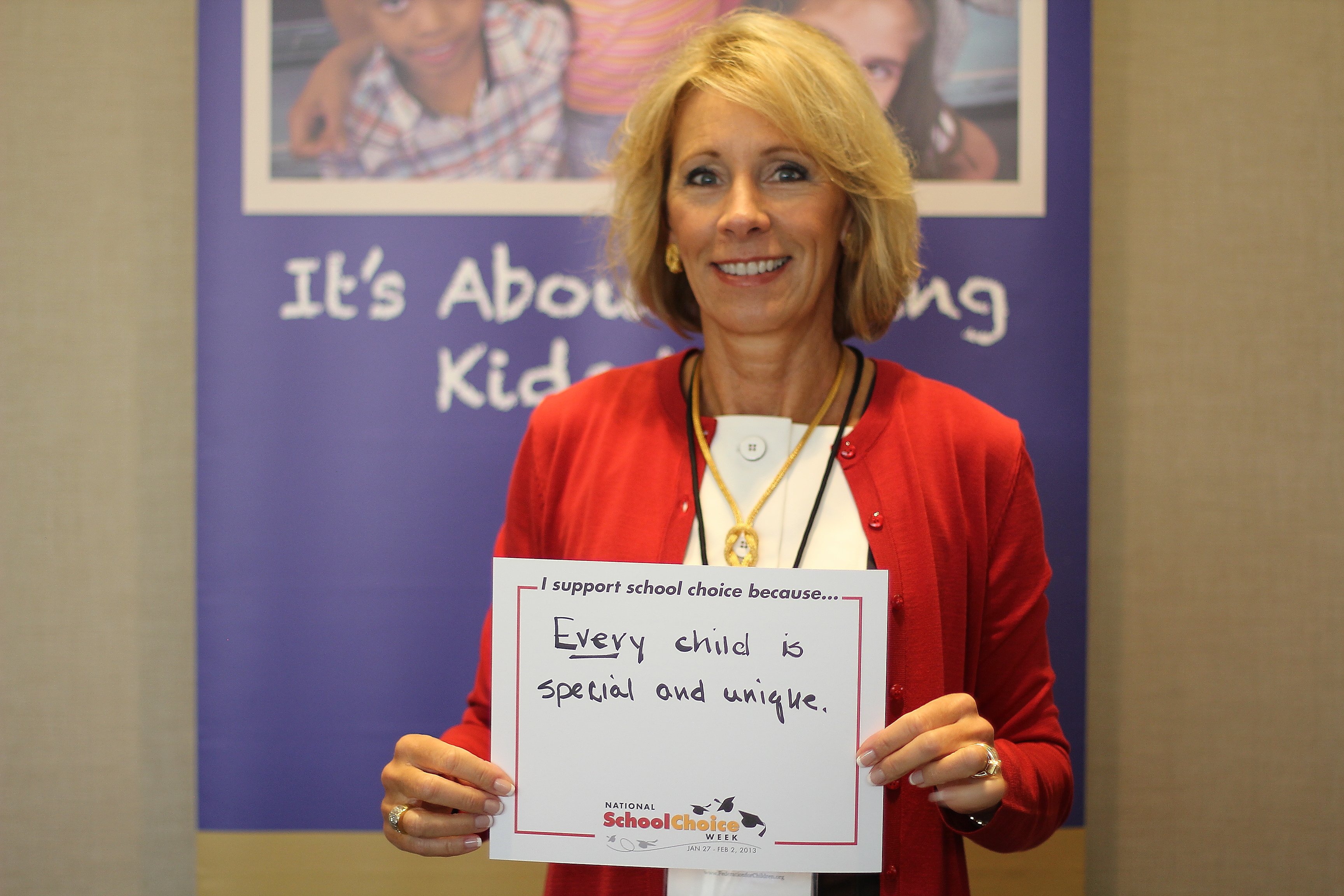
Tuesday night, Betsy DeVos sat before the Senate Health,
Education, Labor and Pensions Committee for her first (and likely only) hearing
before next week鈥檚 vote on her confirmation as the next Secretary of Education.
While it seems inevitable that DeVos will be confirmed, it remains the
responsibility of the Senate, education policy experts, and the public to vet
her qualifications and determine if she is prepared to lead the country on
education issues.
During her hearing yesterday, and elsewhere over the past
several weeks, Sen. Lamar Alexander (R-TN) and other commenters have called
DeVos a 鈥渕ainstream鈥� pick for Secretary of Education鈥攂ut very little about
DeVos is normal or conventional. The qualities that put her so far outside of
the mainstream are not unique benefits, but a clear indication that she lacks
the qualifications and understanding necessary to assume this important role. Her
lack of exposure to the traditional public schools that the majority of
American children attend merits scrutiny, but is not necessarily disqualifying.
Similarly, DeVos鈥� enormous wealth puts her out of touch with the lives and
experiences of the nearly two-thirds of Americans who , but her billions
don鈥檛 preclude her from service in public office. Rather, it鈥檚 her stunning
lack of expertise and experience that should give us all pause.
Secretary of Education isn鈥檛 a position many people have
held鈥擠eVos will only be the eleventh person to assume that title. Nonetheless,
a review of the distinguished men and women who have led the Department of
Education shows a clear, conventional pathway to the position: A demonstrated
background in public service with specific experience in either leading a
school district, state board of education, or university system. While there is
certainly no clear consensus on the qualifications for a position such as this,
it鈥檚 unarguable that public officials have public track records that provide
significant insight into their ideas, attitudes, and activities鈥攁nd leaders in
education are no different.
Conversely, in introducing DeVos, former Senator Joseph
Lieberman said, 鈥淚 know that some people are questioning her qualifications to
be Secretary of Education, and too many of those questions to me seem to be
based on the fact that she doesn鈥檛 come from within the education
establishment.鈥� If by that statement, Senator Lieberman meant that DeVos has
never worked in the public sector, and that she lacks any experience leading
any public institution, he is correct. (She has also never held any elected
office.) Instead, DeVos鈥� experience in education has been characterized as
鈥渁dvocacy,鈥� though that more accurately describes the work funded through her
many charitable organizations than her own efforts. Her work in education has
existed primarily behind the scenes: as a fundraiser, organizer, and
deep-pocketed donor.
The hearing highlighted a range of pertinent PreK-12 issues
that fall under the purview of Secretary of Education: education spending, childcare
and early learning, measuring the academic progress of students, guidelines for
educating students with disabilities, accountability for online learning
providers, equal rights protections for LGBT students, the collection of school
discipline data by the Office of Civil Rights, and more. On the higher
education front, senators spotlighted issues regarding financing postsecondary
education, simplifying financial aid applications, continuing to confront
campus sexual assault, and the regulation of the for-profit higher education
industry.
Normally, it would be possible to look at a candidate鈥檚
resume, and see what choices that candidate made when faced with the real
decisions of running actual institutions, casting a vote on specific policies,
or ()
writing clear opinions for legal cases. A conventional candidate may not have
taken a public stance on every one of these issues, but would have made public
statements about a broad range of them. Further, they would necessarily have
gained significant background knowledge and deep expertise in education policy
and practice that they could draw upon to offer greater insight into their
thinking and decision making.
Instead, when DeVos commented on areas where she does have a
record鈥攚here, according to Senator Alexander, she has 鈥渦sed her considerable
wealth and effectiveness to advance [her] ideas鈥濃�攕he used her behind-the-scenes
role to distance herself from the ideas, activities, and attitudes of
organizations and individuals that she has funded, chaired, directed, and
otherwise been affiliated with (not to mention those in which she has had a
financial stake). She was not forthcoming of the mostly for-profit
charter schools in Detroit that she championed. She flatly denied any ties to
the views espoused by organizations that she has been connected to that endorse
the abusive practice of conversion therapy for LGBT youth. She distanced
herself from the Common Core State Standards, also supported by organizations
with which she is affiliated. She dodged any account of the failures of
for-profit education providers like K-12 Inc. Her record isn鈥檛 just paper thin,
it also appears to be written in invisible ink.
With no clear public record, and few signals from the
president-elect about his education agenda, it鈥檚 troubling that DeVos did not seem
to possess a basic understanding of key education policies, including the responsibilities
of the federal government under the Individuals with Disabilities Act (IDEA),
the difference between student proficiency and student growth measures, and
even simple facts and figures like the percent increase in student debt from
2008 to 2016. Even her rhetoric around 鈥渃hoice鈥� rang hollow. As Senator Lamar
Alexander described, her support for public charter schools and greater choice
for lower income parents could arguably be considered mainstream鈥攁s talking
points. But beneath those talking points, complicated policy questions remained
unaddressed around the considerable challenges of providing real choices to
parents at scale: the differences between nonprofit vs. for-profit charter
schools; the impact and quality of funding portability, or voucher programs;
the troubling outcomes of many virtual schools and distance learning providers;
the consequences of choice, including increased school segregation; and more. A
normal candidate鈥攁 mainstream candidate鈥攚ould have more than talking points: They
would have a record.
For the millions of working Americans that have gained the
experience and credentials necessary to do their jobs effectively, elevating
unqualified individuals to important leadership positions undermines the
legitimacy of our public institutions and further weakens our core beliefs in
education, hard work, and merit-based achievement. In this case, it鈥檚 even more
ironic, given that DeVos will be tasked with leading the country鈥檚 education
system.
As we move forward into the next four years鈥攚here so much that
seems completely aberrant is becoming increasingly normalized鈥攊t鈥檚 worth
reflecting on how we characterize the ideas, attitudes, and activities of our
public officials, especially highly visible ones like DeVos. Senator Joseph
Lieberman characterized DeVos as an outsider, despite her 30 years as the
ultimate Republican insider. But she certainly is an outsider when it comes to
any qualifying experience in education leadership.聽
More 国产视频 the Authors
Issues
Related

Pre-K Is Having a Curriculum Moment. A Professional Learning Movement Needs To Follow.

Federal Early Education Update: June 2026

Beyond Braiding
