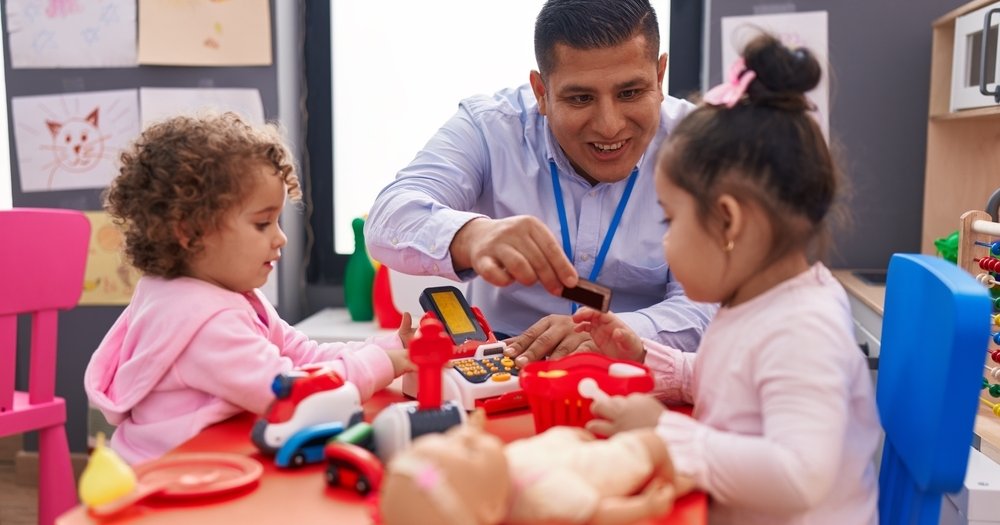
Book Review: Can Pre-K Address Income Inequality?

As we at EdCentral 听听, the political buzz around pre-K is stronger now than ever. Much of this recent momentum is a result of suggesting that high-quality early education programs can improve children鈥檚 progress measured against a bevy of different academic and social indicators stretching to鈥攁nd beyond鈥攈igh school graduation. High-quality pre-K can improve these students鈥� adult earnings and their likelihood of getting a diploma. It makes it less likely that they鈥檒l have children out of wedlock, be arrested, or go on public assistance. And in the short-term, by giving parents a safe, educationally-rigorous place to put their children during the workday.
It almost seems too good to be true! Pre-K put three women on the moon in the 1940s (But the news media, as is customary, wasn鈥檛 paying attention to early education, and missed the whole thing)! Pre-K is also the secret catalyst required for cold fusion!
Ok. Those last two aren鈥檛 strictly based in research. But the point stands: the rewards of investing in pre-K are enormous. And Tim Bartik鈥檚 new book, , offers even more evidence supporting public pre-K investments. After a comprehensive, accessible treatment of the case for public investment in high-quality pre-K, Bartik outlines a 鈥渇ull-scale proposal for early childhood education.鈥� His proposal includes universal pre-K for all 4-year-olds in addition to developmental child care, pre-K, and home visiting programs for children from low-income families in the years before pre-K. He calculates that:
For low-income families, this proposal would offset most of the increased income inequality since 1979; for middle-income Americans, this proposal would offset one-sixth of the increased income inequality.
Bartik鈥檚 proposal is more than just pre-K, but given , that鈥檚 still a big promise. The earnings of low-income households would have needed to increase by 31 percent (in real terms) over that period to keep pace with 鈥渢he growth of average household income.鈥� Bartik estimates that high-quality child care and pre-K for low-income families could raise adult earnings 26 percent for children from these families. Home-visiting programs might also add to that a bit.
Your enthusiasm mileage may vary on this, given your views of the politics of income inequality. As Bartik puts it, his proposal could help with 鈥渙ffsetting recent inequality trends,鈥� which is not the same thing as settling them for good. But his calculations offer new ways of talking about pre-K beyond the 鈥渆very dollar spent on pre-K returns $10 in savings and benefits for society.鈥�
And that analysis really exemplifies the core strength of From Preschool to Prosperity. While early education has gotten hot enough in recent years to attract the mainstream media, their coverage often glosses over () research on which policies work best. There鈥檚 a reason for this鈥� are technically-complex and can be a strenuous read. Bartik bridges the distance between accessibility and expertise. From Preschool to Prosperity is supremely organized and readable, but it鈥檚 also jammed full of useful information. It鈥檚 the book for anyone who鈥檚 been following …and wants to know why it鈥檚 such a big deal. It鈥檚 the book for anyone who鈥檚 heard the (aforementioned) stats on the return on investing in pre-K…and finds themselves wondering just how researchers come up with those numbers.
Honestly, it鈥檚 a great book for anyone whose interest or expertise in early education doesn鈥檛 extend to knowledge of cutting-edge economic research in the field. Readers will finish the book better able to explain the 鈥渨hy鈥� and 鈥渉ow鈥� of high-quality pre-K. That鈥檚 information worth having, since pre-K鈥檚 political prominence hasn鈥檛 necessarily translated into . And we don鈥檛 need sophisticated research to know that ineffective rhetoric supporting access to high-quality pre-K does nothing for kids.听
—
Disclosure: I offered comments on an earlier manuscript version of From Preschool to Prosperity.
More 国产视频 the Authors
Issues
Programs/Projects/Initiatives
Topics
Related

Prioritizing Students with Disabilities in AI Policy

In 2026, States and Congress Will Need to Mitigate the Damage to PreK-12 Education
Inside 2025: A Year of Urgency and the Wins That Mattered Most