
Jason Delisle
Director, Federal Education Budget Project

In case you missed it, it looks like the Budget Committee in the House of Representatives has effectively nixed President Obama鈥檚 new Perkins Loan program. The president鈥檚 would revamp the existing program, which is a revolving federal loan fund administered by individual schools, and replaces it with a new direct loan program that lets the most financially needy students take out larger federal Stafford loans. According to official budget estimates, this would free up federal funds that could be directed to the Pell Grant program. But a little-known provision in the fiscal year 2012 budget resolution that the House of Representatives passed last month makes that proposal moot.
The proposal was part of a series of legislative proposals (called the 鈥淧ell Grant Protection Act鈥�) President Obama included in his fiscal year 2012 budget that would reduce spending on various higher education programs and move the money to the Pell Grant program. Costs for the Pell Grant program have risen steeply in recent years, mainly because Congress made the program more generous, forcing lawmakers to enact a series of ad hoc funding sources to supplement the regular annual appropriation. Those one-time funding sources will be exhausted this year, so Congress needs to boost the fiscal year 2012 appropriation for the program from the current $23.0 billion to $34.2 billion, unless it wants to cut the current maximum grant of $5,550.
Key education stakeholders and most members of Congress have assumed that all of the proposals in the president鈥檚 Pell Grant Protection Act are viable budget options that, if enacted, could help plug the hole in the Pell Grant budget. (In fact, one of the proposals in the president鈥檚 plan, elimination of the year-round Pell Grant, was adopted in the fiscal year 2011 appropriations bill enacted in April.) This is indeed true, except for the new Perkins Loan proposal. Under budget rules that the House of Representatives adopted in the fiscal year 2012 budget resolution, that proposal would actually increase federal spending, not reduce it.
According to the White House Office of Management and Budget (OMB), the President鈥檚 proposal 鈥渟aves鈥� over five years because the government would turn a profit on the loans. In other words, the government would make money by lending to financially needy students at subsidized rates, and those earnings would be put in the Pell Grant program. Following the same accounting rules that OMB used for its estimate, the Congressional Budget Office that the program would save $3.0 billion over five years.
As a result of the 2012 budget resolution, those estimates, however, won鈥檛 pass budget muster in the House.
Buried in the text of the is a provision (Sec. 408) that lets the House Budget Committee use a 鈥渇air-value鈥� estimate of the cost of any new federal loan program or changes to an existing one instead of the official estimates. (Technically, the congressional budget committees already have this authority, but the provision signals a more formalized intent to use it in the House.) Many , including the Congressional Budget Office, believe that a fair-value estimate provides the most comprehensive measure of a loan program鈥檚 costs. Specifically, that accounting method more fully reflects the risks that taxpayers bear in making subsidized loans. In fact, calculated using the official budget rules tend to understate the costs of federal loan programs by excluding a full measure of the riskiness of the loans. Thus government loan programs, like the president鈥檚 Perkins proposal, appear profitable for the government even though borrowers get below-market terms, no private lender would make them with its own capital, and the federal government has no inherent cost-savings advantage.
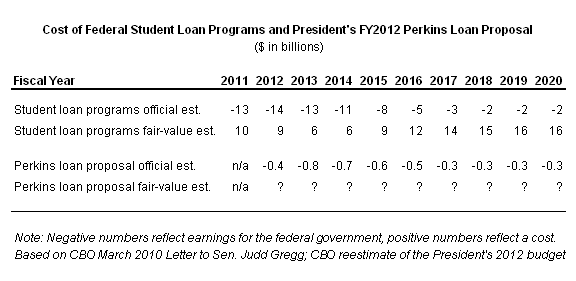
Alternatively, fair-value estimates tend to show that federal loan programs aren鈥檛 profitable for the federal government when borrowers get loans at terms more generous than those available in the private market.
While neither the House nor Senate Budget Committees have been able to get a fair-value estimate of the president鈥檚 Perkins Loan proposal yet, that under that accounting method, the proposal would result in costs rather than savings for the federal government.
In short, if the Perkins Loan proposal doesn鈥檛 result in savings, Congress can鈥檛 use it to offset the costs of funneling more money to the Pell Grant program. So the fate of the proposal lies in the hands of the House Budget Committee. Of course, the Committee doesn鈥檛 have to use a fair-value estimate for the president鈥檚 Perkins Loan proposal; it can use the official one that shows savings. But what playwright puts a gun on the stage if no one is going to use it?
Director, Federal Education Budget Project


