
Can You Love Your Country but Not Its Air Shows?
The paint-chipped school bus groaned as it teetered toward a row of bright blue聽porta-potties聽near the air show entrance. Across the aisle to my left, a boisterous Ohioan, rocking along with the bus, gestured toward the makeshift restrooms, blurting, 鈥淭hat鈥檚 the Blue Angels!鈥�
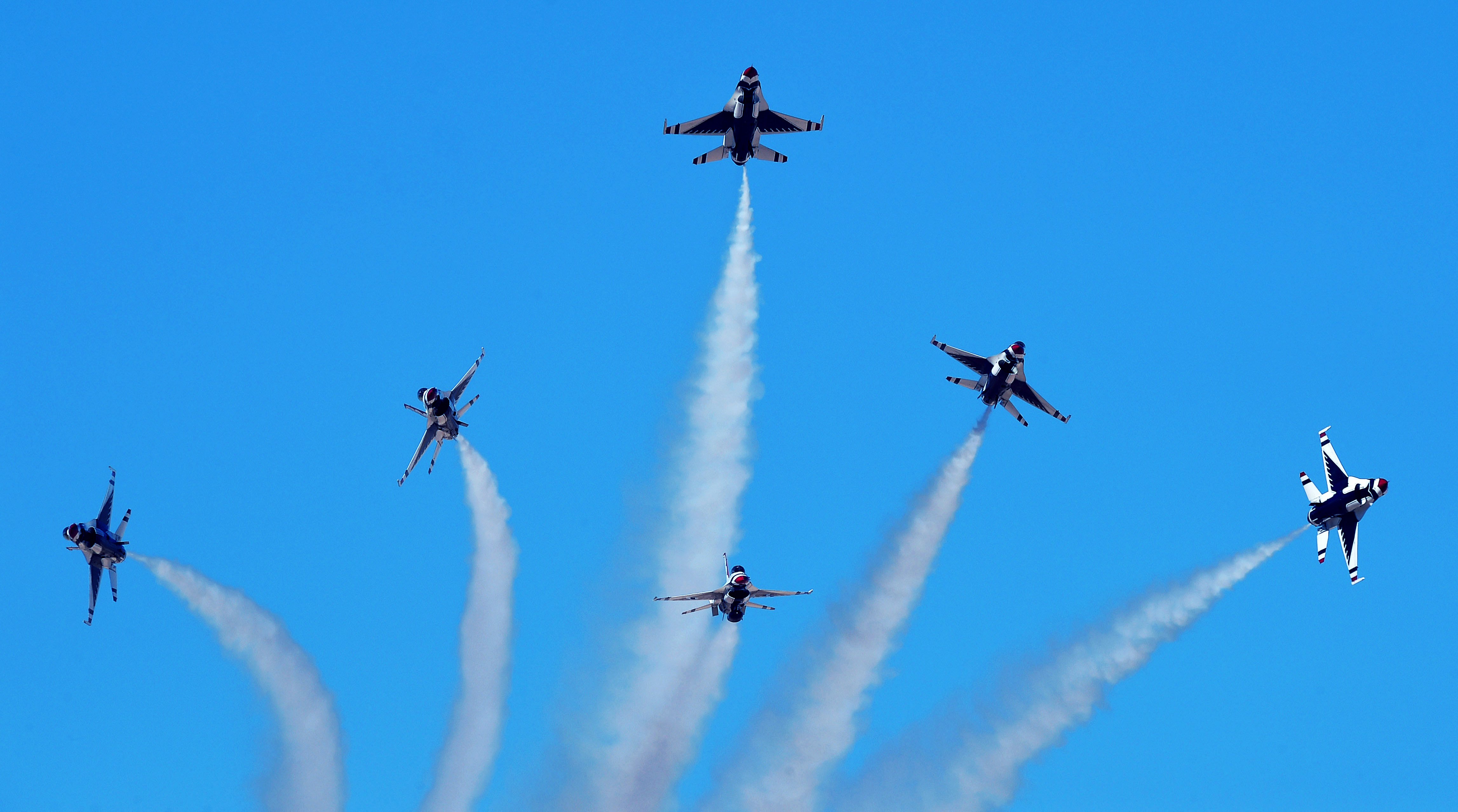
It was an unsubtle dig at the U.S. Navy鈥檚 elite flying squad鈥攁nd the rival of the Air Force Thunderbirds, the main event of the air show in Youngstown, Ohio, I saw recently. Like a roving troupe of rock-stars, the Thunderbirds tour the United States and the world, performing for their fans and signing autographs after shows. The air shows are designed to link the military and the communities in which they鈥檙e embedded鈥攖o bridge the civilian-military divide.
The American military air show is an unbridled celebration of patriotism. A concept which, in light of the ongoing swirling around America鈥檚 national anthem, institutional racism, and love of country, especially when it comes to racial minorities, is, once again, on the tips of people鈥檚 tongues. This chasm over patriotism鈥攖his fault line along racial divisions鈥攊s one I鈥檝e long felt between the civilian population and the American military; it was one I saw playing out right before me at the military fairground, where it seemed like I was being primed and prodded to sacrifice fathers, mothers, sons, and daughters to a controversial cause.
聽 聽 聽 聽 聽 聽 聽 聽 聽 聽 聽 聽 聽 聽 聽 聽 聽 聽 聽 聽 聽 聽 聽 聽 聽 聽 聽 聽 聽 聽 聽 聽 聽 聽 聽 聽 聽 聽 聽 聽 聽 聽 聽***
To my own chagrin, I stood out among the bus of patriots鈥攅ach clad in various articles of clothing emblazoned with the American flag. There were no other black riders with whom I could share a knowing glance. It was just me, armed with a recorder, notebook, and pen.
I was there for an encore performance; I鈥檇 already heard the Thunderbirds鈥� gospel in May, at a show in Oklahoma. It was the first show I鈥檇 attended in a decade, past the point of being a military dependent. And, truthfully, something had bothered me about the show even then, a feeling that, at that moment, I couldn鈥檛 exactly articulate. Now, however, I think I can.
Since his ascendency to the highest office in the United States, President Donald Trump has become an American gut check. Not a test of America鈥檚 ideals, but rather, its reality. Taking a knee during the national anthem at a professional football game has become many athletes鈥� crowning act of resistance. When Trump, speaking before a crowd of mostly white people, carped about this group of mostly black protesters, citizens were again called to the altar for moral reckoning.
Debates on the meaning of patriotism have ranged from the reductive to the quasi-sophisticated. Yet one thing that鈥檚 become increasingly clear is that patriotism is a malleable concept, one that apparently means different things to different people. Patriotism might, on the one hand, speak to unity; we鈥檙e 鈥渙ne nation, under God.鈥� If you peel back another layer, though, patriotism might lie less in this tidy reading and more in a critical, ostensibly divisive love. James Baldwin once wrote, 鈥淚 love America more than any other country in this world, and, exactly for this reason, I insist on the right to criticize her perpetually.鈥� It鈥檚 in these competing definitions of a murky concept where present-day divisions can be found, where Trump has deftly weaponized legitimate grievances. Indeed, this was exactly where I found myself earlier this summer.
At the air show I attended in Ohio, I talked to several people, of varying ages and identities, about patriotism and, more specifically, about their relationship to the military and the war in Afghanistan鈥攊n other words, about the heady web of topics that had been unspooling in my mind since the Oklahoma leg of my Thunderbird tour. I made a bee-line for a mock MQ-9 Reaper battle station, when a bubbly teenager, clutching a small stack of papers, intercepted me.聽
鈥淚鈥檓 assuming you鈥檙e over 17?鈥� she asked me. She then stumbled through a memorized script about the Air Force Reserve program, its scholarship opportunities, and part-time job options. Afterward, she cajoled me into filling out a slip and, in return, agreed to answer some questions for me. I discovered that she was only 19 and had just completed a gap year in South America.聽
Though she didn鈥檛, to her knowledge, have any family in the military, she said that she was excited to volunteer at her first air show because she considered herself to be 鈥渧ery patriotic.鈥� She was puzzled when I asked her, half-jokingly, how it was recruiting for the Air Force.
鈥淥h, I鈥檓 not helping them recruit! I鈥檓 just signing people up to hopefully take jobs in the Air Force Reserves,鈥� she said.
Anecdotally, the people I talked to at the air show were all, in their own way, at the celebration as an expression of their patriotism, and many also mentioned honoring tradition. Hours earlier, the event had kicked off in earnest with a prayer for the troops by the base chaplain that came in blaring over the intercom. It was followed by a speech by Rep. Bill Johnson (R-Ohio), who said that 鈥渨e do this for the men and women answering the call, when the nation enters that call.鈥澛�
At the same time, the people I interviewed were very light on their comments about troops and about the war in Afghanistan. David Baker, 38, a former Army recruit with many piercings, clarified to me, 鈥淚 mean, you always think about the [deployed soldiers], but when you come here, it鈥檚 just to enjoy the show, see what our nation is capable of doing. It鈥檚 just a fun time.鈥�
Baker鈥檚 statement got at something. Before Colin Kaepernick, former quarterback for the 49ers, began kneeling in protest against police brutality and institutional racism, football was, for many, also 鈥渏ust a fun time,鈥� even though the anthem has preceded kickoff at National Football League games since the United States joined World War II. Spectators baptize themselves in the anthem before every game, which permits them to enjoy a common form of American entertainment, apolitically. This, despite the fact that the anthem itself has always been political: When we sing what鈥檚 now our national anthem, we skip over one stanza that reveals Lieutenant Francis Scott Key鈥檚 vengeful glee at the slaughter of the 鈥渢reacherous鈥� slaves who fought alongside the British in the battle for Fort McHenry in 1815, the year in which Key wrote the song.
To me, it鈥檚 peculiar that the current soul-searching surrounding the NFL has never quite seemed to permeate the consciousness of so many attendees at air shows. Perhaps this is because military culture exists in a vacuum鈥攂eyond reproach鈥攑roviding the lay citizen no opportunity to kneel in critique of it. The tragedy of the American military, as James Fallows in The Atlantic, is that the only consideration we afford it as a nation is 鈥渙verblown, limitless praise, absent the caveats or public skepticism we would apply to other American institutions.鈥�
Indeed, our country has for so long sent people to fight its at times questionable conflicts, and at least partly because of that tradition, to criticize people at all for, say, blithe recruitment would be a deeply grievous blow. And in addition to that, none, it seems, can appreciate the celebrity of the Thunderbirds and likewise critique the idolatry of destructive bombs, drones, and other weapons, all of which were on display at the show, since the majority of Americans don鈥檛 even know that the event exists. So at best, we express fealty, when it might be time to take a knee to these sorts of expressions of patriotism, especially if they flirt with an unthinking sort of nationalism.
Military air shows, the flag, the anthem鈥攖hey鈥檙e all sacraments of patriotism, and they matter. They shape what we, as a nation, choose to remember and forget about our past and present, and what we deem as an appropriate way to hold our country to account. When we, as a nation, unify under these kinds of celebratory events, we鈥檙e cleansed of our national sins, the thinking seems to go, and forgiven for our perennial neglect of those who spill their blood in our defense.
I wonder, then, if the definition of patriotism may perhaps be better expressed as a sort of confluence of competing imprints on identity. When black people stand, half-mast, in protest, it鈥檚 in mourning of ideals鈥攍iberty and justice鈥攖hat were, in many respects, never fully realized for black Americans, even after our enfranchisement. In a similar vein, a like-minded engagement with air shows might nod to the sacrifice that our military is all too willing to make, even when what we鈥檙e asking is that they put patriots of other nations at unnecessary, and even unfair, risk, rather than move America closer to that liberty and justice for all. All of this ought to remind us that when we鈥檙e stripped of our ability to reflect, our nation becomes ritually unclean.
聽 聽 聽 聽 聽 聽 聽 聽 聽 聽 聽 聽 聽 聽 聽 聽 聽 聽 聽 聽 聽 聽 聽 聽 聽 聽 聽 聽 聽 聽 聽 聽 聽 聽 聽 聽 聽 聽 聽 聽 聽 聽 聽 聽 聽 聽 聽 聽 ***
I stirred from my perch under the wing of the cargo plane under which I鈥檇 been resting when the music came on over the loudspeaker, indicating that the Thunderbirds were getting ready to start. As they taxied, single-file, down the runway, the No. 1 pilot picked up a miniature flag off of his dashboard and waved it in the canopy window of his F-16.
鈥淭hunderbirds, let鈥檚 run 鈥榚m up!鈥� the team leader said into his mic. Their engines whirred, and as they looped and maneuvered to top-40 radio hits, I was transfixed鈥攋ust like everyone else.
More 国产视频 the Authors
Related

What the Iran MOU Gets Right, Gets Wrong, and Leaves Unresolved

Prenatal Connection to Early Intervention: A Snapshot of Current and Future State

Engagement in a Civic Education Desert
