
Child Care Workforce Lacking in Opportunities

Federal suggest that in 2010, the nation鈥檚 nearly 1.3 million child care workers earned an average of around $9.28 per hour, or $19,300 per year. The lowest-paid 10 percent of workers earned less than $7.65 per hour. With statistics like that, it鈥檚 no wonder studies have found that child care workers leave the profession at high rates — according to , more than half of teachers who left the centers at which they worked actually left the occupation entirely.
The turnover in teachers may be due in large part to the lack of opportunity in the child care sector. Even the highest-earning 10 percent of child care workers in the government鈥檚 report earned only around $14.08 per hour. Many child care workers have lower educational attainment and lack the resources to go back to school. And even if they could, there are few opportunities for career advancement or pay increases within the field of child care. A issued last year, though, found that 36 states were trying to change that by implementing 鈥渃areer lattices鈥� for child care workers.
A career lattice (also called a 鈥渃areer ladder鈥�) provides workers with incentives to improve their education and training in exchange for higher compensation. That increases the odds that high-quality workers would want to stay in the workforce. In a follow-up to last year鈥檚 report, The Bessie Tartt Wilson Initiative for Children how a new career lattice initiative it designed in conjunction with the Massachusetts Board of Early Education and Care looks.
Massachusetts鈥檚 career lattice initiative includes five levels: beginning, novice, independent, supervisory, and leadership. Each level is tied to educational standards, experience, training, and responsibilities. Prior to its development, child care workers鈥� wages were largely flat across educational levels — teachers lacked much incentive to strive for more education. State data from 2012 show that while teachers without a high school diploma earned, on average, $20,001 to $22,500 in child care centers and $22,501 to $25,000 in home-based child care providers. Meanwhile, teachers with graduate or professional degrees weren鈥檛 earning much more — $27,501 to $30,000 in either child care setting.
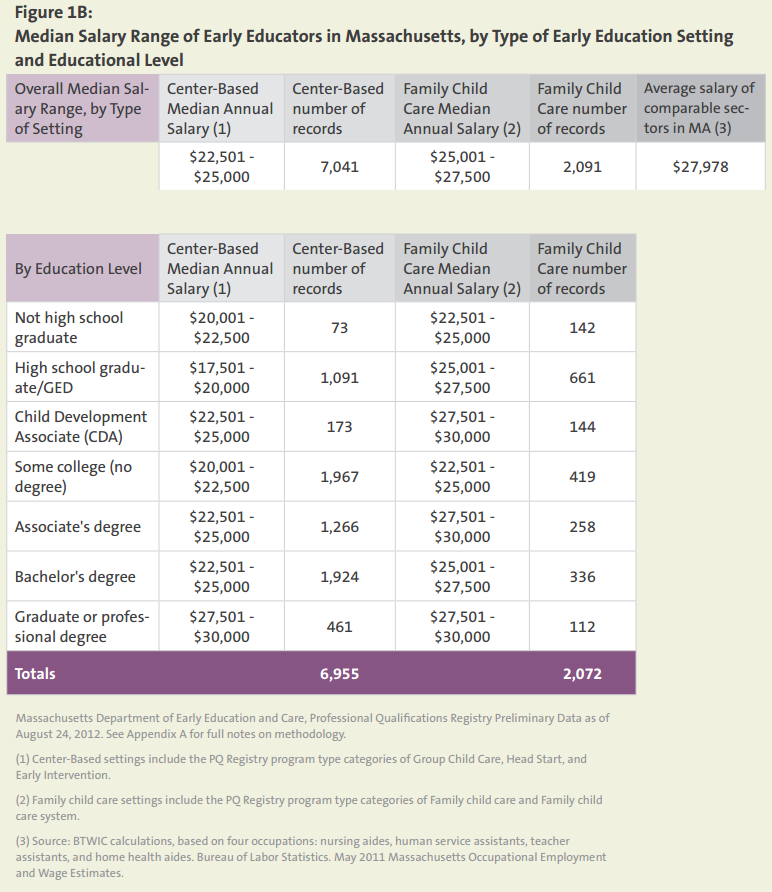
The Massachusetts career lattice is a relatively new effort, approved by the state in May 2011, so it may be too early to say whether the plan will work. But a few indications suggest it might be tough for it to make much impact. It鈥檚 voluntary for centers that employ child care workers, and no data exist as to the percentage of providers participating in the plan, so it is hard to say how many teachers are even currently climbing the ladder. And it鈥檚 not intended to align with the state鈥檚 quality rating system for child care centers, so it鈥檚 not likely to have a significant effect in the immediate future. Moreover, there鈥檚 no state funding to help centers provide the extra funds, although the Bessie Tartt Wilson Initiative is advocating for new funds to help centers implement the proposal.
Still, whether or not the Massachusetts effort ultimately shows results, the movement for professionalism in the early education workforce is a growing one. As more research has been published indicating that children鈥檚 development in the early years is critical to their long-term skills, states and early education advocates have shifted their focus to professional development, teacher education, and improved compensation policies for early educators.
In fact, California has ranked teacher education such a high priority that it is now targeting even unlicensed child care workers for training — the license-exempt family members, friends, and neighbors who receive state subsidies to care for children. A new issued by the Center for the Study of Child Care Employment at University of California-Berkeley looked at the state鈥檚 efforts to provide teaching skills and information on child development to license-exempt caregivers.
The report found that about 7,300 California three- and four-year-olds and 7,000 infants and toddlers were cared for by license-exempt providers who received state Department of Education subsidies. Those providers are reimbursed at 60 percent of the reimbursement rate for licensed family child care — down from 90 percent at the peak of reimbursement, as a result of budget cuts. That works out to $24 per day per two- to five-year-old child 聽in L.A. County.
Discussions with parents and providers in the license-exempt care system found that caregivers and parents had different ideas about school readiness activities and child development, and different perceptions of how much attention the other group gave to those activities. The report鈥檚 authors write, 鈥渨e were struck by the disparity between parents鈥� and providers鈥� perspectives about how knowledgeable or involved each other were in the area of school readiness鈥� — a clear indication that better communication is in order.
And large caseloads for the state employees mean they don鈥檛 have much time to connect caregivers or offer trainings. However, caregivers were open to learning more about how best to promote their charges鈥� well-being and healthy growth, going so far as to name specific services the state could offer to enhance their own child development activities. That鈥檚 a clear opening for the state to offer some training, or perhaps even an informal career lattice not unlike the one that Massachusetts is implementing.
The early childhood workforce is historically a neglected one — low-paid, minimally educated, and frequently held in lower esteem than teachers of older children. But the research is very clear that child development is at its most vulnerable in the early years, and that continuity in children鈥檚 care is beneficial for them. The Massachusetts career lattice and California鈥檚 training efforts for even unlicensed caregivers are a promising start to improving opportunity for this habitually under-resourced profession.
Issues
Programs/Projects/Initiatives
Related

Federal Early Education Update: March 2026

A Bureaucratic Shakeup Threatens Future Child Care Research
