Jacob Kepes
Intern, Future of Land and Housing
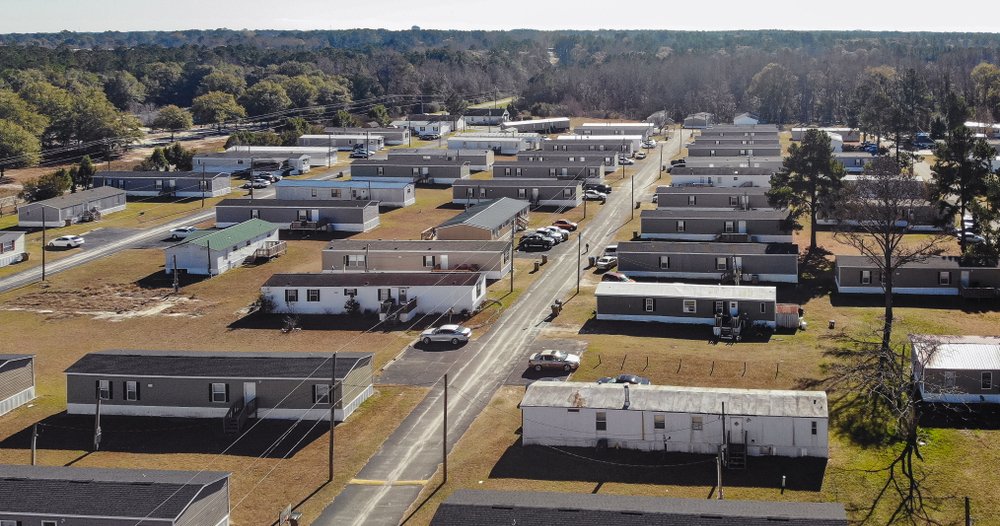
Housing in the United States is less now than at any point in the last 40 years, with the number of rent burdened households increasing to 40.6 million. In the midst of this crisis, mobile homes, which house an estimated , offer a key source of housing affordability.
Two growing trends are threatening to exacerbate the vulnerability of mobile home residents: climate change is rapidly altering the world around us, uniquely impacting mobile home residents. These homes are more vulnerable to environmental impacts, resulting in of mobile home residents. And, a of corporate buy-ups of mobile home parks threatens to further reduce the climate resilience of mobile homes, while also making them less affordable.
Some suggest that since 2015, corporate investors have bought one-third of all the country鈥檚 mobile home parks. Research shows that when corporations buy homes, they tend to take , increase home prices and rents, , , and . All of these have the potential to reduce the climate resilience of mobile homes, while also making them more expensive.
Taken together, the affordability, climate, and corporate ownership crises threaten to leave mobile home owners, some of the most vulnerable Americans, even more at risk to experiencing poverty, climate catastrophes, and displacement.
Mobile homes, also called manufactured or 鈥減refabricated鈥� homes, are homes built off-site and delivered to a lot. Mobile homes are a key source of affordable housing in America with units across the nation. The average cost of a mobile home is . By comparison, the average price of a single family home in America is .
Mobile homes鈥� relative affordability, however, comes with unique challenges. Traditional mortgage loans are often unavailable for mobile homes because they are not considered 鈥渞eal property.鈥� As a result, over 65 percent of manufactured homes are purchased through , which have significantly higher interest rates than traditional mortgage loans. Additionally, while 60 percent of people living in mobile homes own the home outright, they often do not own the land underneath, and instead rent it from a park owner. This tenuous ownership structure makes mobile home residents vulnerable to displacement when the land on which mobile homes sits is purchased by someone else.
Finding available land to park a mobile home on is also tricky. Partially due to the stigma surrounding mobile homes and mobile home parks, many of the country manufactured housing or allow only single-family zoning. These forms of exclusionary zoning continue to promote economic segregation and contribute to the affordability crisis.
While a significant part of affordable housing stock in the U.S. is made up of mobile homes, these homes are uniquely vulnerable to climate change.
Geographically, mobile homes are concentrated in parts of the country with the highest risk from extreme heat, tornadoes, hurricanes, wildfires, and floods, including rural areas and in the . Even intra-regionally, mobile homes tend to be located in areas more vulnerable to .
Economically, households living in mobile homes make approximately compared to households in other types of housing. This means mobile home owners may not be able to afford basic needs like air conditioning, let alone upgrades that make their homes more climate resilient. Mobile home residents are more socially and economically vulnerable when climate change threatens their homes, as they are more likely to be .
Legally, because mobile homeowners living in mobile home parks do not own the land they live on, they are unable to access federal funds for rebuilding or repairing damaged homes. This includes for mobile homeowners after a disaster, which are often or . Sometimes, rebuilding is not even allowed, for example when a mobile home is within a or when new zoning regulations come into effect after a mobile home鈥檚 destruction.
The tenuous ownership structure often means that mobile homeowners . And when funds are available, they are often inequitably distributed, because mobile homeowners might be offered the of the home rather than the pre-disaster appraisal. In other instances, FEMA might claim a mobile home is repairable when a state might condemn it as completely destroyed, leaving a mobile home resident with a .
Lastly, mobile homes face significant physical vulnerabilities due to their construction. Mobile homes lack a basement, and thus a shelter for tornadoes. Research shows that mobile home residents in the Southeast are more susceptible to damage and death from . Older mobile homes built before 1994 are much more physically vulnerable to massive storms, like and tornadoes, because of their weaker wind standards. Mobile home residents are also uniquely at risk of heat-related deaths. Arizona State University鈥檚 Knowledge Exchange for Resilience program found that mobile home residents accounted for between 2006 and 2019 in the Phoenix Metro Area, despite the fact that mobile homes only accounted for 5 percent of the population.
These intersecting risks leave mobile home residents less able to make their homes resilient to climate impacts, and to recover after climate events.
Some say that corporations have bought one-third of mobile home parks since 2015. This trend is not unique to mobile home parks: corporate buy-ups of real estate have across the housing sector since the 2008 financial crisis. However, the ownership structure of many mobile home residents may make these residents particularly vulnerable to corporate buy-ups.
According to the , around 40 percent of those living in mobile home parks do not own the land they occupy. This split tenure arrangement means that mobile home owners are just as vulnerable as renters to having mobile home parks sold out from under them, whether to a private equity company like and real estate investment trusts (REITs) or a smaller corporate landlord.聽 Because it costs on average to move a mobile home, owners often have little choice but to stay, even when faced with higher rents, worse maintenance and higher restrictions often imposed by corporate landlords.
Mobile home residents are economically and socially vulnerable, and often less able to adapt to a changing climate. Are corporate buy-ups of mobile home parks increasing this vulnerability?
While there has been little research to date on this topic, it is plausible to hypothesize that when corporate landlords increase rents, reduce maintenance standards, and impose restrictions on climate resilience measures like the planting of or the use of external , they decrease mobile home owners鈥� ability to respond to climate shocks. More research is needed to investigate this linkage.
Regardless of whether corporate buy-ups are decreasing mobile home owners鈥� climate resilience, we know these residents are uniquely climate vulnerable to begin with, and that action is urgently needed to stabilize them in the face of extreme heat and increasingly frequent and severe disasters. Federal funding for climate adaptation must be inclusive of mobile homes. Under the , HUD funds the retrofitting of multi-family housing with more efficient and sustainable materials. A similar funding solution could be used for mobile homes.
We must policies that prevent low-income buyers placing mobile homes on their property, which could bring more affordable housing to our cities in more climate-resilient areas.
And, we must expand opportunities for mobile home residents to , for example by for the sale of parks and by promoting resident-owned community models like those promoted by .
As our country faces the dual crises of climate change and affordable housing, it is critical to ensure that mobile home residents are not left facing a choice between safety and affordability.
Intern, Future of Land and Housing
Senior Fellow and Director, Future of Land and Housing