Jason Delisle
Director, Federal Education Budget Project

When this July to a low 3.61 percent (4.25 percent after the six-month grace period for recent graduates) the consolidation loan market, once robust and competitive, will be a shadow if its former self. There are policy explanations, economic explanations, and of course, political explanations for the change in the consolidation market. And like many things in student loan policy, the story is filled with irony.
 Not Many Loans Left to Consolidate
A borrowers with variable rate Stafford loans (those originated before July 2006) will be able, as of July 1st, to lock in the new low rate for the lives of their loans by refinancing. However, demand for this option may be low, as few borrowers are likely to have any unconsolidated, variable rate Stafford loans left (consolidation is a one-time option). From 2002 to 2006, interest rates on these loans dropped so low that nearly all borrowers who were eligible at the time to consolidate their loans did so, locking in rates between 2.77 and 5.30 percent. For a brief time, even borrowers still enrolled in school could refinance their loans, though in-school consolidation was discontinued as part of . What鈥檚 more, new loans taken out since July 2006 all carry fixed interest rates, removing the main benefit of consolidation.
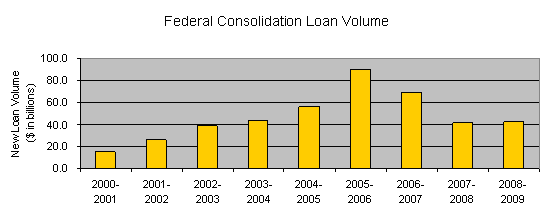
And Not Many Consolidators Left Either
But those few borrowers with eligible loans looking to refinance today aren鈥檛 likely to find their mail boxes stuffed with consolidation offers. Back , free market competition in the program was fierce and lenders offered all sorts of borrower benefits to win business, from reduced interest rates to reductions in the total loan balance. It was the kind of dynamic that one would expect the staunchest supporters of the Federal Family Education Loan (FFEL) program (many of whom are Republicans) to laud. After all, FFEL supporters’ favorite buzzwords are 鈥渇ree-market,鈥� 鈥減rivate-market,鈥� 鈥渂orrower benefits,鈥� and 鈥渃ompetition.鈥�
Instead, many of the staunchest supporters of FFEL — including the Republican leaders of the education committee in the House of Representatives and the Bush Administration () — pursued policies , by making the program less attractive for borrowers and loan consolidation companies alike. They argued that consolidators did not 鈥渋nvest in the FFEL program鈥� since these companies didn鈥檛 originate loans when borrowers entered school, only afterward. Consolidation critics also argued that the program was too costly, and poorly targeted, by providing generous federal subsidies to borrowers who did not necessarily need the help. Indeed, , but one couldn鈥檛 help get a whiff of pretense.
In reality, those who fought to squash the consolidation market to the big loan companies. To protect their loan portfolios, Sallie Mae, Citibank and others had to compete with consolidators and match the generous borrower benefits these companies were offering, which ate into their profits. The Sallie Maes of the world wanted the student loan consolidation market to go away. FFEL supporters in Congress wanted to and eliminate the borrower benefits resulting from it.
Subsidy Cut for Consolidators
While the fixed interest rates on new Stafford loans to refinance, and has largely aided consolidation opponents in curtailing competition for loans, recent subsidy cuts are a final blow.
reduced subsidies on consolidation loans and Stafford loans by the same amount. But an existing 鈥渞ebate鈥� on consolidation loan subsidies — which Congress put in place in 1993 — effectively reduces the consolidation subsidy by a further 1.05 percentage points compared to an unconsolidated loan. Lenders today complain that the credit crunch and subsidy cuts have made Stafford loans unprofitable. If so, then . [Information on how the loan subsidies work .]
Irony for FFEL Supporters
Borrowers should expect to find few, if any, lenders willing to consolidate loans given the state of the market. As our earlier post pointed out, borrowers can always refinance their loans into the Direct Lending even if they have FFEL loans. That鈥檚 likely to lead to an uptick in volume of .
Ah, the irony.
Supporters of FFEL who espouse the virtues of competition and borrower benefits have helped to squash both in the consolidation loan market. As a result, these same FFEL supporters, who loath the Direct Loan program, may have actually encouraged borrowers to refinance their FFEL loans into Direct Lending.
Maybe irony isn鈥檛 the word. Poetic justice, perhaps?
Director, Federal Education Budget Project