New Advocacy Group Pushes for Multilingualism in D.C. Schools
This Friday, Netflix鈥檚 smash hit series, House of Cards, kicks off its third season. It鈥檚 the sort of event that that sparks a special level of buzz within the Beltways鈥� borders. It鈥檚 a bit like being in New York City for Fashion Week: the show reflects something of D.C.鈥檚 self-image back upon residents in ways both flattering and discomfiting. It鈥檚 validating to see our world depicted dramatically鈥�House of Cards finds ways to make the denseness of D.C. political jockeying interesting and meaningful. But it鈥檚 also unsettling to recognize the grains of truth lurking in the show鈥檚 dark portrayal of how pettiness plagues the political process.
But there鈥檚 another D.C., one that rarely makes an appearance in shows centered on 鈥�.鈥� It鈥檚 home to 鈥溾�� music. To . To hundreds of thousands of American voters who pay taxes and are eligible for the draft鈥�. To the nation鈥檚 . And to a community whose racial, ethnic, religious, and linguistic diversity is truly global.
D.C.鈥檚 dynamism as a local community was on full display earlier this week at a panel event hosted by the . The discussion, titled 鈥�,鈥� was the second in a series of local events designed to build a groundswell of support for multilingualism in D.C.鈥檚 public schools. National leaders, like Director of the U.S. Department of Education鈥檚 Office of English Language Acquisition (OELA) Libia Gil, joined state leaders, like Lynn Fulton-Archer, one of the specialists coordinating Delaware鈥檚 statewide World Language Immersion program, to discuss promising policies for making American education more linguistically diverse.
For example, Gil opened the evening explaining how uses its $42 million grants budget to 鈥渇ocus on top-quality research鈥� and improve professional pathways that聽diversify the linguistic backgrounds of American teachers. Like many other panelists, she explained that dual-immersion聽programs are uniquely powerful because they generally bring native English speakers together with students who speak another language at home in order to build on each group鈥檚 linguistic assets.
In addition, voices from the business community, like Marriott鈥檚 Sonia Zamborsky and Joint National Committee for Languages and National Council for Languages and International Studies Executive Director Bill Rivers, explored various ways of gauging the value of multilingualism in the United States. Rivers cited recent data showing that 11 percent of American companies are actively looking for multilingual job candidates. DC鈥檚 unique position in the global economy could make multilingualism even more important in the local job market.
Panelist after panelist echoed this point in a variety of ways. Specifically, they noted that domestic and global workforce demands are changing rapidly鈥攎ost jobs being created now in the United States depend in some way on foreign trade. Zamborsky was blunt: 鈥淟anguage skills are typically seen as nice, fluffy, pat-you-on-the-head, aren鈥檛 you a good global citizen…but they also make you a better employee.鈥�
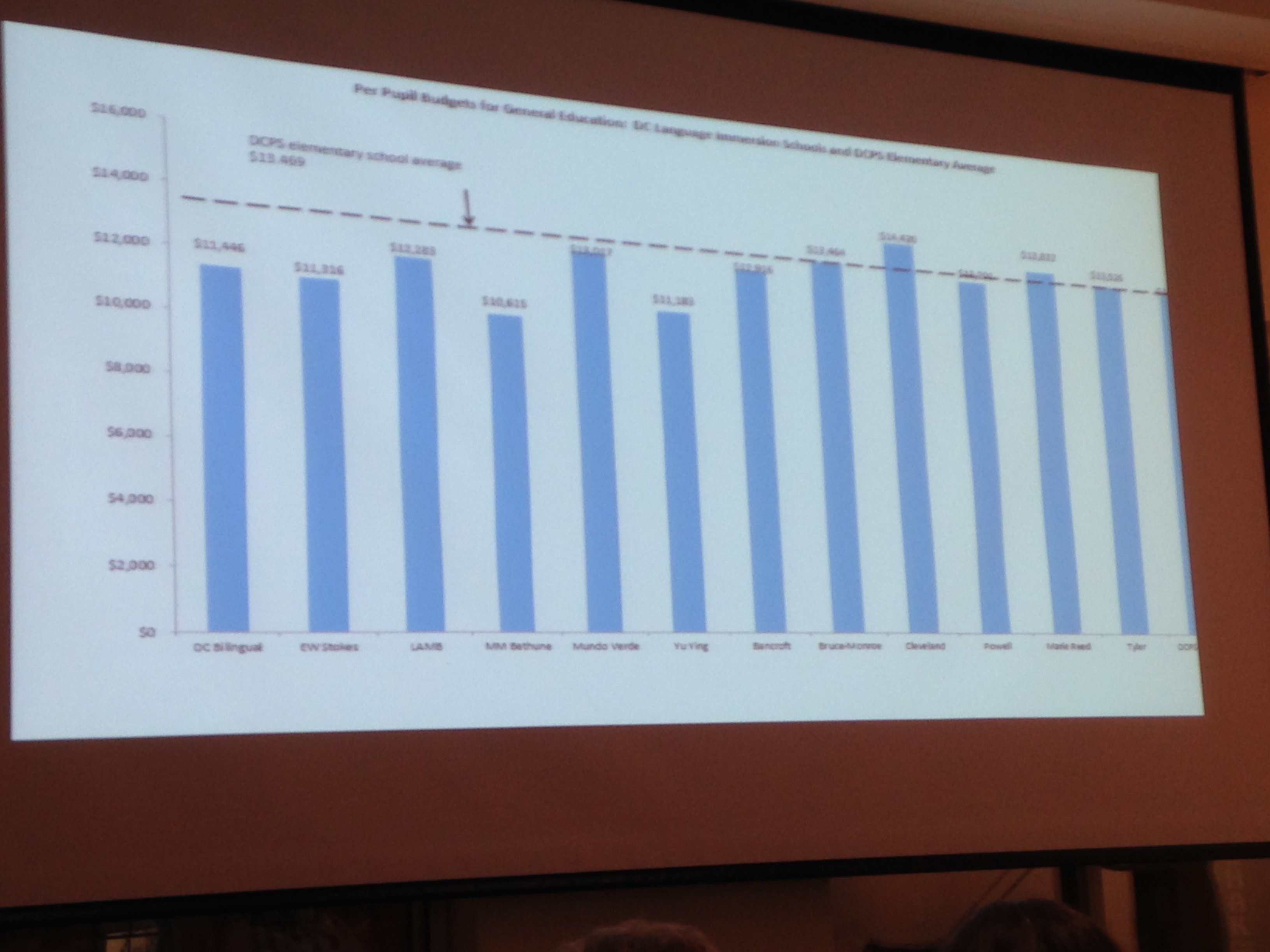
After the event, DC Language Immersion Project co-founder Vanessa Bertelli explained that the group formed in response to when it comes to D.C.鈥檚 existing public dual-immersion聽programs. 鈥淭hese programs are currently concentrated in Northwest D.C.,鈥� she said, 鈥淎nd therefore are not a viable option for people East of the [Anacostia] River.鈥� That is, most of these programs are currently flourishing in places that are most easily accessible to D.C.鈥檚 wealthier families, which means that folks from D.C.鈥檚 poorest neighborhoods can only attend if they 鈥渉ave the resources or the time to travel across the District four times a day.鈥�
Before starting the group, Bertelli had been part of earlier efforts to convince her neighborhood school鈥檚 leaders to include Spanish immersion as part of their public pre-K program. They 鈥渟urveyed current and prospective parents, came up with implementation plans, engaged with all levels of school administration, and testified at public hearings, but it was not sufficient鈥We] realized that unless there is a strategic, systemic plan for expanding immersion across the District, D.C. is not going to be able to seize this opportunity.鈥� Specifically, she says, D.C. stakeholders should think of 鈥渋mmersion as one of the elements in a comprehensive, long-term plan to positioning themselves economically as global competitors.鈥�
Of course, vision-setting is just the first step. . As Rivers put it on Tuesday night, 鈥淚 don鈥檛 want [immersion] to sound like a magic bullet, because it鈥檚 not; it鈥檚 very hard to do.鈥� In her presentation, Delaware鈥檚 Fulton-Archer noted that the state鈥檚 new World Language program involved thoughtful collaboration between governmental agencies, non-governmental stakeholders, philanthropic efforts, and more. (For more on the challenges of taking program design all the way through to implementation, from Veronica Alvarez鈥檚 presentation at 国产视频鈥檚 Dual Language Learners National Work Group.) She also highlighted a human capital problem : at present, the pipeline for training high-quality dual-immersion instructors is simply inadequate to demand.
So: what are the DC Language Immersion Project鈥檚 prospects? Well, even though D.C.鈥檚 local government has as a punchline provider for comedians and cynics alike, the District鈥檚 education leadership has proven more effective in recent years. There鈥檚 plenty of reason to be optimistic that those leaders are ready to heed calls for more multilingualism in D.C. schools. Because as House of Cards makes clear, dysfunction here has more to do with than Washington itself.
(Update: to watch the DC Language Immersion Project panel discussion!)
**Disclosure: my son is enrolled in Washington, D.C.鈥檚 public pre-K program (and my daughter will be soon). They are dual language learners ().
—
Note: This post is part of 国产视频鈥檚 Dual Language Learner National Work Group.
“
More 国产视频 the Authors
Issues
Programs/Projects/Initiatives
Related

In 2026, States and Congress Will Need to Mitigate the Damage to PreK-12 Education

Identifying English Learners in Pre-K: State Policies, Rationale, and Practices

What to Know 国产视频 Education Funding in Biden鈥檚 Budget