
A Dictator Tries to Convince the World He’s a Democrat
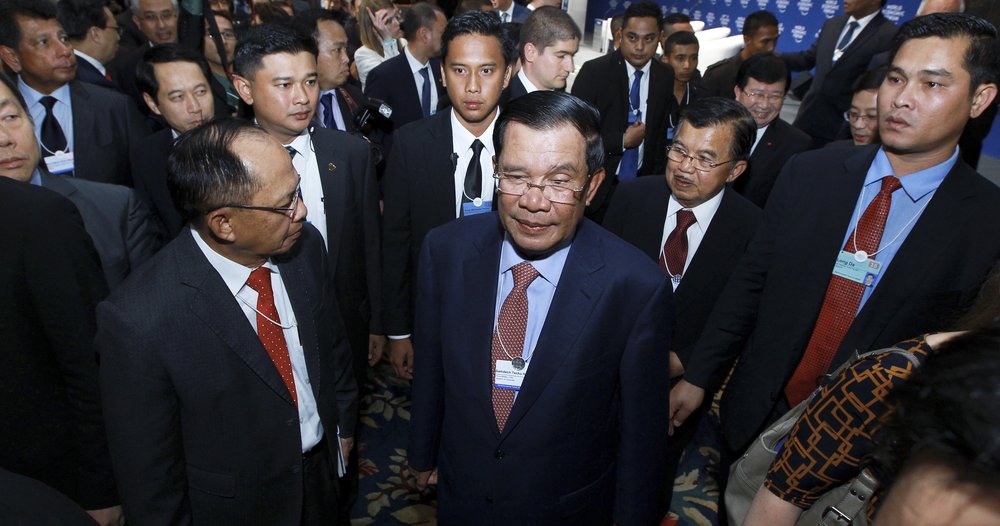
Cambodia鈥檚 ruling party following the July 29 national election. Headed by Prime Minister Hun Sen, who has ruled the country for more than three decades, the Cambodian People鈥檚 Party (CPP) announced that it will now hold all 125 seats in the country鈥檚 National Assembly.
That the CPP would win handily was a foregone conclusion. The ruling party鈥檚 only real competition, the Cambodia National Rescue Party (CNRP), had been last November, while its leader, Kem Sokha, was on flimsily concocted 鈥渢reason鈥� charges. To top that off, in the months leading up to the vote, the government executed an on independent media and civil society groups, severely restricting the space for free expression and competition.
Yet despite the absurdity of the election conditions and results鈥攚hich speak to the country鈥檚 firm 鈥攖he government has labored to promote the idea that democracy is alive and well in Cambodia. To do so, officials have leaned heavily on two factors in the recent polls: high voter turnout, and the presence of election observers. By relying on these metrics, the Cambodian government has revealed its own need for democratic legitimacy鈥攁 need that, in some ways, offers a glimmer of hope. Even so, on both fronts, the purported credentials are nothing more than a mirage.
Cambodia鈥檚 National Election Committee (NEC) reported that voter turnout stood at 82.2 percent on election day, considerably higher than the 68 percent of voters who showed up to the polls in the previous parliamentary elections in 2013. A by the dissolved opposition to encourage people to abstain from voting appeared鈥攐n the surface鈥攖o have failed to garner significant public support.
But given the NEC鈥檚 lack of independence, there are legitimate questions to be asked about the validity of the reported figures. Furthermore, the turnout numbers鈥攅ven if they are to be believed鈥攔eflect the results of intimidation and public fear, rather than voter enthusiasm or consent. Worried that low turnout could undermine the election鈥檚 legitimacy, CPP officials in the lead-up to the vote publicly labeled those planning not to cast ballots as 鈥溾�� and to withhold public services from non-voters. Even in the midst of this drastic coercion effort, the number of spoiled ballots鈥攅ffectively protest votes鈥� from 2013, pointing to considerable public resentment.
The NEC was also the nearly 80,000 domestic and hundreds of international election observers present for voting day, which reportedly in registered monitors compared with 2013. The NEC鈥檚 Chairman that the presence of international observers, in particular, 鈥渟hows that the election is open, participation is comprehensive and that there is a lot of trust in the election.鈥�
But Cambodia鈥檚 most respected, independent domestic election watchdogs observers, citing concerns about the , as did credible international observer groups like the Carter Center, which that, given the CNRP鈥檚 dissolution, it could not 鈥渃onsider deploying observers to an election process that is manifestly unfair.鈥� Likewise, foreign governments from Europe and Japan, which had sent election monitors to Cambodia in the past, opted not to do so this year.
In their place came governments like China鈥攁 key backer of the CPP regime鈥攚hich sent election observers to Cambodia for the first time. There were also monitors from groups like the International Conference of Asian Political Parties and Centrist Asia Pacific Democrats International鈥攂oth of which have direct ties to the CPP. In the past, these so-called 鈥溾�� have issued glowing reports of deeply problematic elections around the world, and this time was no different. A hodgepodge of right-wing politicians from European countries also to praise the vote. Among them was a politician from Moldova who openly said that he did not 鈥渂elieve in free elections.鈥� While much of the world decried the in Cambodia, these faux observers hailed the 2018 election as democracy鈥檚 鈥�.鈥�
Despite its dubious bona fides, the CPP had held up these 鈥渙bservers鈥� and their positive reports as evidence that the election was free and fair, even inflating their credentials in certain instances to bolster that case. For instance, the CPP touted the collection of right-wing European politicians as 鈥淓uropean Union observers鈥濃�攑resumably to the dismay of the actual EU, which declined to monitor and . In addition, several who also traveled to Cambodia to observe鈥攁pparently unaware of the larger context behind the government鈥檚 invitation鈥攚ere by the Cambodian authorities. And at least one government-aligned news outlet even described foreign journalists reporting on the election as 鈥溾�濃�攕eemingly an effort to juice the stats on foreign monitors.
With this troublesome election behind it, the CPP is again in firm control of Cambodia and empowered to continue on its path of increasingly repressive dictatorship, absent the limited space for opposition and free expression that existed previously. It鈥檚 also clear, however, that the Cambodian government is not yet ready to fully embrace a rhetorical defense of one-party rule. Hun Sen still needs to pay lip service to democracy, pointing to a surprising resilience of democratic norms鈥攅ven amid setbacks globally鈥攁nd, perhaps, a weakness in the CPP鈥檚 otherwise formidable position.
Much has been made of Cambodia鈥檚 , a regional power that has emerged as a key foreign investor in the country and . A fatalistic narrative has developed in some Western policy circles, underscored by a belief that actions by the international community鈥攑articularly democratic nations鈥攚ould have on Cambodian government decisions in the face of Chinese largesse.
But despite this clear shift, the Cambodian government鈥檚 obsession with bolstering the legitimacy of the 2018 election demonstrates that it may actually be more sensitive to the wider international community鈥檚 perceptions. At the same time, the Cambodian public has come to expect democratic processes, the emergence of which coincided with the end of the country鈥檚 brutal civil war, and the government recognizes that it will require more than repression to keep those expectations at bay.
Hun Sen wants it both ways: He wants to claim a democratic mantle but doesn鈥檛 want to deal with the pesky competition that comes with a genuine election. He is hoping that inflated turnout numbers and thumbs up from fake observers will be sufficient substitutes for genuine democratic processes. The question now is if a skeptical domestic public and international community will buy his game.
More 国产视频 the Authors
Related

Disability in the United States at 250

From 鈥楻isky Business鈥� to 鈥楳ission: Possible鈥�: Why ECE Learning Cohorts Work

State Education Budgets in Turbulent Times
