
Down With the ‘Spanish Flu’
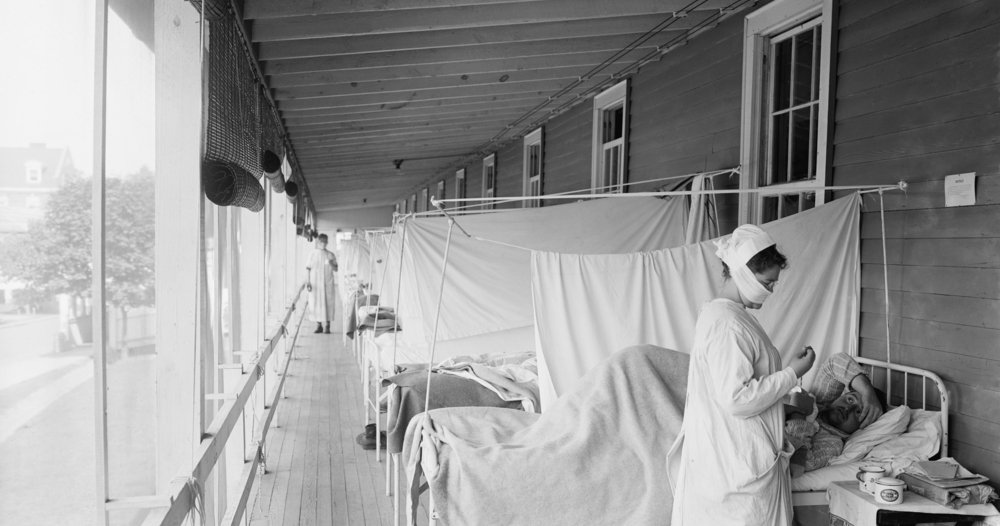
In 1918, an influenza pandemic swept the world, causing more deaths in a year than any event in human history鈥攁 rather broadly estimated 50 million to 100 million, or 3 to 6 percent of the world鈥檚 population. The flu, which killed around 20 percent of those who contracted it, became known as the 鈥淪panish flu鈥� or the 鈥淪panish Lady.鈥� The name spread, well, like influenza and has persisted to this day.
But just as Chinese checkers wasn鈥檛 invented in China, Australian shepherds aren鈥檛 from Australia, and freedom fries aren鈥檛 French, the Spanish flu did not originate in Spain nor did Spain bear the brunt of it. In fact, of the millions of influenza deaths, less than 260,000 took place in Spain.
The misnomer, according to an episode of the podcast , came about as a result of geopolitical forces. When the pandemic broke out during World War I, neither side wanted the other to find out they were sick鈥攏or did they want their own troops to lose morale or their publics to panic. News of the outbreak was suppressed or heavily underplayed in Germany, France, the U.K., and the U.S. But Spain, like Switzerland, was neutral in the war, and its media had no qualms about covering the contagious outbreak weakening its population, creating the false impression that this was a Spanish disease. As virologist John Oxford put it: 鈥淎nd the rest of the world I think looked around and said, 鈥榃hat鈥檚 going on in Spain?鈥� And so since that time, much to the annoyance of the Spanish and much to the annoyance of Spanish virologists, I can tell you, we鈥檝e all called the Spanish flu ever since.鈥�
An in a 2008 issue of the journal Clinical Infectious Diseases tracks the extensive flu coverage in the uncensored Spanish media. It first appeared in a headline in Madrid鈥檚 ABC newspaper in May 1918 and was blamed on Madrid鈥檚 annual holidays, which saw people gathered in close contact in ballrooms and parties. Soon King Alfonso XIII became ill, as well as the prime minister, and la epidemia reinante (鈥渢he prevailing epidemic鈥�) became daily news fodder. Though the flu was striking people ill in a dramatic fashion, mortality was initially low, and the flu became known as the Soldado de N谩poles, named for a catchy Spanish song popular at the time. It soon became clear, however, that this flu was no laughing matter.
Though Spain鈥檚 relatively free press and great interest in the flu led to its association with the flu, the country was far from the hardest or the first hit. Spain鈥檚 mortality rate () trailed both Italy鈥檚 and Portugal鈥檚 among the European countries included in a 2009 paper published in . In fact, though cases were reported in May, Spain鈥檚 official 鈥減andemic period鈥� didn鈥檛 even begin until , while Finland鈥檚 began in January, and Germany鈥檚, Bulgaria鈥檚, and Portugal鈥檚 in March. To this day, it鈥檚 still not agreed where exactly the 1918 H1N1 virus originated. Previous research has suggested as potential sources, but according to the aforementioned of European mortality burdens, it likely wasn鈥檛 Europe: The authors conclude that 鈥渢he synchrony of the mortality waves in the different countries 鈥� pleads against a European origin of the pandemic, as was sometimes hypothesized.鈥� These days, the flu is to have reached Spain via France.
The fairer name in the blame game would probably be the 鈥淲orld War Flu鈥濃�攐r the 鈥淧oliticians鈥� Flu.鈥� As Oxford points out on BackStory, politicians hold much of the blame for the flu鈥檚 millions of deaths鈥攊t wouldn鈥檛 have been so deadly had it not been for the war and the large number of troops concentrated in Europe. 鈥淚 myself put it at the feet of politicians,鈥� he said. 鈥淚f it had not been for that war, the pandemic would not have arisen.鈥� When the war came to an end and troops began returning to their various corners of the globe, the flu came with them, spreading exceptionally rapidly for 1918. While it鈥檚 still unclear where exactly it originated, the war was clearly to blame for its range. Furthermore, wartime censorship meant it took communities by surprise, while wartime conditions of lowered nutrition and sanitation likely inflated the death rate.
Europe was hit hard and early, but truly, the whole world suffered. The U.S. actually fared better than most: According to the report, estimates of the American death toll range between 400,000 and 675,000鈥攁s little as 0.47 percent of the population (as compared with Europe鈥檚 1.1 percent). Other countries were not so lucky. The flu killed somewhere between 鈥攂etween 8 and 21 percent of the total population of Iran. According to , the pandemic killed up to 17 million people in India; 1.5 million in Indonesia; 400,000 in France; 390,000 in Japan; 250,000 in Britain; and 100,000 in Ghana. One of the hardest hit areas was about as far away from the war as one could get: Pacific Islanders had among the highest mortality rates, with Tonga, Tahiti, Nauru, and Western Samoa losing large swaths of their populations in a space of months (Western Samoa lost of its population in less than two months). This, along with the tragically high death rate among Maori and Native American populations, is suggested to be in part due to lower rates of previous exposure: their 鈥溾�� immune systems.
What does all this mean for the next global pandemic, which many scientists鈥攊ncluding members of this upcoming Future Tense panel鈥攃onclude is inevitable? The world is far more connected than it used to be, both physically and technologically, but will globalism hurt or help us? 鈥淚n some ways, we鈥檙e in good shape, and in some ways, we鈥檙e in really bad shape,鈥� said Rebecca Katz, a Georgetown global health professor and a pandemic consultant to the Department of State. She points out that over the summer, we had one of the busiest travel days in history, with more than . 鈥淲e move around the world pretty fast, which means that anything that emerges from one part of the world can be anywhere else within 24 to 36 hours.鈥� Katz adds that our highly urban and aging society, as well as increased population and food trade, also add up to make today鈥檚 world particularly vulnerable to a deadly respiratory virus. But it鈥檚 not all bad. 鈥淥n the plus side, our medical care is much more advanced, our ability to produce medical countermeasures is much more advanced, our ability to treat the secondary bacterial infections is much more advanced,鈥� she added.
There really isn鈥檛, however, any way to contain the spread of something like the Spanish flu in today鈥檚 world. (In a for Future Tense, Bina Venkataraman explores the history, inefficacy, and stigmatization of forced quarantines.) When the next deadly flu strikes, very few places on Earth will be immune鈥攚hen I ask Katz where would be the safest place if a global pandemic were to break out tomorrow, she suggests the moon. Hopefully, unless World War III breaks out, such a flu won鈥檛 be known by whichever country鈥檚 press was free enough to cover it first. Wherever it starts, and whatever it is known by, one thing鈥檚 for sure: The 1918 pandemic will always be known as the Spanish flu. Sorry, Spain.
This article in , a collaboration among , 国产视频, and .
More 国产视频 the Authors
Related

Disability in the United States at 250

From 鈥楻isky Business鈥� to 鈥楳ission: Possible鈥�: Why ECE Learning Cohorts Work

State Education Budgets in Turbulent Times
