Vicki Shabo
Senior Fellow for Gender Equity, Paid Leave & Care Policy and Strategy, Better Life Lab
Wage Replacement, Duration, and Funding in U.S. State Paid Family and Medical Leave Programs

This document has been updated multiple times since its original June 2021 publication to reflect newly passed or modified state paid leave programs, new data on state programs, and benefit and contribution information. It will continue to be updated periodically as new information is available.
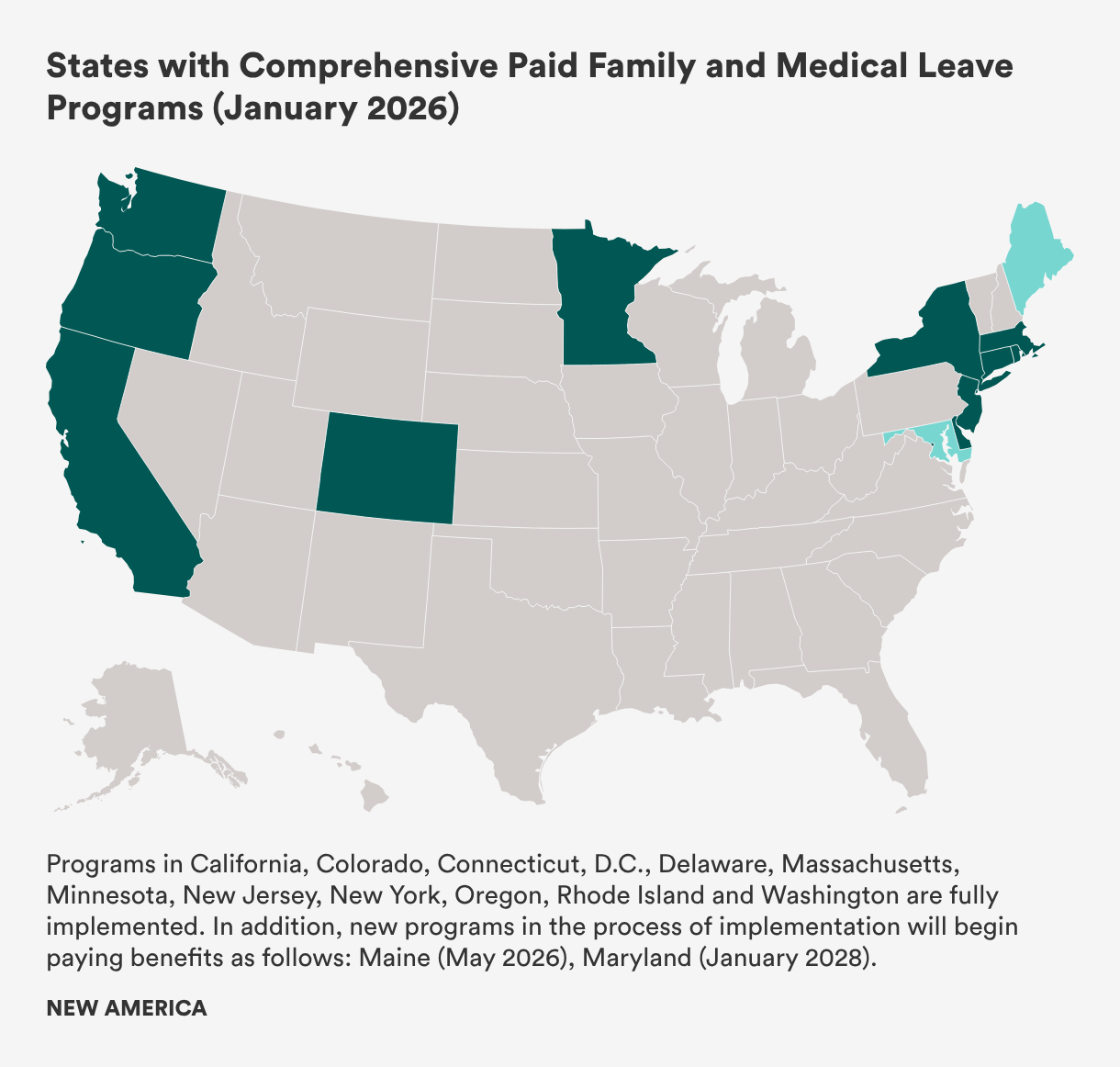
As of May 2026, 14 states plus the District of Columbia (DC) have or will soon have statewide paid family and medical leave programs in place.
, , , , , , , , , , , , and currently make paid leave benefits available to workers.
will begin paying benefits in January 2028, after several implementation delays.1 鈥檚 newly enacted program, passed in April 2026, will also begin paying benefits in December 2028.2
Without a federal paid family and medical leave program鈥攍ike the U.S. House of Representatives and in 2021 as part of the Build Back Better Act but the Senate failed to take up鈥攕tates are laboratories for innovation.
This explainer is a companion to Paid and Unpaid Leave Programs in the United States. It addresses policymakers鈥� questions about paid family and medical leave program design, benefits, and funding methods. It shows that the value delivered by comprehensive paid leave programs comes at an affordable cost.
This explainer also touches on a voluntary paid leave program models, both those in and , and another alternative鈥攖he authorization of private paid leave insurance coverage for employers to purchase in Alabama, Arkansas, Florida, Kentucky, South Carolina, Tennessee, and Texas. Virginia also authorized the sale of private insurance in 2022, prior to passing a comprehensive statewide policy in 2026. However, these voluntary employer options are not comprehensive programs, do not guarantee access to private-sector workers, and neither the nor the authorization approach to paid leave.
Paid leave prevents workers and their families from falling down a financial rabbit hole when breadwinners need time away from their jobs to care for a loved one or address their own serious health issue. This is a critically important matter of equity and security because just 27 percent of workers have paid family leave through their jobs absent a state policy, and low-wage workers are 10 times less likely to have access to paid family leave than the highest-paid workers,聽according to the most recent BLS data available from 2023.
In 2018, Brandeis University researchers estimated that a typical worker would forgo in lost wages to take 12 weeks of family or medical leave without pay. While on leave, workers still need to afford basic expenses to keep their families afloat, which is all the more difficult as prices have risen and has become more challenging. Paid leave can provide the security to meet these basic financial obligations.
Urban Institute released in 2024 estimates that a comprehensive paid family and medical leave program modeled on the proposed federal FAMILY Act would reduce poverty among leave-takers by 16 percent, especially for Black and Latine families. Access to FAMILY Act benefits would also increase net income for nearly 90 percent of families, with the largest increases benefiting families with low incomes.
The country鈥檚 first two paid family leave programs, in California and New Jersey, began by replacing a fixed percentage of a worker鈥檚 typical wages when the worker needed to take paid family or medical leave (55 percent and 67 percent, respectively). These two states have subsequently raised their wage replacement rates and one鈥擟alifornia鈥攁bandoned a fixed percentage of wages for a sliding-scale approach.
The next two programs to pass鈥擱hode Island and New York鈥攁lso take a fixed percentage approach but have not updated their wage replacement rates of 60 percent and 67 percent, respectively, though is slated to increase wage replacement to 70 percent in 2027 and to 75 percent in 2028.
Delaware, which passed in 2022 and began paying benefits on January 1, 2026, follows this older model of applying a uniform wage replacement rate but follows best practices by researchers to set wage replacement at 80 percent of a worker鈥檚 average weekly wage鈥攁llowing lower-wage workers to use needed paid leave without falling into poverty and enabling middle-wage workers to continue to meet their basic household expenses.
Virginia, which passed in April 2026 and will begin paying benefits in December 2028, also adopted a flat 80 percent wage replacement rate.
Programs in all newer states except Delaware and Virginia have adopted a sliding-scale approach to paid leave benefit payments and provide higher wage replacement to lower-wage workers. This helps to make leave more affordable and accessible to people often living paycheck to paycheck.
Maryland, when it begins paying benefits in January 2028, will also provide up to 90 percent of low-wage workers鈥� typical wages and a blended rate for others..
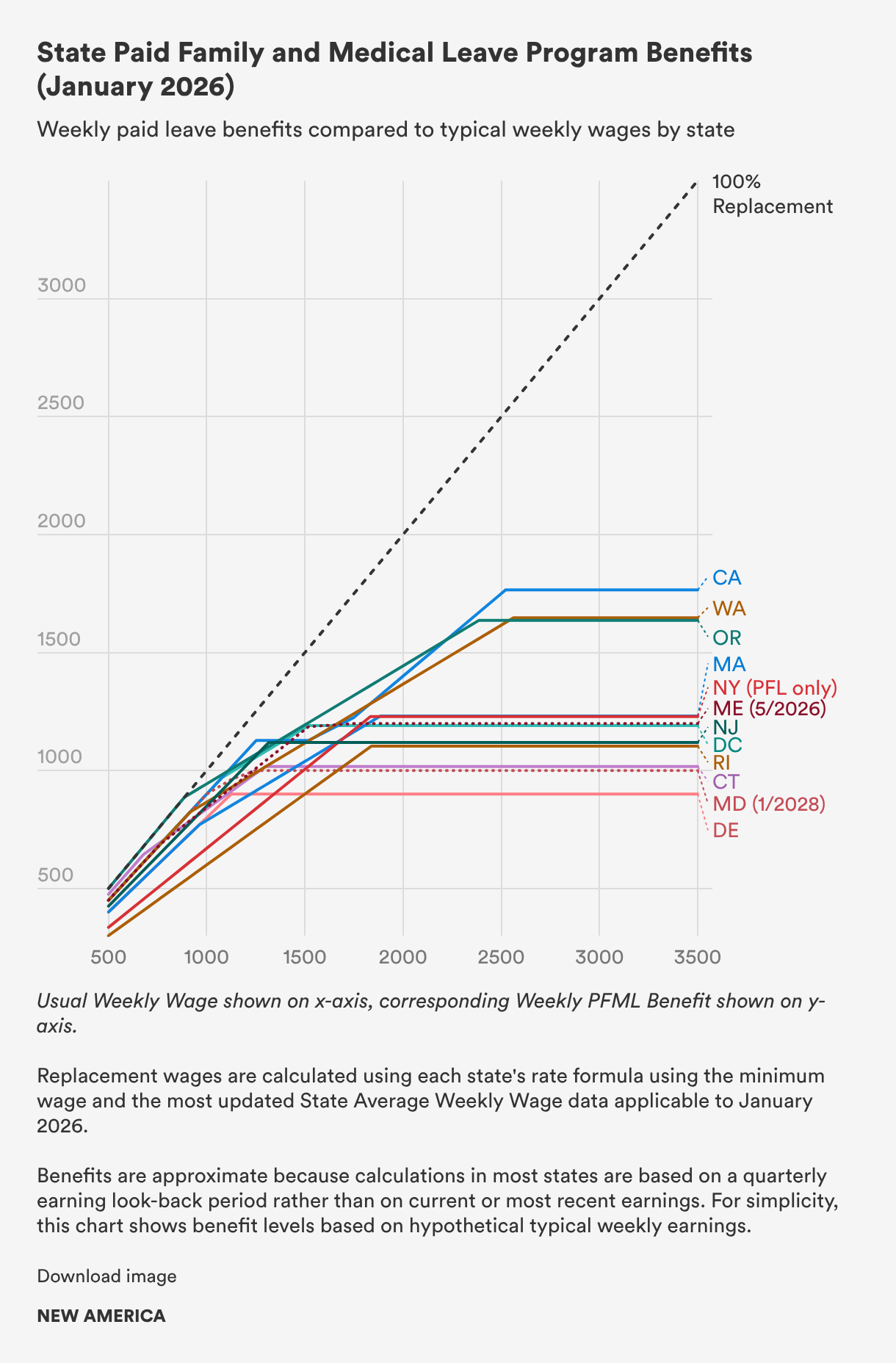
The figure below shows the approximate benefit that workers at different wage levels can expect to receive in each state鈥檚 current or forthcoming program. A shows approximate wage replacement for workers who are paid minimum wage, average weekly wages, or fractions or multiples of the state average weekly wage (SAWW) in each state. (The Appendix provides more information about wage replacement rates.)
To compare apples to apples, we calculate benefits using the 2026 minimum wage and the SAWW that the state is using to calculate paid leave, workers鈥� compensation, or unemployment benefits in 2026. Benefit amounts are also not exact since most states use a look-back period on recent wages rather than the exact wage a worker typically receives when they take leave.
Comprehensive state programs are funded through small, mandatory payroll deductions from employers, employees, or both. Tax rates are no more than 1.3 percent in any state in 2026, and most are 1 percent or less. In each state other than New York, the money is pooled into a statewide social insurance fund from which benefits are paid; in New York, private insurers and a state insurance fund, similar to a public option, exist side by side.3
Each state鈥檚 program covers, at a minimum, core reasons for leave: care for a new child, care for a family member with a serious health issue, and care for one鈥檚 own serious health issue. Some also cover military families鈥� need for leave related to deployment and safe leave for people dealing with domestic violence, stalking, and sexual assault.
The two tables below show the contribution levels for employees and employers and the taxable wage base on which premiums are calculated and provide context for what these contributions 鈥渂uy鈥� in terms of the paid family and medical leave available to workers, including each state鈥檚 duration of paid leave. (The Appendix provides more information about payroll tax rates, benefit caps, and duration.)
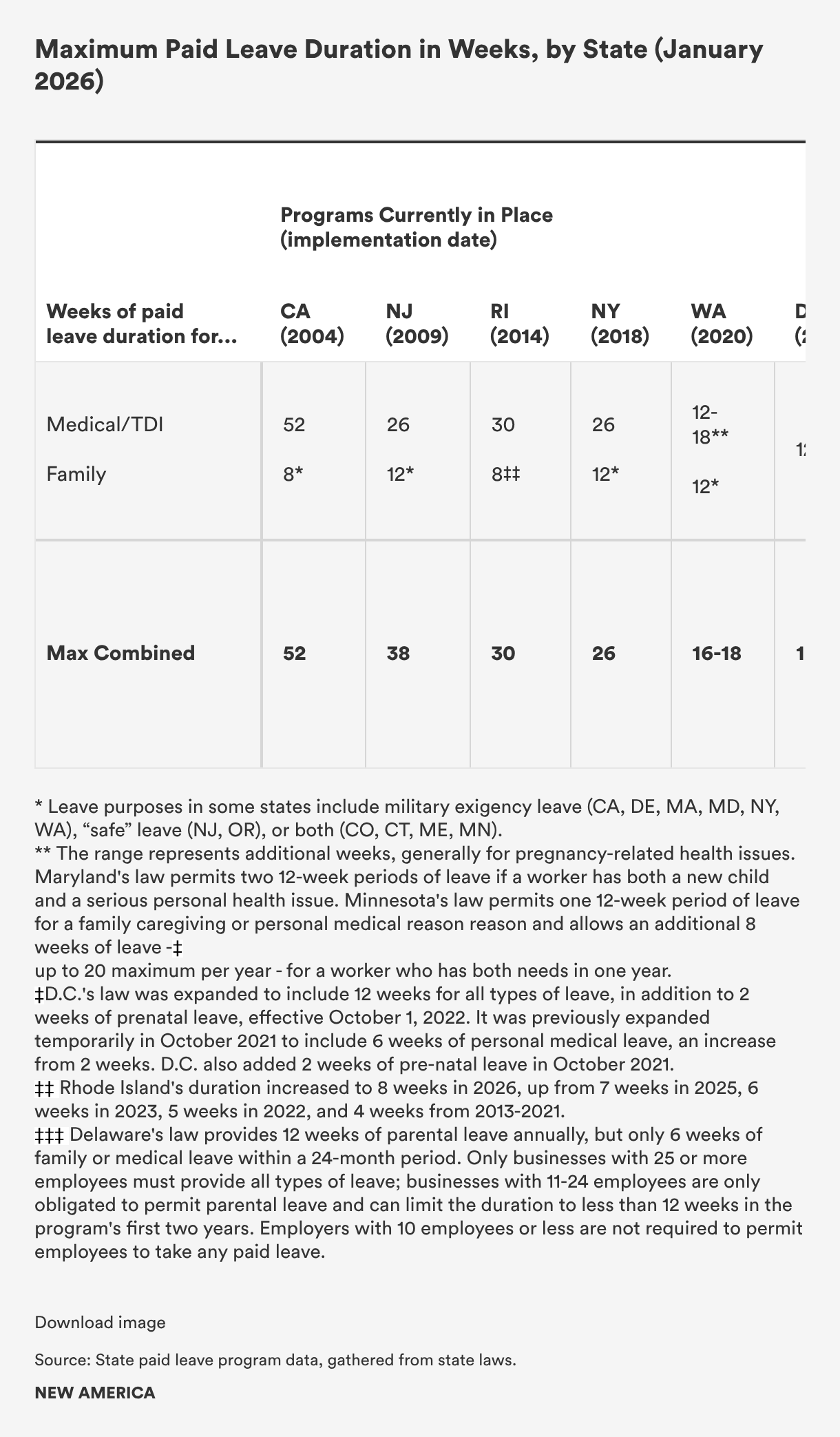
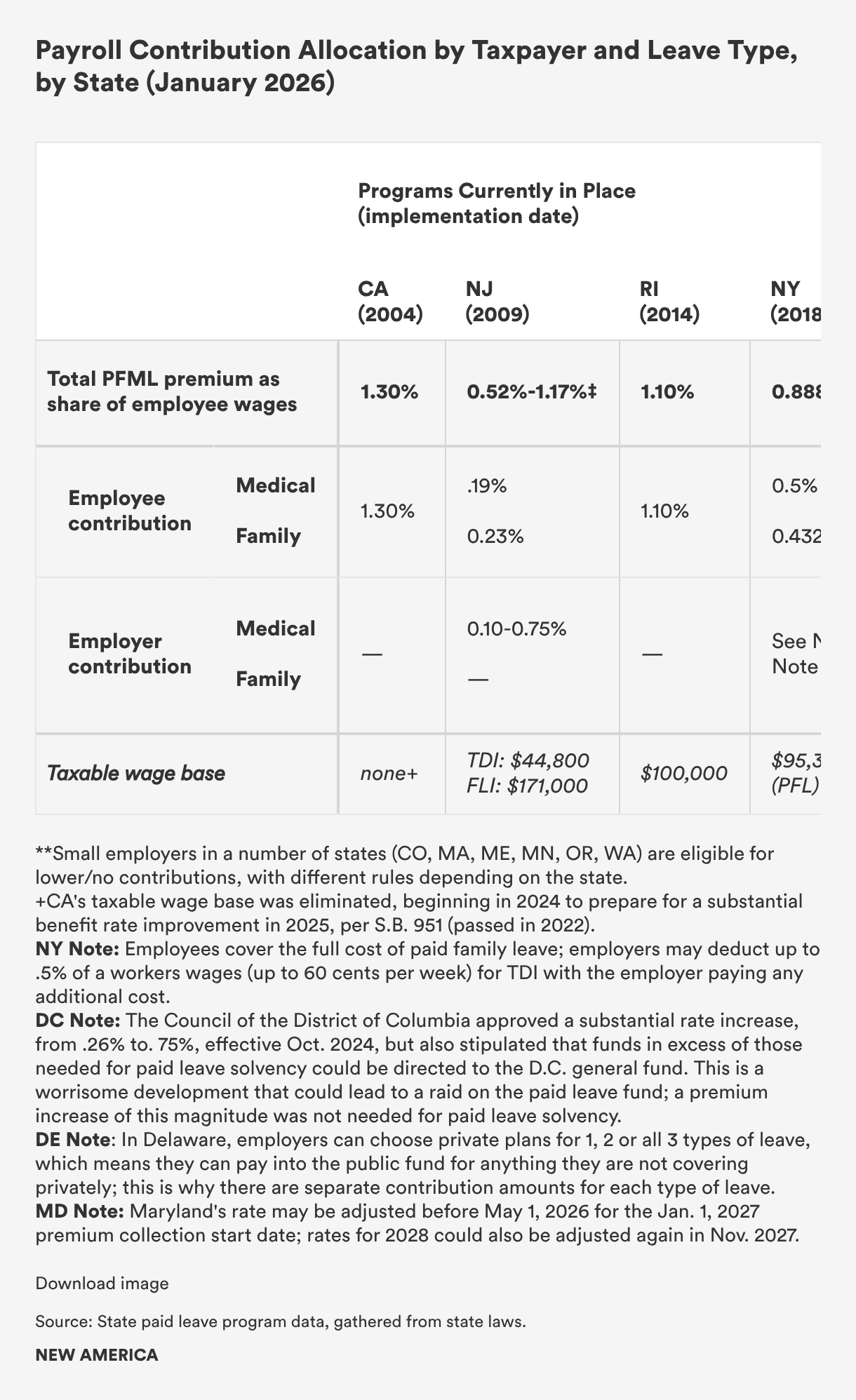
In brief, each state passed programs to provide paid leave and collect payroll contributions, and most administer benefits to eligible workers. States need to build up their funds before making wage replacement benefits available to workers, which means there is usually a lag between the passage of legislation, the collection of premiums, and the availability of benefits to workers.
The family caregiving portion of nearly all state paid leave programs allows workers to take paid leave to care for a range of family members鈥攑arents, spouses, children, and grandparents in all; and grandchildren, siblings, parents-in-law, and domestic partners in most鈥攁nd seven newer or newly expanded laws also include 鈥渃hosen鈥� family members.
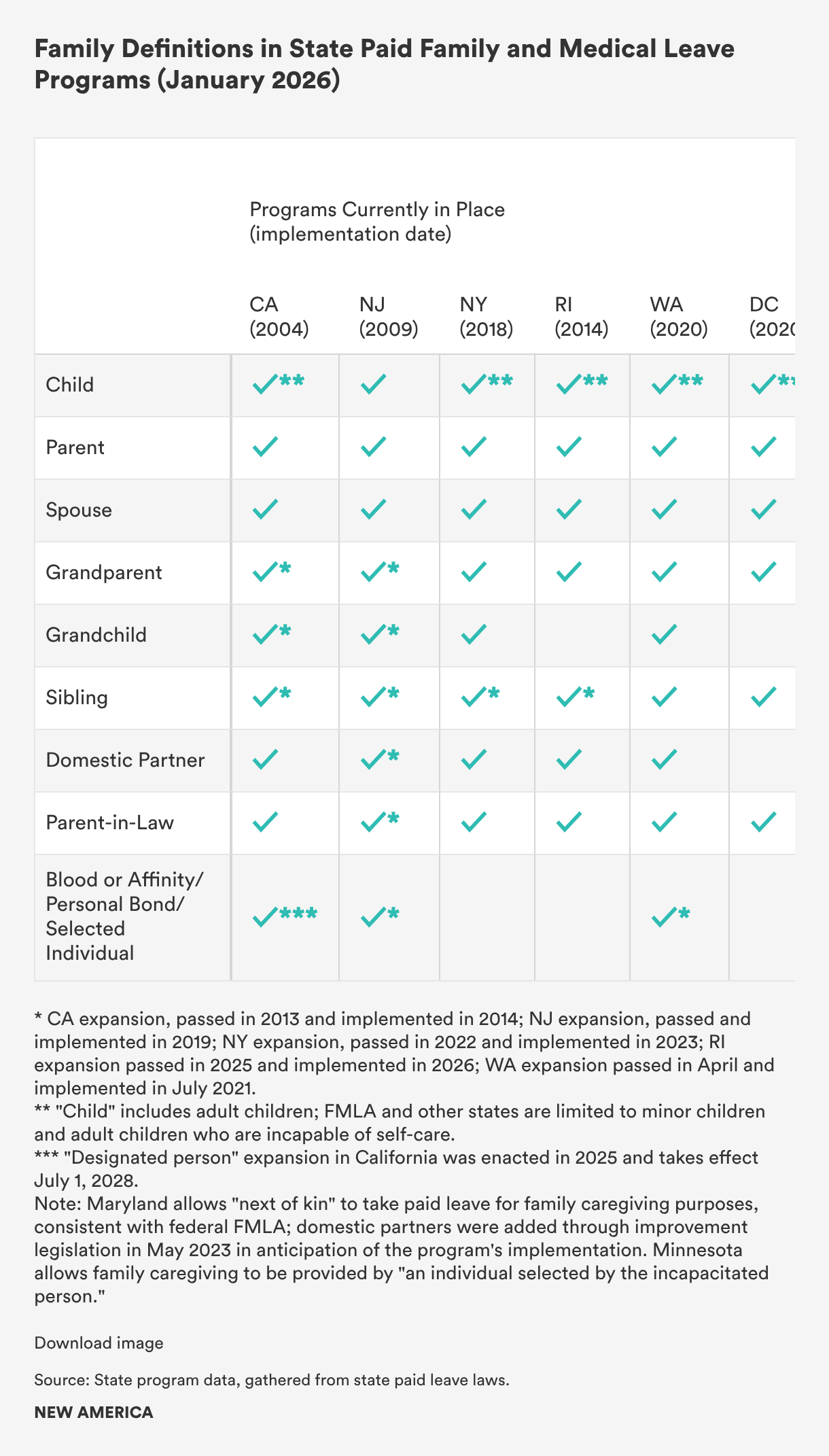
The funding for the programs is sufficient to cover all the caregiving purposes and relationships that the laws include. The inclusion of extended family members does not add appreciably to program costs, and broad family coverage is particularly to ensure that people of color (who disproportionately have extended family care responsibilities), LGBTQ+ people, and people with disabilities and their caregivers can realize the promise of paid leave programs.
Comprehensive, universal state paid leave models provide substantial financial security to working people at minimal individual cost, usually for an adequate number of weeks. Federal lawmakers can use these parameters in assessing paid leave policy options and designing a national program.
Two new approaches to paid family and medical leave policy were implemented in 2023 but have yet to show real impact.
In , the Governor created a program that covers public sector workers with six weeks of paid family leave at 60 percent of their typical wages鈥攖his is substantially less time and lower rate replacement than most programs in states with comprehensive, universal policies. Private employers can purchase paid family and medical leave insurance through this plan if they choose to do so, and workers whose employers do not offer paid family leave insurance can purchase insurance privately and have premium contributions deducted from their paychecks.
Only one insurer (MetLife) bid for a contract with New Hampshire to provide this insurance product, and the rates they estimate charging employers are higher in most cases than payroll contributions in states with paid family and medical leave programs.4 In 2025, just under 18,000 workers, or 2.5 percent of the New Hampshire workforce, were through this program. Of these, just over 9,361 were state employees who were automatically covered, while 7,633 were covered through an employer鈥檚 voluntary plan, and 919 opted into individual coverage.
has adopted a system like New Hampshire鈥檚, but administered by the Hartford insurance company. State workers were covered as of mid-2023, while private employers鈥� participation opened in July 2024 and individuals could begin buying coverage in July 2025. As of August 2025, just under 鈥攁 tiny fraction of the workforce鈥攚ere covered.
In in 2022, the state legislature granted the state insurance commission the authority to approve the sale of family leave insurance products in the state. As of December 2025, just two insurers were approved to offer a family leave insurance product, and there is no public information on whether employers have purchased it. The comprehensive public insurance program that the legislature adopted in 2026 permits employers to offer private insurance products that meet the minimum standards of the new law; this is a common feature to all but two of the 15 universal paid leave programs in the United States. Therefore, although the 2022 Virginia law did not include specific parameters for duration, wage replacement, or family members covered by a private plan, the later passage of the 2026 universal paid leave program statute means that any products sold by the 2028 start of the statewide program would need to meet the minimum requirements of the statewide paid family and medical leave program.
In 2023, five additional states (, , , , and ) enacted similar laws based on an . In 2024, and did the same.
A recent by 国产视频 and the National Partnership for Women & Families found that few insurers are selling products in these states, and there is no public information on whether employers are purchasing these products. There are also concerns about policy parameters, pricing, and access to information about the availability of products, as well as concerns about insurance regulators鈥� understanding of these products and oversight.
In California, the benefit amount depends on the highest quarter of earnings during a base period (first four of last completed calendar quarters before starting date of claim). Beginning in 2025, workers with quarterly wages of at least $722.50 up to 70 percent of the average quarterly wage will receive 90 percent of their wages, and workers with higher wages will receive 70 percent of their usual wages, up to a cap of $1,765/week in 2026 (which is 63 percent of the SAWW). See this from the California Employment Development Department and a .
In New Jersey, as of July 1, 2020, claimants are paid 85 percent of their average weekly wage. In 2026, the maximum weekly benefit is $1,119 per week. See . Prior to July 2020, claimants were paid two-thirds of their average weekly wage, up to a maximum of $667 per week.
In Rhode Island, wage replacement is equal to 4.62 percent of the wages paid to employees in the highest quarter of the base period. In 2026, the maximum benefit is $1,103. See .
In New York, as of 2021 after four years of scaling up, the wage replacement rate reached its full amount of 67 percent of employee鈥檚 weekly wage up to 67 percent of SAWW. The maximum benefit in 2026 is $1,228.53. See . Temporary disability insurance has different wage replacement in New York, and the maximum benefit is just $170 a week; this is the only state in which TDI and PFL programs have different payment rates. Advocates are working to update TDI in New York.
In Washington state, the wage replacement rate is 90 percent of the employee鈥檚 wage up to 50 percent of SAWW plus 50 percent of employee鈥檚 wage over 50 percent of SAWW. Maximum benefit in 2026 is $1,647 (90 percent of SAWW). See .
In DC, the wage replacement calculation is based on the minimum wage. The replacement rate is 90 percent of the employee鈥檚 wage up to 150 percent of DC鈥檚 minimum wage x 40 plus 50 percent of the employee鈥檚 wage over 150 percent of DC鈥檚 minimum wage x 40. Maximum benefit is $1,190 a week for 2026. See .
In Massachusetts, wage replacement rate is 80 percent of the employee鈥檚 wage up to 50 percent of SAWW plus 50 percent of the employee鈥檚 wage over 50 percent of SAWW. Maximum benefit for 2026 is $1,230.39, which is 64 percent of SAWW. See .
In Connecticut, the wage replacement calculation is based on minimum wage. Replacement rate is 90 percent of employee鈥檚 wage up to minimum wage x 40 plus 60 percent of employee鈥檚 wage over minimum wage x 40. Maximum benefit is minimum wage x 60, $1,016.40 in 2026. See .
In Oregon, the wage replacement rate is 100 percent of the employee鈥檚 wage up to 65 percent of SAWW plus 50 percent of the employee鈥檚 wage over 65 percent of SAWW. Maximum benefit is 120 percent of SAWW and minimum benefit is 5 percent of SAWW. The maximum benefit for 2026 is $1,636.56. See .
Colorado鈥檚 wage replacement formula follows Washington state鈥檚: 90 percent of the employee鈥檚 wage up to 50 percent of SAWW plus 50 percent of the employee鈥檚 wage over 50 percent of SAWW, and the maximum benefit is 90 percent of SAWW. For 2026, the maximum benefit is $1,381.45. See .
Maryland鈥檚 wage replacement rate is 90 percent for workers with an individual average weekly wage that is 65 percent or less of SAWW plus 50 percent of wages that are above 65 percent of SAWW. The maximum benefit will be $1,000 a week beginning in January 2028 annually thereafter; the minimum benefit is $50 a week. See .
Delaware鈥檚 wage replacement rate is 80 percent of the individual鈥檚 average weekly wage, up to a cap of $900 per week in the program鈥檚 first two years (2026 and 2027), with annual adjustments thereafter. The minimum benefit is $100 a week (including full wage replacement for workers who make less than $100 per week but are otherwise eligible for the program). See .
Minnesota鈥檚 wage replacement is in three tiers: 90 percent up to half of SAWW; 66 percent of workers鈥� wages that fall between over half and the full SAWW; and 55 percent for wages that exceed the SAWW. The maximum benefit is the same as the SAWW, which is calculated annually and is $1,423 in 2026. See .
Maine鈥檚 wage replacement rate is 90 percent for workers with an individual average weekly wage that is 50 percent or less of SAWW plus 66 percent of wages that are above 50 percent of SAWW. The maximum benefit is the SAWW, which is $1,198.84 in 2026. See .
Virginia鈥檚 wage replacement rate is a flat 80 percent for workers, up to a maximum benefit of 100 percent of SAWW. See .
California鈥檚 law was passed in 2002, implemented in 2004, and has been amended multiple times, including in 2022 to greatly increase wage replacement beginning in 2025. The maximum length of family leave increased from six to eight weeks on July 1, 2020. See and . On January 1, 2021, individuals became eligible to receive up to six weeks of military exigency leave; see . In 2026, payroll tax contributions are 1.3 percent, a slight increase from the 1.2 percent rate charged in 2025.
In New Jersey, 2019 legislation made changes to the state paid family leave program. Some changes took effect in January 2020, and others took effect on July 1, 2020. See , and see TDI and . Note that TDI contributions for employers vary based on how often their workforce uses TDI (鈥渆xperience rating鈥�); this is the only state to experience-rate its TDI contributions. In 2026, workers will pay .19 percent in TDI premiums, down from .23 percent in 2025 after a two-year holiday in 2023 and 2024. Rates for FLI decreased to .23 percent in 2026, from .33 percent in 2025.
See Rhode Island . Rates for 2026 are 1.1 percent, returning to 2024 levels, but鈥攂eginning in 2026鈥攑remiums are assessed on more of workers鈥� earnings in order to pay for higher wage replacement rates. Rhode Island allows for a maximum of 30 weeks of combined annual disability and family leave. Beginning in 2026, one week of leave is available for bone marrow donation, and 30 days is available for organ donation. See for 2026.
See New York . The taxable wage base cap is equal to the SAWW. Employers are and may take up to a 0.50 percent payroll tax from employees to cover benefits (but only up to $0.60 per week). New York鈥檚 paid family leave can be used for military exigency leave. Workers鈥� family leave contribution rate in 2026 is .432, a slight increase from 2025鈥檚 .373 percent, but less than rates in 2023 and 2024.
See Washington state . The taxable wage base cap is the Social Security cap. Small businesses with fewer than 50 employees are not required to contribute to premiums but are incentivized to do so. Some individuals can qualify for up to 16 to 18 weeks combined leave (e.g., individuals who experience complications in pregnancy may be eligible for 18 weeks of leave). Washington鈥檚 law includes military exigency leave; see . In 2023, Washington began to allow seven days for a pregnancy loss or loss of a child. Washington鈥檚 contribution rate in 2026 is 1.12 percent.
See DC . DC extended the duration of paid family and medical leave to a total of 12 weeks beginning in October 2022, up from an interim increase in 2021 and the program鈥檚 initial offering of just two weeks of paid medical leave, six weeks of paid caregiving leave, and eight weeks of paid parental leave. DC also offers two weeks of prenatal leave, as of October 2021; see . DC reduced employer payroll contributions from .62 percent to .26 percent in 2022 and kept premiums there for 2023 and 2024. In 2025, the Council approved a premium increase to .75 percent, and that is the same rate applied in 2026. The DC paid leave fund is available for other purposes due to a 2025 statutory change allowing excess funds to be transferred to DC鈥檚 general fund. See more (section 12a, page 18).
See Massachusetts . Small businesses with fewer than 25 employees are not required to contribute to premiums. The taxable wage base cap is the Social Security cap. Note that the maximum length of leave is capped at 26 weeks per year (12 weeks of family leave, 20 weeks of medical leave, and 26 weeks to care for a wounded service member). See . Massachusetts鈥� contribution rate dropped from .68 percent in 2022 to .63 percent in 2023, but jumped to .88 percent in 2024 and has remained there in 2025 and 2026.
See Connecticut . Workers pay the .5 percent payroll tax rate, which has been stable for all program years from 2022 through 2026. The taxable wage base cap is the Social Security cap. Note that the maximum annual length of leave is 12 weeks plus an additional two weeks for a health condition resulting from pregnancy. Connecticut鈥檚 law includes both military exigency leave and 鈥渟afe鈥� leave for survivors of family violence. Connecticut caps military exigency leave at 26 weeks per two-year period.
In Oregon in 2026, workers and businesses will a combined 1 percent of payroll, just as in 2024 and 2025. The taxable wage base cap is the Social Security cap. Oregon鈥檚 law includes 鈥渟afe leave鈥� for survivors of domestic violence, sexual assault, and stalking. Small businesses are not required to contribute to the program.
In Colorado, the statute prescribed tax rates and wage bases set at .9 percent with contributions split between workers and employers for the program鈥檚 first two years, 2024 and 2025. In 2026, the rate dropped slightly to .88 percent. The taxable wage base is the Social Security cap. Small businesses are not required to contribute to the program. Colorado鈥檚 law was expanded beginning in 2026 to include an additional 12 weeks of leave for parents with babies in a neonatal intensive care unit鈥攖he first state in the country to offer NICU leave. The law also includes both military exigency leave and 鈥渟afe鈥� leave for survivors of domestic violence, stalking, and sexual assault. See .
In Maryland, the rate that workers and employers will contribute has initially been set at .9 percent. Maryland鈥檚 law also includes employer-side contribution exemptions for businesses with fewer than 15 employees. The taxable wage base is the Social Security cap. Maryland鈥檚 law covers military exigency leave. See .
In Delaware, the statute prescribes the tax rate but does not specify a limit on the taxable wage base, however, the implementing agency has set the rate at the Social Security wage base. Delaware鈥檚 contribution amounts are subdivided by statute for each type of leave鈥攑arental (.32 percent), medical (.4 percent), and family care (.08 percent)鈥攁nd the statute includes a trigger that would reduce benefit levels if contribution amounts exceed 1 percent. In addition, coverage and eligibility rules are restrictive: Businesses with fewer than 10 employees are not covered, either for contributions or for benefits to workers, and businesses with 11 to 24 workers only contribute for parental leave, and their employees are only covered for parental leave. Even within covered businesses, only workers who meet FMLA eligibility criteria are eligible for paid family and medical leave benefits. Delaware鈥檚 law includes military exigency leave. See .
In Minnesota, the 2026 contribution rate is .88 percent, divided between workers and employers. The statute also employers to purchase either type of leave separately, with the other type covered by the state program at a reduced cost. Employers can seek 50 percent of the premium cost from employees. Businesses with fewer than 30 employees may exclude a portion of payroll expenses ($12,500 for each employee, up to $120,000) for the first 20 employees and $12,000 for the 21st through 29th employee. Employees must still pay the employee portion of the premium and are not affected by this wage exclusion. See this . Minnesota鈥檚 law both military exigency leave and safe leave.
In Maine, the statute sets a maximum initial contribution rate of 1 percent. Employers with 15 or more workers must pay 100 percent of premium costs and may seek 50 percent from their employees; in businesses with fewer than 15 workers, employers remit only 50 percent of the premium, which is deducted from employees鈥� pay. See . Maine鈥檚 law covers both 鈥渟afe鈥� leave and military exigency leave.
In Virginia, initial contribution rates will be set by October 1, 2027. Employers with 11 or more workers must pay 100 percent of premium costs and may withhold up to 50 percent from their employees. Employers with 10 or fewer workers remit only 50 percent of the premium, which is deducted from employees鈥� pay. See . Virginia鈥檚 law covers military exigency leave for up to 12 weeks, and 鈥渟afe leave鈥� for up to four weeks. See 搂 .
Senior Fellow for Gender Equity, Paid Leave & Care Policy and Strategy, Better Life Lab