Five Years After Tornado, Moore Is Rethinking How It Prepares for Disasters
This essay is adapted from that originally ran with KGOU, where you can also listen to the audio recordings of the stories. Credit for story images: Jacob McCleland / KGOU.
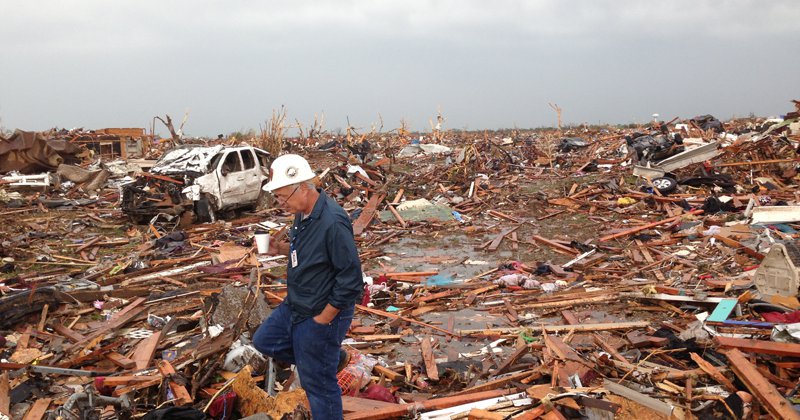
Marvin Haworth walks through a house frame that鈥檚 under construction in the Seiter Farms development in Moore, Oklahoma.
鈥淵ou see these hurricane clips right there? You see one at every rafter in the house. They鈥檙e all tied to the wall, so that rafter cannot be pulled loose from the wall,鈥� Haworth (pictured below) says as he points toward the connection between the frame鈥檚 walls and roof.
Hurricane clips are metal straps that are often used in construction along the Gulf Coast to keep a roof attached to the walls during a hurricane. And are required to use them in Moore as part of the city鈥檚 building codes.
鈥淚t鈥檚 all about connectivity. You鈥檙e connecting everything today so that the house doesn鈥檛 come apart as easily,鈥� Haworth says.
On May 20, 2013, a monster EF5 tornado devastated this community, killing 24 people, including 7 children at Plaza Towers Elementary School. It was the city鈥檚 since 1999.
In 2014, Moore became the only municipality in Oklahoma to adopt residential building codes that are strong enough to survive an EF2 tornado. The new homes in Moore are designed to withstand winds up to 135 miles per hour. The codes require hurricane clips, bolts connecting the frame to the foundation, narrower spaces between roof joists and more durable garage doors, among other things.
Haworth, who helped craft Moore鈥檚 codes, says the garage door is the weakest part of a home and is typically the entry point for damage. After a garage door is destroyed, pressure from tornadic winds can take a house apart. First the garage roof fails, followed by the garage walls. The house roof is usually the next to go.
It was apparent following the May 2013 storm that garage doors were the weak link.
鈥淲hen you went out and looked at them, the houses on the perimeter of that tornado that received the least amount of damage, the garage doors were what was damaged on all of those houses in the outer edges of the tornado,鈥� Haworth said.
Costs of Doing Business
And those strong garage doors, hurricane clips (pictured below), and other materials come at a cost to builders.
Kevin Simmons, an economist at Austin College in Sherman, Texas, wanted to see if the codes , as compared to the neighboring city of Norman. What he found surprised him.
鈥淓ssentially you saw little to no effect of the building code in terms of the number of homes that are built and sold in Moore,鈥� Simmons said.
When a regulation increases the cost in one market, but not in a neighboring one, Simmons says consumers usually flee in search of lower prices.
鈥淭he expectation is that when you increase the building cost that you may suffer a reduction in sales, you may suffer a reduction in permits,鈥� Simmons said.
But that鈥檚 not what happened in Moore. Simmons says that when the codes were initially proposed, engineers expected an increase in cost by about one dollar per square foot. It actually turned out to be about twice that, or even higher in some cases. But home buyers didn鈥檛 see a radical change in pricing.
Plus, Simmons says, consumers want stronger houses.
鈥淚t reflects a sense on the part of people that live in central Oklahoma that this is a good thing, to have a product, to live in a house, that has a higher probability of surviving a windstorm with little to no damage is something that people demand,鈥� Simmons said.
Moore has not suffered a catastrophic tornado since 2013, so Simmons has not been able to test how the city鈥檚 new building codes hold up during a storm. However, Florida adopted similar codes statewide after 1992鈥檚 Hurricane Andrew. from later hurricanes, including Hurricane Charley in 2004. The Insurance Institute for Business and Home Safety estimated homes built to the new codes suffered approximately 40 percent less damage during Charley than those built before implementation of Florida鈥檚 code.
Simmons believes Oklahoma would also benefit from a statewide code similar to the Sunshine State.
鈥淪o I think that Oklahoma is a good candidate for doing what the state of Florida did: Enact a statewide building code that’s based on these wind engineering principles,鈥� Simmons said.
But not all builders would agree. Tony Faust is the owner of DaVinci Homes and the president of the Central Oklahoma Home Builders Association. He says all of these new materials are being added behind the walls.
鈥淚t’s increasing the cost and it just takes time for that appraisal process to catch up and eventually it will show that these homes cost more,鈥� Faust said.
Faust says the cost of constructing a home in Moore has increased by over three dollars per square foot for him. Now, he鈥檚 apprehensive about building there.
鈥淚f someone contracts us to build a custom home in Moore we will. But as a standard right now, I’m not building speculative homes right now in Moore,鈥� Faust said.
Despite the additional expenses, homebuilder Marvin Haworth says he still thinks the stronger building codes are a good idea.
鈥淢aybe at some point, everybody would want to build their house, whether they live in Moore [or not] they might say, I want that code in my house. I want you to build my house to this code,鈥� Haworth said.
But he would still like to revisit the regulations to bring down some costs.
Schools Add Storm Shelters
Houses, however, aren’t the only buildings that have captured people’s attention in the years since tornadoes ripped through parts of the state in 2013. In particular, in the aftermath, Oklahoma schools have made storm shelters a priority.
Preschool students run tiny hands through a plastic tub of little blue beads that look like fish. They then scurry across the room to sing 鈥淭he wheels on the bus鈥� with their classmates.
It鈥檚 a bright, colorful, happy room here at the in El Reno, Oklahoma. And just a few steps down the hall, child care director Barbi Slimp opens the door to another room that鈥檚 just as cheerful.
鈥淲e have lots of soft furniture, and we have it set up in centers. And it鈥檚 a comfortable environment for the children,鈥� Slimp says. 鈥淎nd they visit frequently so they鈥檙e not afraid to come in when it鈥檚 necessary.鈥�
This room (pictured below) works as both a play room and a storm shelter. It鈥檚 one of five FEMA-certified shelters on the Canadian Valley campus. There鈥檚 enough room for every student and employee at the campus.
鈥淲e have had to come in one time and the children didn鈥檛 even know what was happening. They just thought we were coming in to play and have a good time. But the teachers and parents had peace of mind that we had a safe place to be,鈥� Slimp says.
A little more than a week after the Moore killed seven students at an elementary school, destroyed Canadian Valley on May 31, 2013. Here in El Reno, just 25 miles west of downtown Oklahoma City, the tornado ripped through the campus in the evening when few people were present. Nobody died at the school.聽Twenty-one people died elsewhere, .
, a partner at in Oklahoma City, designed the rebuilt Canadian Valley campus. He wanted to make sure safe rooms and storms shelters are an everyday part of the learning environment.
鈥淲ith every one that we design we wanted it to be as usable and as flexible as possible,鈥� Armbruster said.
Armbruster specializes in educational facilities, and he says demand for school shelters spiked after May 2013.
鈥淏efore that we might do one storm shelter every five years or less. Now I think we have at least five or six under construction right now,鈥� Armbruster says.
Trade-Offs
Many school districts now include shelters or safe rooms when they construct new buildings, and it鈥檚 a big undertaking. Armbruster (pictured below) says a regular classroom costs about $175 per square foot. It costs about $100 per square more to fortify a class as a safe room.
, an economist at Troy State University, says tornado fatalities in schools are rare. According to his research, there have been about 290 school deaths in the United States since 1880.
鈥淥ne reason for that is that schools are engineered buildings. So they already are pretty well built, relative to houses and particularly mobile homes,鈥� Sutter said.
Additionally, classes often aren鈥檛 in session when a tornado strikes.
Sutter says improving school safety by installing storm shelters is a question of marginal benefit.
鈥淕iven that you already have a pretty well-built school, what you鈥檙e really talking about now is taking a low probability of students being killed in a tornado and reducing it to zero or virtually close to zero,鈥� Sutter said.
He says the small number of deaths that occur each year at schools mean that the cost per life saved is very high. In Oklahoma, for example, Sutter estimates the cost per life saved would be approximately $268 million.
In Oklahoma, school buildings generally are not funded through state appropriations. Instead they are funded locally, through property taxes or voter-approved bond issues. That means the installation of a storm shelter or safe room is decided locally by school boards and district voters, which Sutter thinks is good policy.
鈥淚f people wanted to pay extra to protect their children when they are at school, that鈥檚 entirely their call. And that鈥檚 one of the points where I really don鈥檛 like to criticize or tell people what they should or shouldn鈥檛 do,鈥� Sutter said.
Oklahoma Institute for Child Advocacy CEO Joe Dorman disagrees. When he was a Democratic state representative in 2014, Dorman tried to pass legislation to create a statewide bond issue to help fund the construction of storm shelters, but it failed.
鈥淲hen you factor in the cost of construction when you鈥檙e dealing with a bond issue, to upgrade that to a space that has safe areas from tornadoes, it鈥檚 not that much extra,鈥� Dorman said. 鈥淭he peace of mind and the assurance that you have it, it鈥檚 worth it.鈥�
Dorman says Oklahoma鈥檚 legislature has done nothing else to provide money for school storm shelters. He says the problem with leaving it up to school districts is the requirement for a 60 percent vote to pass a bond issue.
鈥淪o you have many school districts that have a difficult time getting to that level. My home town of Rush Springs is a perfect example. It took multiple times presenting bond issues before a package was approved by the voters with a 60 percent margin,鈥� Dorman said.
School Districts Look Ahead
Many school districts have moved forward with shelters, especially in the state鈥檚 larger cities. Since 2013, Tulsa Public Schools have added FEMA-certified shelters or safe rooms in 8 of their 80 buildings. Five more are under construction now and will be complete by the fall.
Out of the 73 active schools in the Oklahoma City Public School district, 28 have safe rooms, with four more under construction. The district has built 27 safe room gyms to FEMA specifications since 2013.
Norman Public Schools has safe rooms in all 25 of its buildings, four of which were constructed after 2013 and follow FEMA鈥檚 guidelines.
All 35 buildings in the Moore Public Schools District will have FEMA-rated shelters when all current and future construction is complete.
Many smaller districts also included storm shelters in their plans, or have plans to do so.
Okeene Public Schools superintendent Gary Pittman cracks open the door to a dressing room underneath his school鈥檚 1960s-era gym
Currently, students take shelter here in the event of severe weather. These dressing rooms don鈥檛 have the requirements to be considered a safe room, but it鈥檚 the safest place for students to take cover in this rural, northwestern Oklahoma school.
Pittman says the Moore tornado weighs heavily on him.
鈥淵ou always look at the things that happen to be able to think about, what would we do in that same case?鈥� Pittman said. 鈥淲here would we take the kids? Well obviously our safest place is the bottom of the gymnasium in the dressing rooms.鈥�
Pittman says his school board will put a bond issue before voters next year. The proposal will call for a brand new gym that will have a storm shelter.
Support for this essay was provided by the Weather Eye Award, an award given to distinguished local reporters by RiseLocal, a project of 国产视频鈥檚 National Network.
More 国产视频 the Authors
Issues
Programs/Projects/Initiatives
Topics
Related
Dutch Flood Experts Come to Help Protect Galveston
How Texas Is Trying to Pioneer a Disaster Preparedness Path
For Boston Climate Resilience, It’s Full Steam Ahead