Aaron Loewenberg
Senior Policy Analyst, Early & Elementary Education
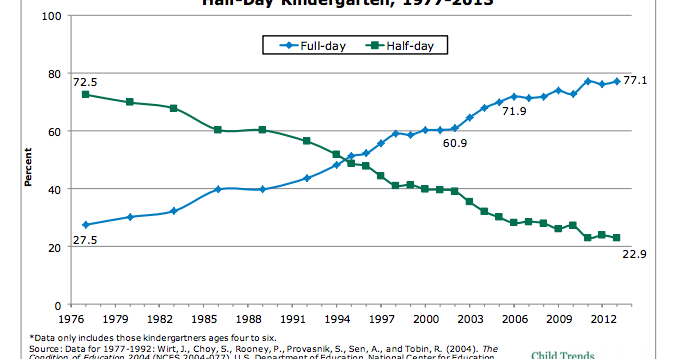
As state legislatures around the country continue their sessions, we鈥檙e keeping an eye on states considering legislation related to full-day kindergarten. First, a reminder of the current state of play when it comes to full-day kindergarten around the country. Currently, require school districts to offer a full-day of kindergarten instruction. (Depending on the state, 鈥渇ull-day鈥� kindergarten can range from 4-7 hours per day. See our brief 鈥淢aking the Hours Count鈥� for more on this inconsistency.) However, more districts are offering full-day kindergarten options today than in the past. In fact, since 1977 the percentage of kindergartners enrolled in full-day rather than half-day programs from 28 percent of all kindergartners to 77 percent in 2013 (see chart below). I won鈥檛 go into the research on the benefits of full-day kindergarten in this post, but check out CJ Libassi鈥檚 for a good overview of the research and details about a first-of-its-kind randomized trial of full-day kindergarten that shows sizable learning advantages at the end of the year compared to half-day programs.

So, what action are we seeing at the state level when it comes to funding full-day kindergarten programs? First, let鈥檚 take a look at bills whose fates have already been decided. In Virginia, all but three localities already require schools to offer full-day kindergarten. Legislators considered a bill to require all districts to offer full-day kindergarten as well as a bill that would have denied full accreditation to districts not offering full-day kindergarten. These bills, however, were both on party-line votes. A kindergarten bill in New Hampshire met the same fate. The New Hampshire bill would not have required districts to offer full-day kindergarten, but would have provided additional state funding to districts that chose to offer it. As the Education Commission of the States explained in a , the way a state chooses to fund its kindergarten programs can provide districts with strong incentives or disincentives to offer full-day kindergarten. The New Hampshire bill made it out of committee, but was then on a party-line vote before the New Hampshire House.
A couple of other states are considering full-day legislation, but proponents aren鈥檛 optimistic about the chances of seeing a bill passed this session in these states. In Colorado, legislators are that would provide about $243 million to fund free all-day kindergarten for all students in the state. Currently, all but 10 of Colorado鈥檚 178 districts offer full-day kindergarten, but districts are forced to rely on local funds to pay for it and, in some cases, charge tuition to cover the cost. (13 states allow districts to charge parents tuition if they want their child to attend for a full day.) While the proposed bill passed the House Budget Committee, it鈥檚 to die in the Appropriations Committee due to the state鈥檚 current budget restrictions. Utah legislators proposed $10 million in additional state funding for optional full-day kindergarten, though districts would still be allowed to charge parents a fee for the extra hours. While the bill , it was in the Senate.
There are a handful of states still actively considering full-day kindergarten legislation. Legislators in New Jersey are considering related to early education, including that would require all districts in the state to offer full-day kindergarten at an estimated cost of about $78 million. On a related note, the New Jersey Assembly recently passed a bill that would create a task force to study statewide full-day kindergarten, though Governor Christie similar legislation last year. In New Mexico, requiring districts to provide full-day kindergarten was recently introduced and is currently sitting in committee. And, in New York, a bill that would pay for full-day kindergarten across the state by using funds from the state lottery. The bill has yet to be acted upon, however.
States that are considering full-day kindergarten legislation would do well to examine the example recently set by Oregon. As I wrote , while the legislation passed by Oregon did not require districts to implement full-day kindergarten, it did provide $110 million a year to cover the costs. The results have been dramatic. In the 2014-15 school year, only 42 percent of kindergartners in the state attended full-day kindergarten. This school year, 99.7 percent of the state鈥檚 kindergartners are in full-day kindergarten. While many school officials initially worried that they lacked the necessary resources to handle full-day kindergarten, 740 out of 750 of the state鈥檚 schools eventually found a way. And of the ten schools that don鈥檛 offer full-day kindergarten, nine of them are charter schools or rural schools with only one or two kindergarten students.
Minnesota is another example of a state that districts to offer full-day kindergarten. While Minnesota does not require districts to offer full-day kindergarten, in 2013 Governor Dayton signed a bill that made full-day funding available to all districts that wished to participate. As a result, in the 2014-2015 school year, of Minnesota kindergarteners attended a full-day of school.
While seat time isn鈥檛 everything, a full-day of kindergarten for more instructional time, a broader curriculum, and increased time for playful exploration. We鈥檒l continue monitoring the status of full-day kindergarten legislation in these states and others as state legislative sessions continue throughout the remainder of the year.“
Senior Policy Analyst, Early & Elementary Education