
Georgia on No One’s Mind
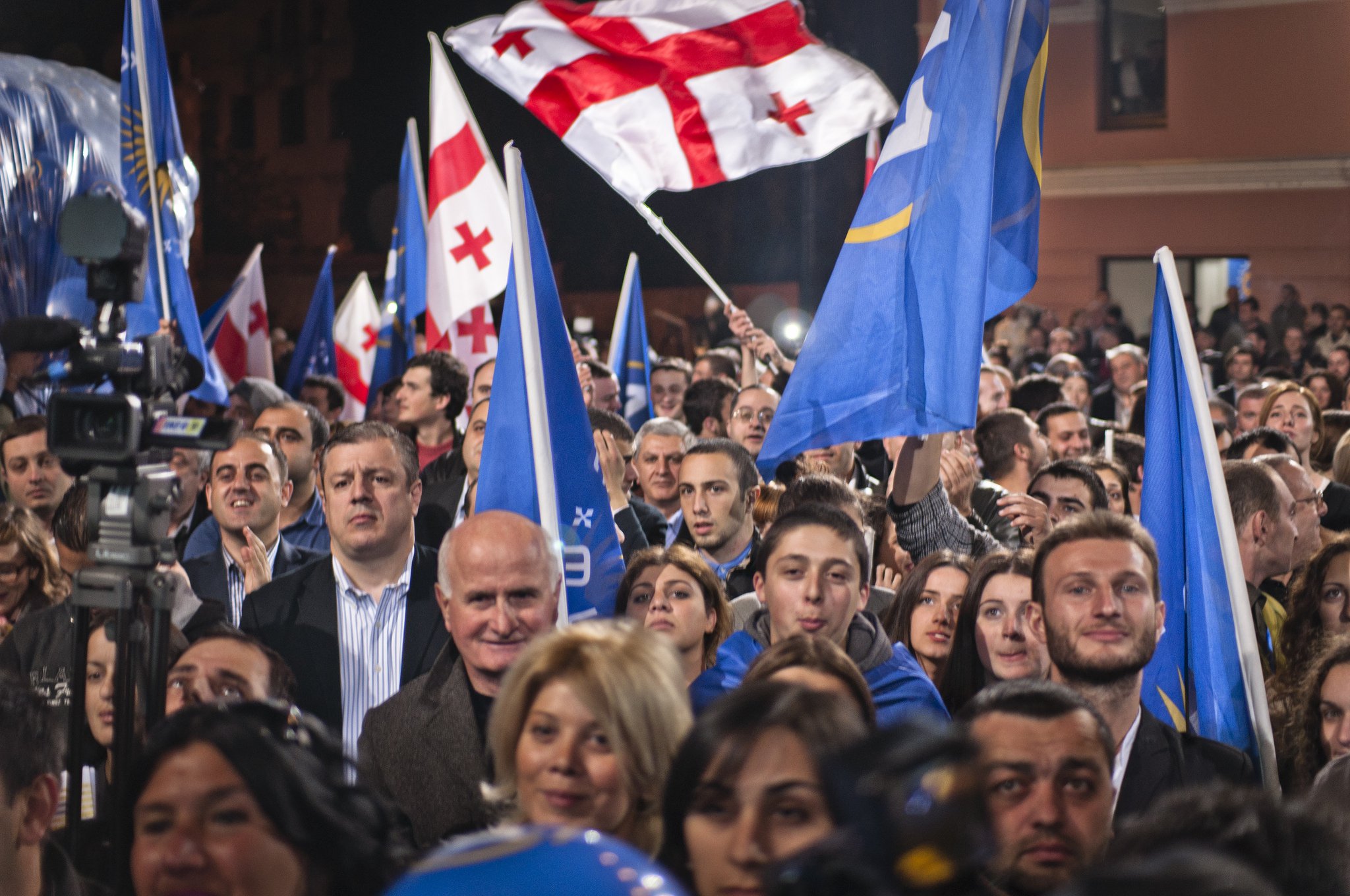
There鈥檚 a scene in the 2007 film Charlie Wilson鈥檚 War when the titular character, a congressman played by Tom Hanks, tries to make a case to his congressional peers. He wants to allocate one million dollars toward building a school in Afghanistan, as a way for the United States to combat Soviet propaganda in the country. In response, one of his colleagues asks: 鈥淎fghanistan? Is that still going on?鈥� seconds later, another quip follows: 鈥淲e鈥檙e a little busy now reorganizing Eastern Europe, don鈥檛 you think?鈥�
The film takes place in the 1980s, at the height of the Cold War. But even today, a similar scenario of political amnesia is playing out. In 2008, the entire transatlantic community, including Brussels and Washington, condemned Russia鈥檚 invasion of Georgia. Senator John McCain, known for his blistering critique of the Kremlin, : 鈥淭oday, we are all Georgians.鈥� But now, 10 years on, a familiar sort of forgetting has left Georgia, a country of geopolitical importance, jammed in a state of development limbo鈥攐ne that actors neither inside nor outside the country seem to be in much of a hurry to remedy any time soon.
How to pluck out the heart of this particular mystery? In a sense, the current reality shouldn鈥檛 be all that surprising. After all, the West itself is facing challenges of the magnitude it hasn鈥檛 seen since the end of the Cold War. Its political, economic and even philosophical underpinnings . Understandably, it鈥檚 in no mood to be a political cheerleader for a seemingly obscure country like Georgia.
Indeed, gone are the days of unfettered democracy promotion and calls for , even though Brussels, with support from Washington, had in its relationship with Georgia. The issue isn鈥檛 necessarily the level of global support for Georgia, critical as it may be. Rather, it鈥檚 the carte blanche the West has traditionally given to Georgian governments. Which is to say: Western support for Georgia on the international stage might now be diluted by internal dynamics, ones unique to the long history of Sovietization of Georgia鈥檚 socio-political culture.
This domestic development has, in turn, cleaved Georgia into two entities: a pro-Western country on the one hand, and a post-Soviet one on the other. Yet the West has largely ignored this duality, fueling a mood of forgetfulness that in ways mirrors the one that came to beleaguer Afghanistan. (And the consequences have been severe: As the journalist Remy Tumin for The New York Times, 鈥渁 truce was ostensibly called in 2008, but… ask any Georgian in the area and they will insist the conflict never really ended.鈥�)
Yet this isn鈥檛 to point the finger of blame for Georgia鈥檚 glacial modernization solely at foreign powers. When it comes to Georgia鈥檚 relations with Russia, old habits appear to die hard. More specifically, the country hasn鈥檛 seemed to learn from the mistakes of its second and third presidents: Eduard Shevardnadze and Mikhail Saakashvili, respectively. During their tenure as president鈥擲hevardnadze between 1995 and 2003, and Saakashvili between 2003 and 2012鈥攂oth men transferred strategic economic assets to clandestine Russian-Georgian business groups. On top of that, Washington had to interfere to prevent the sale of the main Georgian oil pipeline to Gazprom, a large Russian company. What was perhaps most disturbing, however, was that Saakashvili鈥攖he great modernizer, and a tireless fighter against Putin鈥檚 regime鈥攕old off almost the entirety of Georgia鈥檚 economy. Far from modernizing these sectors, Russian businesses .
Today, these sectors languish in inefficiency, and they鈥檙e run by what鈥檚 been dubbed by the literature as 鈥渞ed directors.鈥� They鈥檙e also drowning in dilettantism, raising questions about favoritism and corruption. It seems that over seven decades of Soviet dictatorship have eroded some people鈥檚 ability to distinguish between adversaries and friends.
Other internal actors have derailed Georgia鈥檚 development, too. For one, billionaire oligarch Bidzina Ivanishvili, who made his money in Russia, has decided to maintain the status quo. The political environment he鈥檚 created has the investment climate in the country. Ivanishvili was previously prime minister of Georgia, but stepped down after only one year in office. (The political party he financed with his money, the Georgian Dream party (GD), beat Saakashvili in parliamentary elections in 2012, effectively removing him from power.) While in office, he summoned the heads of Georgian companies and publicly scolded them for distorting the rules of the game in their favor. But that was merely a PR stunt, and it was the extent to which he cared to address Georgia鈥檚 clandestine, post-Soviet business landscape.
Now, as a private citizen, Ivanishvili is widely believed to be an unofficial ruler of the country, working through a network comprised of his relatives, members of the GD, and popular support he receives from those social elites who are beholden to him (mainly because he still pays their salaries and serves as a sort of arbiter of their professional careers). More startling, he also arguably wields the real power behind current Prime Minister Giorgi Kvirikashvili, though he still falls miserably short on his promises to develop a vibrant civil society and bolster human rights.
A decade after Georgia captured international attention, its development seems to be on no one鈥檚 mind鈥攏either on the minds of international actors, nor on the minds of most domestic actors, who seem to care more about keeping their hands on the levers of power.
Both Brussels and Washington ought to use their political clout to reduce the crippling legacy of Soviet influence, which any wily person can mold to boost himself above institutions, creating a personal brood of followers. At the same time, it鈥檚 Georgia鈥檚 government that must ultimately do the grunt work of cleaning up its backyard. In the private sector, the government must create greater transparency of key economic sectors. It must also carve out a sense of social and political fairness (to see why, look at how Ivanishvili鈥檚 feud with the current Georgian president, Giorgi Margvelashvili, speaks to how he鈥檚 willing to place himself above his office; he鈥檚 yet to forgive Margvelashvili for allegedly disobeying directives, and has accused him of selling out to the opposition party).
Georgia鈥檚 political elites will likely avoid scrutiny from the West, but they鈥檇 be wise to remember that their fellow Georgians have a penchant for elevating politicians to the status of a deity鈥攐nly to condemn them later with an equal and opposite intensity.
More 国产视频 the Authors
Related

Engagement in a Civic Education Desert

Built to Last: How Leaders Are Creating Sustainable Early Childhood Funding

Pre-K Is Having a Curriculum Moment. A Professional Learning Movement Needs To Follow.
