
Germany’s Murky Year Ahead
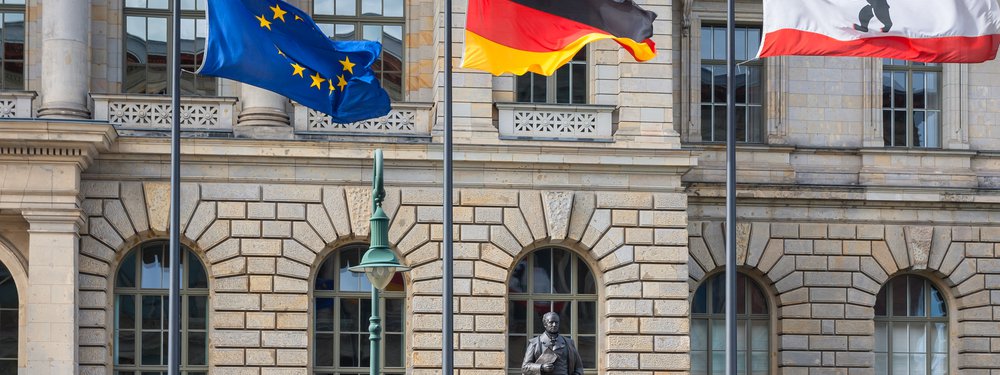
Germany is ringing in 2018 not with a fresh start, but stuck in political limbo. While Chancellor Angela Merkel and other party leaders were originally confident that they鈥檇 have a new ruling coalition by Christmas, current estimates now put that timeline at Easter鈥攊f negotiations go smoothly. Exploratory negotiations between the Social Democrats (SPD) and Merkel鈥檚 Christian Democrats (CDU) began on Jan. 7 and will last through the rest of the month. Formal negotiations won鈥檛 begin until March鈥攂ut again, that鈥檚 assuming talks go well.
What鈥檚 more, perhaps the only group from the chaos so far is the far-right Alternative f眉r Deutschland (AfD), which will likely use the coalition struggles to decry traditional parties; if the talks fail (again), even better for AfD leaders Alice Weidel and Alexander Gauland.
What does this all mean? Well, it doesn鈥檛 mean that Germany is having a democratic crisis, but, in 2018, the country鈥檚 uncertain political climate is likely to augur major changes to domestic policies, even leadership positions, and possibly a big moment of opportunity for the AfD.
The Carnegie Endowment鈥檚 Cornelius Adebahr told me in an interview that 鈥渇orming a coalition government at this particular moment really entails that all questions and all issues are on the table.鈥� While Merkel is of another grand coalition between the SPD and CDU, members of both parties haven鈥檛 written off a minority government鈥攕omething that鈥檇 鈥攚herein the CDU would always have to find new coalitions to pass legislation. SPD leader Martin Schulz suggested in December that a cooperation coalition would create a government only over issues the parties agree on, but that idea was short lived.
Today, another grand coalition seems most likely, but it鈥檇 come at a hard price for the CDU.
As the third-largest party, an SPD/CDU coalition would make the AfD the largest opposition party, a role that comes with . For one, the party would be in charge of the Committee on Budget鈥檚 chairmanship, meaning that it鈥檇 have聽a say over fiscal policy, and get the first right to respond to government statements. For a party that already seems determined to disrupt the parliament鈥攊t was most recently in the news for more , and Green Party Bundestag representative Konstantin von Notz worries about the AfD during International Holocaust Remembrance Day鈥攖he right to respond will give it a consistent, visible platform. And, of course, as the opposition leader, the AfD would gain more legitimacy. Right now, it鈥檚 unclear how the AfD will try to govern. Its inexperience in politics, along with other parties鈥� refusal to include it in legislative coalitions, may make the AfD unsuccessful. But as of this week, the party is polling only about .
Moreover, in grand coalition discussions, the CDU is in the hard position of not only considering whether to give the AfD these new powers, but also negotiating tense domestic policy concessions with the SPD. It鈥檚 among domestic policy that Adebahr expects Germany to see the most dramatic changes from previous government鈥檚 policies. While Schulz was given a mandate to negotiate at the in December, the SPD is skittish about what some see as the party selling its soul for the third time. To reclaim the identity that critics say was lost in the last grand coalition, the SPD is likely to drive a hard bargain over domestic policy to re-establish its platform in the public eye and to make sure that the agreement passes the party vote.
According to Adebahr, with domestic policy, 鈥渢here鈥檚 more room for innovation, whether it鈥檚 for education or police cooperation. People realize that there are things to be done in Germany and, say, if the SPD went ahead with its plan for a more generalized system of healthcare, that would be a real, fundamental change.鈥� Michael Groschek, an SPD state minister, that it鈥檚 鈥渦nthinkable鈥� for the party to approve a coalition 鈥渨ithout concrete improvements in the areas of labor market policy, pensions, and healthcare.鈥� In a similar vein, SPD deputy leader Ralf Stegner that the CSU鈥檚 funding goals aren鈥檛 compatible with his party鈥檚 financial priorities; the CSU, , promoted increasing NATO spending. For Stegner, he鈥檇 rather see the money go to social programs. On Sunday, a joint party statement some, but not all, of the policy working groups were able to make progress.
Leadership positions are also a bargaining chip in coalitions. However, the SPD鈥檚 identity crisis means that it could negotiate aggressively, and more, in turn, could be at risk if talks get ugly. For instance, in a conversation in mid-December, Adebahr gave current foreign minister and former SPD leader Sigmar Gabriel a 50-50 chance of staying. Though he鈥檚 held the position for longer than some expected and is a political heavyweight, his close relationship with Merkel could be unpopular if the SPD favors creating a fighting, rather than a harmonious, coalition.
This need not be a bad thing, though. Some critics feel that the CDU is overdue for a leadership change, after 12 years with Merkel at the helm. The 2017 election marked that she was heckled on the campaign trail. A new poll from newspaper Die Welt showed that . Even within the CDU, Merkel鈥檚 party isn鈥檛 uniformly behind her. According to Bloomberg鈥檚 Arne Delfs, it鈥檚 mostly her critics inside the party who are wary of further coalition-blending with the SPD鈥攁nd, as political scientist Ulrich Sarcinelli , those members are trying to lay the groundwork for a 鈥減ost-Merkel era.鈥� Unlike most German leaders, including her own predecessor, though, Merkel , so finding a replacement would be both difficult and, perhaps, embarrassing.
Adebahr noted that while Merkel losing power is 鈥渘ot imminent,鈥� he said that 鈥渋t鈥檚 really open to what price the SPD is going to ask for in the coalition and what price the CDU/CSU is willing to pay.鈥� More likely than demand that Merkel leave, Adebahr said that he can see the SPD requesting new elections in two years, or using Merkel鈥檚 position as a sort of compromise in exchange for a domestic policy win. Essentially, 鈥渘othing is sacred or set in stone.鈥�
While coalition talks continue behind closed doors, the world spins on鈥攐r tries to. The European system has received major reform proposals from French President Emmanuel Macron and European Commission President Jean-Claude Juncker, which some consider the biggest challenge for 2018, but they can鈥檛 move forward without Germany鈥檚 formal involvement. Not getting a say in European affairs also means that some EU budgeting also is at stake, which could influence subsidies as far into the future as 2021-2027. But the German government until it鈥檚, well, a real government again.
Even if聽it鈥檚聽not in a democratic crisis, Germany鈥檚 current situation offers another example of this era鈥檚 unusually difficult version of politics as usual. With no good options, the coalition talks won鈥檛 end in too much celebration, even when a government is finalized. Instead, observers are likely to see the consequences of this political limbo through 2018 and, potentially, for years to come.
More 国产视频 the Authors
Related

Engagement in a Civic Education Desert

Built to Last: How Leaders Are Creating Sustainable Early Childhood Funding

Pre-K Is Having a Curriculum Moment. A Professional Learning Movement Needs To Follow.
