


Harkin Interest Rate Proposal Costs Students More than Bipartisan Bill

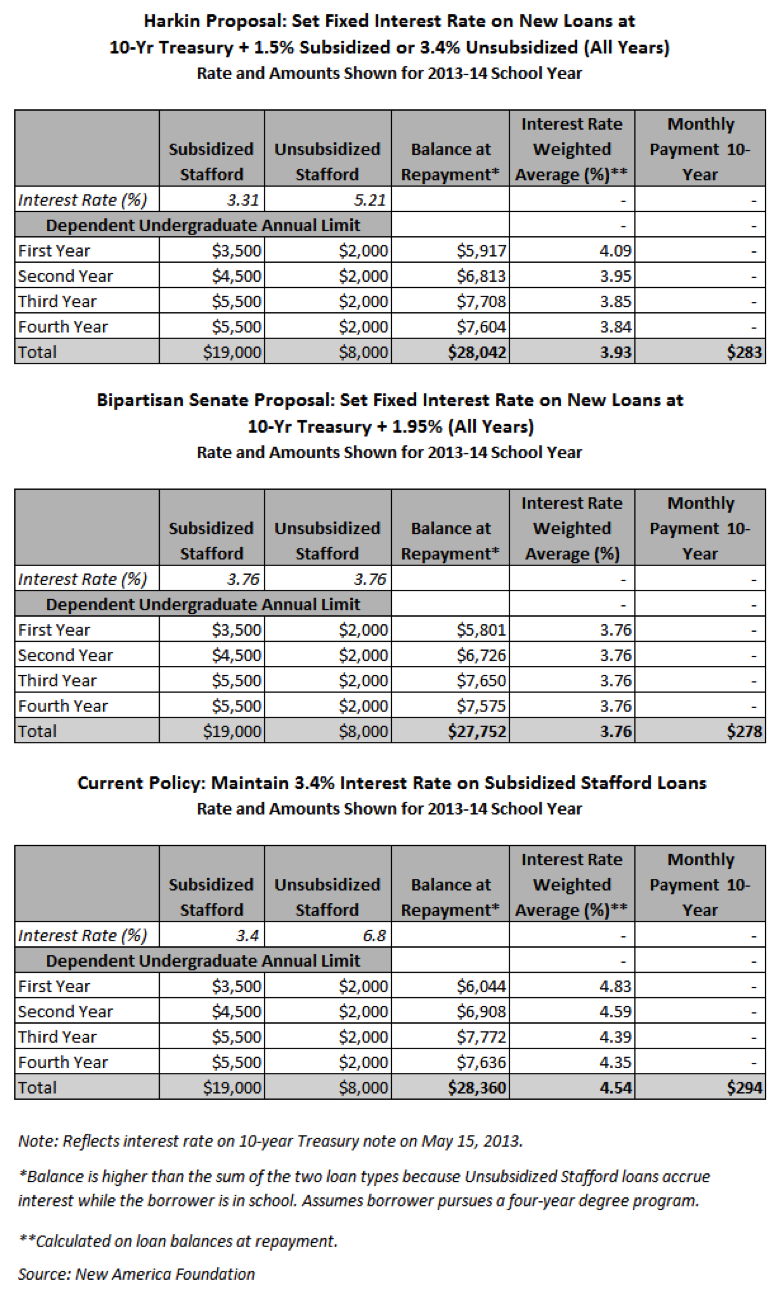
Less than a week before interest rates are scheduled to double on some federal student loans, yet another proposal has surfaced in the Senate. Sen. Tom Harkin (D-IA), chair of the Senate Health, Education, Labor, and Pensions Committee, is reported to be similar to one Sens. Manchin, King, Coburn, and Burr released last week, only his plan includes lower rates on Subsidized Stafford loans (but higher rates on Unsubsidized) than the bipartisan Senate proposal and Senator Harkin adds a cap on rates.
Harkin鈥檚 plan ties rates to the 10-year Treasury-note rate, plus a 1.5 percent markup for Subsidized Stafford loans; a 3.4 percent markup on Unsubsidized loans; and a 4.5 percent markup on PLUS loans. Stafford loans would be capped at 8.25 percent, and PLUS loans would be capped at 9.25 percent. (Consolidation loans, currently capped at 8.25 percent, would no longer have a cap.) The Manchin-King plan, on the other hand, would start with the same 10-year Treasury rate with a 1.95 percent markup on undergraduate Stafford loans; a 3.4 percent markup on graduate Stafford loans; and a 4.4 percent markup on PLUS loans.
Yesterday, we monthly payments for a hypothetical student taking out the maximum in Subsidized and Unsubsidized Stafford loans for four years of school, under several of the existing proposals. (We used the current Treasury rate as a basis for our estimates.) Today, we鈥檙e adding the Harkin proposal to those estimates. Readers should note that the bipartisan proposal is still a better deal for undergraduates than the Harkin proposal. And because the bipartisan bill reduces the interest rate for both Subsidized and Unsubsidized loans, more students will 聽get a better deal.
The bipartisan Senate proposal achieves lower loan balances and overall interest rates for undergraduates than the because it charges graduate students more than undergraduates on Unsubsidized Stafford loans. We think charging graduate students higher rates to provide undergraduates lower ones is smart policy. It鈥檚 also progressive. Student loan borrowers with graduate degrees are hardly an economically oppressed class. Meanwhile, too many Americans struggle to obtain an undergraduate degree.
Maybe progressives could learn a thing or two from Sens. Manchin (D-WV), King (I-ME), Coburn (R-OK), and Burr (R-NC). The bipartisan proposal is a better deal for students, and it鈥檚 a better solution to the problem. 聽
础迟迟补肠丑尘别苍迟蝉:听
Issues
Related

Quality Principles for Workforce Pell Programs

