
Homeless Austin Residents Criticize Governor’s ‘Demonizing’ Tweets
This article in The Texas Tribune.
On a January afternoon, Pam Reynolds pushed her wheelchair across the pavement of a Texas Department of Transportation facility in Austin that Gov. turned into a temporary shelter for people experiencing homelessness. She was flanked by a black Labrador puppy and her tent neighbor, Amy, who was carrying rain-soaked blankets that were still dripping.
Reynolds said she slept on the soaked sheets for three nights before someone helped her exchange them for a dry set from another resident. Before Abbott and state officials transformed the facility into a shelter, Reynolds lived in the concrete underbelly of State Highway 183 in the state鈥檚 capital.
鈥淚鈥檝e been beaten up, nearly raped, except I fought for my life,鈥� Reynolds said.
So is life in the governor鈥檚 camp better than life under a highway?
鈥淚 guess,鈥� Reynolds said as she stared past the tree line.
Homeless Austin residents say life at the shelter in the southeast Austin neighborhood of Montopolis is an improvement for them鈥攂ut still an incomplete solution to life without steady shelter. And some still feel stigmatized and targeted by the governor鈥檚 claims of increased crime involving homeless people and routine clearings of homeless communities elsewhere in the state鈥檚 capital.
Abbott, a Republican, has used recent assaults allegedly perpetrated by homeless Austin residents to criticize city officials for changes to its camping ordinances, though he hasn鈥檛 provided a direct link between those rules and violent behavior.
Austin city officials last year relaxed ordinances prohibiting lying in public areas. Those officials later tightened the ordinances and prohibited lying on sidewalks, near shelters and in high fire-risk areas.
After a homeless man was accused of stabbing another resident experiencing homelessness Jan. 8, Abbott the Texas Department of Public Safety to increase patrols downtown and around the University of Texas.
After the Austin Police Department arrested a woman for allegedly in downtown Jan. 24, Abbott Austin official鈥檚 choice to relax the city鈥檚 camping ban was allowing 鈥渓awlessness鈥� and corresponds with a 鈥渞ise in violence,鈥� though he did not provide crime statistics to back up the claim.
And on Saturday, after a CBS Austin in which witnesses to a stabbing said they believed the suspect was homeless, Abbott that state lawmakers will 鈥渙verride Austin鈥檚 reckless policies.鈥�
The Austin Police Department has not responded to questions about whether there has been an increase in violent crime correlated with the ordinance changes.
Last fall, Austin police Chief Brian Manley told city leaders that between summer 2018 and summer 2019, violent crime in which the suspect was homeless and the victim was not rose 11 percent, compared with a citywide violent crime increase of 15 percent. Cases where the suspect was not homeless but the victim was increased 19 percent.
Life at the camp
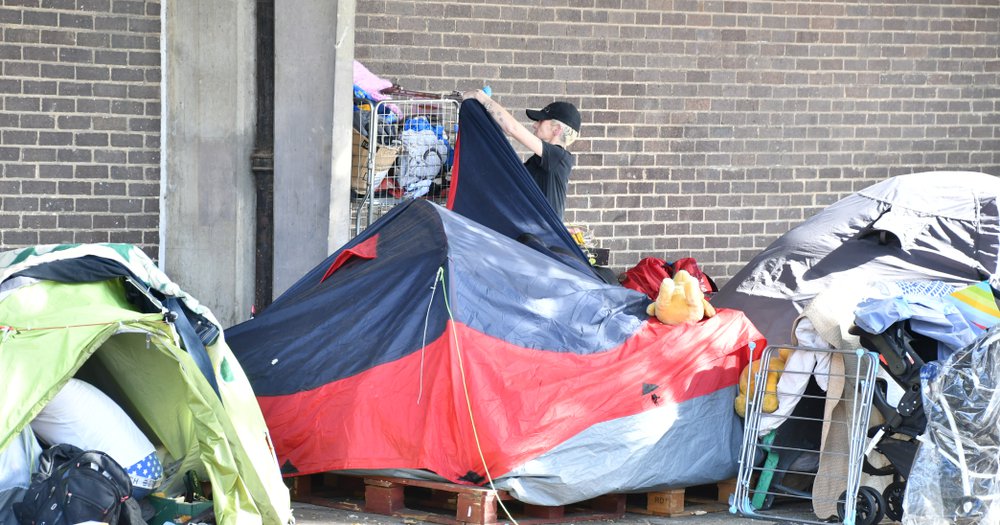
At the shelter, residents are assigned spots to pitch tents and are given packages of food three times a day. 国产视频 a dozen of the spaces are covered, while others are not.
There are also port-a-potties and hand-washing stations at the front of the camp. A state trooper is posted at the site 24 hours a day for security.
During its first week as a shelter in mid-November, 22 homeless residents started camping there, according to the Texas Division of Emergency Management. That number has recently grown to 107 residents.
Among the state agencies involved with the temporary shelter, none will claim oversight or leadership. The Texas Division of Emergency Management seems to have the largest share of daily work; it distributes food packages three times a day and assists with third-party donations to the camp.
Residents like Reynolds and Manuel Baez, who was a handyman before the Great Recession, said one of the best benefits of Abbott鈥檚 camp was the stability of having assigned spots to return to every night.
While his wife heated lunch鈥攁 mixture of canned tuna, boiled eggs and onion鈥擝aez compared his time at Abbott鈥檚 camp with his time sleeping near the Terrazas Branch of the Austin Public Library on East Cesar Chavez Street.
鈥淲e鈥檙e better over here because nobody messes with you. It鈥檚 your own place. We all try to get along. Sometimes we got problems because people are different, but we try to get along,鈥� Baez said.
Baez and Reynolds also said they worry less about violent crime because state troopers offer a constant police presence. However, some residents said they are still robbed by their fellow homeless residents like they were under highways.
On a recent afternoon, Barbara Terrell gave a goodbye hug at a nearby bus stop to a friend who had come to visit her at the camp. She said she wanted to leave with him, but she didn鈥檛 have a bus pass. She said the bus fare was relatively expensive for residents of the camp.
鈥淭hey should鈥檝e gotten bus passes or some way for us to get out. Because a lot of people don鈥檛 have bus passes, so you can鈥檛 really go anywhere,鈥� Terrell said.
Being stuck without transportation was the primary complaint from shelter residents. Reynolds said they don鈥檛 have access to grocery stores, medical care or fresh clothing because of the camp鈥檚 distance from Austin鈥檚 urban core. The camp is a two-hour walk from downtown.
According to Tammy Quinn, who is the program manager for Capital Metro, the company provided a bus stop to the campsite at the request of TxDOT.
鈥淭here are no resources over there that are in walking distance,鈥� Quinn said.
Demonized and targeted
Austin Mayor Steve Adler has criticized how Abbott tweeted videos of crimes and attributed them to homeless residents without verifying the suspects鈥� housing status. Adler has also called the governor鈥檚 responses examples of 鈥渄emonizing鈥� homeless people. LaShawn Ramsey, who lives at the governor鈥檚 camp, agreed with Adler鈥檚 description.
鈥淭hey鈥檙e focusing on the bad apples more so than the good apples. … They make every homeless person seem the same way, and we鈥檙e not. Just like there鈥檚 classes of people in the workforce, there鈥檚 classes of people dealing with homelessness, too,鈥� Ramsey said.
Katherine Juarez lives under Interstate 35 and said it鈥檚 not just the governor鈥檚 words but also his temporary solutions that make her feel like a criminal.
鈥淭hey tell us that we have to move our stuff across the street every Monday. So we go and take it over to Wendy鈥檚, and we get criminal trespass while we鈥檙e waiting for them to clean under the freeway. They set us up,鈥� Juarez said.
John Buckner, who lives under Interstate 35, said he agrees with the governor鈥檚 approach to homelessness but takes issue with 鈥渉ow he demonizes it鈥� and is skeptical of the governor鈥檚 claim of increased crime linked to the camping ordinance change.
鈥淭he [crime rate], has it really increased much, or is it the same or is it less?鈥� Buckner said. 鈥淭hat鈥檚 what I want to know. You鈥檙e not giving me an example. You鈥檙e just saying, 鈥楲ook, someone got stabbed,鈥� so that they pass the policies. No. Tell me how many people were being stabbed before the policy change.鈥�
Long-term plan
Abbott鈥檚 recent actions were announced as temporary solutions to homelessness, but details of the state鈥檚 long-term strategy aren鈥檛 known.
鈥淕ov. Abbott is committed to ensuring that adequate resources are provided to unsheltered Austinites to help them transition out of homelessness, while continuing to work with private-sector and faith-based organizations to develop more long-term solutions beyond this temporary camping space,鈥� said John Wittman, a spokesman for the governor.
Austin鈥檚 leadership Saturday, Abbott listed four 鈥渆asy鈥� steps to solving homelessness: prioritizing public safety, opening large shelters, and providing mental health treatment and job training before finding people long-term housing.
Seth Christensen, a spokesperson for the Texas Division of Emergency Management, said his agency doesn鈥檛 provide mental health and drug addiction treatment or job training, and he doesn鈥檛 know of any state agency that does.
鈥淭he governor has provided a safe place for the homeless to go. [Private providers] don鈥檛 have to go hunting for them in the woods or under bridges … but those interactions are between the individuals and the providers,鈥� Christensen said.
Abbott鈥檚 list recommends permanent housing as the final step in ending homelessness, contradicting the advice of homelessness experts.
Last year, Gary Painter, director of the Homelessness Policy Research Institute at the University of Southern California, the Tribune that the 鈥渉ousing first鈥� model is an approach to homelessness that seeks stable housing for people before addressing issues like addiction and mental illness.
鈥淲hile it might be more expensive because you are providing housing, it ends up saving money,鈥� said Painter. 鈥淚t is at least [as] cost effective as the other model and also certainly much more effective.鈥�
Residents of Abbott鈥檚 camp say they appreciate temporary answers but are also looking for long-term solutions.
鈥淭hey鈥檙e saying they鈥檙e doing something, but they鈥檙e really not, so we鈥檙e out here surviving on our own,鈥� Ramsey said. 鈥淭hey have boxes with water hoses calling it a shower. How can we wash to be able to get off our feet to actually get a job?鈥�
Terrell is maintaining her skepticism of the governor鈥檚 long-term strategy for homelessness.
鈥淚鈥檓 thankful to the governor for opening the camp because it鈥檚 a better option than being in lawless hands,鈥� Terrell said. 鈥淗owever, it鈥檚 confusing to hear him advocate harsher treatment and further criminalization of the most vulnerable. I feel he is playing into the haters by raising his torch. It makes me wonder what his intentions are to me and the others living at his camp.鈥�
More 国产视频 the Authors
Related

鈥淧eace Through Strength鈥� Is Hard to Read

“Getting the Golden Ticket”: Participants’ Perspectives on Lexington’s First Assembly

Civic Assemblies: A Framework for Community Colleges
