
How False News Haunted the Brazilian Elections
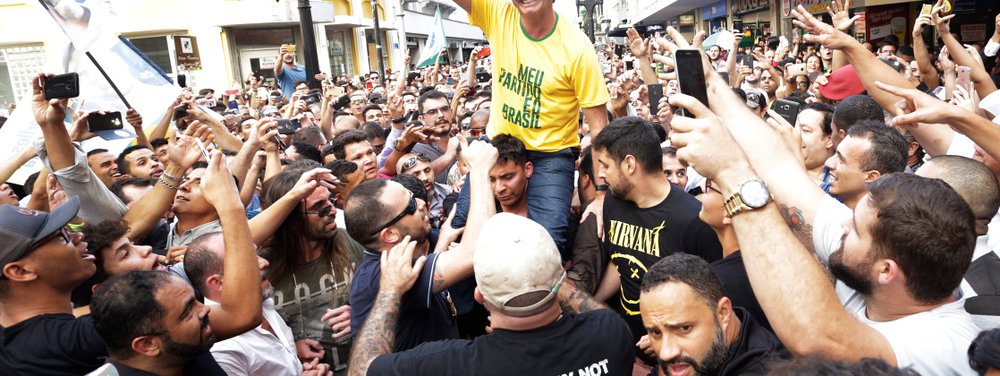
Three days before the most polarized election in the history of Brazil鈥檚 young democracy, a video making controversial claims about one of the presidential candidates appeared on Facebook. 鈥淟ook what the Workers鈥� Party is putting in cr猫ches,鈥� read the caption. The minute-long accuses Workers鈥� Party candidate Fernando Haddad, who lost Sunday鈥檚 election by 6 percentage points, of planning to .
鈥淚t鈥檚 a part of the gay kit, it鈥檚 Haddad鈥檚 invention,鈥� says the video鈥檚 narrator at one point.
Within 48 hours, the rumor-checking it had been watched more than 3 million times.
Although fact-checkers debunked the erotic baby bottle story Brazilians headed to the polls, it likely barely mattered: The 2018 Brazilian election was dominated by false news. Experts suspect that coordinated misinformation efforts may have played a part in Brazil鈥檚 elections as far back as 2010, but this year was supposed to be an improvement, with social media platforms like Facebook working with fact-checking efforts to stem hoaxes and propaganda. It didn鈥檛 work. Scrambling the discourse around the election even further was WhatsApp, the Facebook-owned encrypted messaging service where the movement of misinformation is untraceable. And it coincided with the rise of Brazil鈥檚 far-right president-elect, Jair Bolsonaro, whose loyal supporters are one of the main .
鈥淭his campaign showed that political communication is completely vulnerable, especially on WhatsApp because it鈥檚 not monitorable,鈥� said Pablo Ortellado, a University of S茫o Paulo professor who runs GPOPAI, a research group that studies public policies for information access.
The group鈥檚 confirms Ortellado鈥檚 suspicions that the platform was likely a huge source of misinformation: Just 8 percent of the most-shared information in groups was correct. 鈥淭here was a frightening amount of low-quality information,鈥� he said.
On Friday, Oct. 25, the same day the baby-bottle rumor began spreading, the Organization of American States called the spread of fake news via private networks to manipulate the Brazilian electorate 鈥�.鈥� Laura Chinchilla, a former president of Costa Rica who oversaw the OAS鈥� mission to observe Brazil鈥檚 elections, : 鈥淚t鈥檚 such a new phenomenon and so recent, it is the first time in a democracy we are observing the use of WhatsApp to massively disseminate false news.鈥�
The reference to the 鈥済ay kit鈥� in the baby-bottle rumor wasn鈥檛 arbitrary: It鈥檚 been a frequent talking point of Bolsonaro since 2011, when his eventual political adversary Haddad was the country鈥檚 minister for education. At the time, Brazil鈥檚 evangelical caucus in its congress had taken issue with a proposed educational initiative to combat homophobia, labeling the 鈥淪chool Without Homophobia鈥� materials as the 鈥済ay kit.鈥� Bolsonaro, then a National Congress representative for the state of Rio de Janeiro and himself famously homophobic, . In 2011, he sent people to distribute pamphlets outside Copacabana鈥檚 subway stations, saying that the educational materials would 鈥渟timulate homophobia鈥� instead of fighting it. Six years later, in August 2017, Bolsonaro鈥檚 base had grown and he was gathering momentum to become a presidential candidate. That August, when he with transgender reality star In锚s Brasil declaring their mutual disgust for the 鈥済ay kit,鈥� their meeting went viral.
The actual educational materials were no longer being used by this point. But the 鈥済ay kit鈥� became an important example of how false information could be used to manipulate public policy in Brazil, says Yaso Cordova, an affiliate at Berkman Klein Center at Harvard and a fellow at DigitalHKS at Harvard鈥檚 Kennedy School: 鈥淭he most radicalized people at the time [2011] campaigned strongly with misinformation.鈥�
Aware that fake news would be a problem in its elections this year, 24 Brazilian media outlets teamed up in July to tackle the spread of false information. (鈥淧roject With Proof鈥�) had backing from Google, Facebook, and Harvard鈥檚 Shorenstein Center. Additionally, long-running fact-checking agencies and websites informally collaborated to tackle misinformation, with one such group the weekend before Sunday鈥檚 election.
What differentiates this election, according to Cordova, was the apparently highly organized spread of misinformation, disseminated across multiple social networks to make it seem more credible. 鈥淚n this election, misinformation campaigns were far more coordinated [than in the past]鈥攜ou had a part of one false story on WhatsApp, another part on YouTube, another on Facebook, another on Twitter,鈥� she said.
Facebook, facing widespread criticism after its alleged role in spreading misinformation everywhere from the . to , also came under pressure to act in Brazil following after the of Rio city councillor Marielle Franco. But this isn鈥檛 a new role for the platform in Brazil, which along with Twitter and 13-year-old social media platform Orkut has played a role in coordinated misinformation campaigns in previous presidential races in Brazil.
During 2014, were used to boost support for politicians competing in the election. The long-term strategy, which created profiles a couple of years before they would be used for political purposes, employed real-life people to man multiple false profiles. They posted made-up information about daily life, turning political only when election season came around. A similar strategy was , which the BBC revealed that paid-for blogs disseminated fake news favoring Dilma Rousseff鈥檚 2010 election campaign via Orkut and Twitter. Rousseff denied the allegations.
But while Facebook and Twitter were willing to work with Brazilian fact-checkers this time around, one social media giant was not. WhatsApp has an estimated 120 million users in Brazil, a country with around 220 million citizens. And despite being Facebook-owned, WhatsApp has a history of being standoffish toward Brazilian attempts to bring it in line鈥攅ven from Brazilian judges in criminal cases in 2016.
鈥淥ne of the biggest difficulties for fact-checking in these elections was to get to the people who most needed it,鈥� said Tai Nalon, founder of fact-checking agency Aos Fatos (鈥淭o the Facts鈥�). Nalon says that Aos Fatos was fairly successful via Twitter and Facebook, particularly with its fact-checking bot , to which users could send dubious links to be checked. But unlike Facebook and Twitter, Nalon said WhatsApp鈥攚hich she described as 鈥渢he biggest misinformation engine during elections this year鈥濃�攚as unwilling to take action against fake news on its platform.
Businesses, too, are able to use the platform to send out mass messages to clients. In mid-October, an investigation by leading Brazilian newspaper a multimillion-dollar 鈥渁nti-Worker鈥檚 Party campaign,鈥� funded by a group of Brazilian business owners. With capacity to send out millions of WhatsApp messages instantaneously, the group鈥檚 activity constituted illegal campaign activity which may have benefitted Bolsonaro. 鈥淢y adversary is seeking to benefit from electoral crimes,鈥� Haddad shortly after the news broke.
What makes WhatsApp so potent a venue for misinformation? 鈥淲hatsApp is a private network, but at the same time it鈥檚 mass dissemination,鈥� said Ortellado. 鈥淭his means you can鈥檛 know if a misinformation campaign was launched, you can鈥檛 make counterpoints to refute it, and you can鈥檛 determine who鈥檚 responsible.鈥� It could often start with a rumor, overheard in conversation or appearing via other social media鈥攐r perhaps read on blog with decidedly political leanings and little credibility, like the conservative website (鈥淭he Antagonist鈥�). People then warn their friends and family on WhatsApp, or pass on the rumor via group chats on the service. There, away from public notice, unverified information could spread like wildfire.
Amid concerns over misinformation during the campaign, WhatsApp said that it had been taking proactive measures to isolate accounts that appeared to be spreading misinformation using its own detection mechanisms. However, fact-checker Nalon says the company 鈥渁t no point showed itself willing to sit down and talk with fact-checkers to think about solutions.鈥�
Misinformation could be here to stay for Brazilians. Social networks such as Facebook and WhatsApp are often included in phone plans due to agreements with network operators.
But Cordova says that these plans, used by approximately 70 percent of Brazilians, often offer limited online access to information away from social media platforms. With a lack of local news outlets in rural areas creating , people depend even more heavily on both social media and interpersonal conversations. In addition to cultural factors, like a public exhaustion with Brazil鈥檚 and an evangelical population that feels ignored by recent governments, Cordova believes that the continued spread of misinformation helped elect Bolsonaro鈥攁nd the conditions that allowed it to happen are unlikely to change.
鈥淭hese factors created a yearning for a savior,鈥� said Cordova. 鈥淭hese yearnings slotted into our election cycle, and ended up electing a populist with dictatorial tendencies.鈥�
This article in , a collaboration among , 国产视频, and .
More 国产视频 the Authors
Related

Disability in the United States at 250

From 鈥楻isky Business鈥� to 鈥楳ission: Possible鈥�: Why ECE Learning Cohorts Work
State Education Budgets in Turbulent Times
