How Netflix’s ‘GLOW’ Trounces Historical Tropes
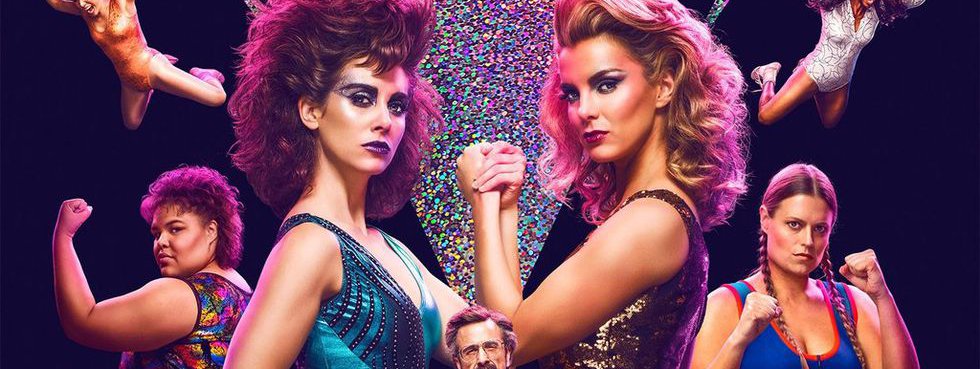
This season, GLOW聽continues to prove that it鈥檚聽more than聽鈥�80s nostalgia.
In Season 1 of Liz Flahive and Carly Mensch鈥檚 Netflix show, which premiered in 2017 and is based on the real-life Gorgeous Ladies of Wrestling circuit of the 1980s, viewers were introduced to a diverse cast of women. Via a Saturday morning wrestling show, these women embody a variety of personas. Crucially, these identities are steeped in stereotypes. For instance, there鈥檚 Arthie 鈥淏eirut the Mad Bomber鈥� Premkumar (Sunita Mani), an Indian American whose finishing move is 鈥淭he Beirut Bomber.鈥� There鈥檚 also Jenny 鈥淔ortune Cookie鈥� Chey (Ellen Wong), a Cambodian immigrant with a Chinese moniker. While these portrayals ostensibly offend, they鈥檙e meant to subvert, as the show charts the women鈥檚 increasing agency over their lives both in and outside the ring. This subversion is perhaps sharpest in GLOW鈥檚 second season, released this month, through the character of Tamm茅 Dawson (Kia Stevens), a food stamp-toting 鈥渁ngry black woman鈥� who goes by鈥攖hat鈥檚 right鈥擶elfare Queen.
In the fourth episode of Season 2, 鈥淢other of All Matches,鈥� Tamm茅 battles against Debbie 鈥淟iberty Belle鈥� Eagan (Betty Gilpin). In her personal life, Debbie is reeling from a divorce, but her wrestling alter ego is meant to be a foil for that: the all-American girl next door, with big blonde hair, red lipstick, rosy cheeks, and hokey phrases like, 鈥淧ersecuted by the English, we will persevere!鈥� She鈥檚 also meant to stand in contrast to the seemingly money-hungry Welfare Queen in their good-versus-evil throw-down. As the match begins, Welfare Queen saunters onto the stage with a fur coat, gaudy jewelry, and a bucket of fried chicken鈥攖he ultimate caricature. She then provokes the crowd by leaning even more into the stereotype: 鈥淵ou like my coat? Thank you for it, because I bought it with your taxes.鈥�
Liberty Belle wins, but the emotional crux of the match actually comes after the body slams have ended. Before Liberty Belle leaves the ring, she declares: 鈥淚 would like to dedicate my victory to all of the mothers out there鈥攅ven you, Welfare Queen. I know you鈥檙e a mother, too.鈥� She continues: 鈥淣o, y鈥檃ll, it鈥檚 true. She has many, many kids. But I have hope in my heart鈥擨 believe even the worst among us can be transformed. That鈥檚 why I got Welfare Queen an entry-level position at my favorite fast-food restaurant. Who wants Welfare Queen to get a job?鈥� The crowd shouts in agreement: 鈥淕et a job!鈥� Liberty Belle then places an apron around Welfare Queen鈥檚 body and a broom in her hand. It鈥檚 a humiliating scene, dusted with the belittling behavior of a white savior, and it becomes more heartrending when Welfare Queen meets the eyes of her son, Ernest, in the audience. At one point earlier in the show, he said of his mother鈥檚 persona, 鈥淪ounds like you鈥檙e playing a minstrel character on public television.鈥�
And yet, here, the scene works as a form of subversion because viewers know that Tamm茅 isn鈥檛 her stereotype鈥攖hat Welfare Queen is a gross mischaracterization. Ernest, for one, is a product of his mother鈥檚 hard work. At the beginning of the episode, Tamm茅 connects with a drive-through worker at least partly because she herself knows what it鈥檚 like to work long hours for little pay, and all while raising a child on her own. Ernest, too, defies society鈥檚 expectations for young black men: He鈥檚 the recipient of a scholarship to Stanford University, where he鈥檚 a medical student. Viewers see images of a worn-out Tamm茅 driving many hours, from Los Angeles to Stanford鈥檚 campus in Palo Alto, to see her son for only three hours. Theirs is a relationship between a doting, protective mother and an equally protective son. 鈥淚 can鈥檛 believe you did that. Wrestling. You threw a white girl across a ring,鈥� Ernest says after the match. It鈥檚 a line delivered not with contempt or embarrassment鈥攂ut with pride.
Notably, GLOW鈥檚 contrast of fact and fiction鈥攐f perception and reality鈥攎irrors the real-life concept of the welfare queen, a term popularized during the Reagan years to describe a spectral public aid scammer. The original welfare queen, Slate鈥檚 Joshua Levin in 2013, was Linda Taylor, a fair-skinned woman who could pass as various racial identities and who, in the 鈥�70s, was accused of welfare fraud, among other crimes. Despite the lack of evidence that welfare recipients, as a group, fraudulently hemorrhaged money from the economy, the term 鈥渨elfare queen鈥� was increasingly deployed to claim just that鈥攁nd it maligned black women in particular. This narrative has, over the years, shaped policy on poverty alleviation, and its implications can still be felt decades after Ronald Reagan first used it on the campaign trail. Today, when political candidates decry the excesses of welfare and people who supposedly profit from its inefficiencies, images of black women鈥攚ith many kids, untethered to a stable job or a nuclear family鈥攃ome to the fore. That Flahive and Mensch鈥檚 reimagined character pushes back against this historical demonizing makes Tamm茅 all the more clever.
But GLOW鈥檚 resonance in the America of 2018 stretches even further. In light of President Donald 国产视频 penchant for basing policies on stereotypes, it鈥檚 important to remember the damage that can be inflicted through flimsy narratives鈥攐nes fueled by false perceptions. Take 国产视频 signing this year of to limit financial assistance by imposing work requirements, which in many ways reinforce the Reagan-era bias against low-income black people, especially black women. As the writer Bryce Covert for the New York Times earlier this year, 鈥渨ork requirements have never been about helping the poor or unemployed. They鈥檝e always been about punishing black people.鈥� She adds that the exemptions some states are adding to these requirements, based partly on people鈥檚 geography, 鈥渨ould, in effect, spare white, rural residents from work requirements but not black ones in urban areas. These proposals have turned the subtext that was there all along into legible text.鈥�
This isn鈥檛 to say that Welfare Queen, the character, is perfectly nuanced. It鈥檇 be interesting, for instance, to see the show grapple with the fact that America often expects 鈥渨orthy鈥� people to be pure: affable, loving, fault-free鈥攍ike Tamm茅 and Ernest. And of the 20 episodes so far, 鈥淢other of All Matches鈥� is really the only one in which viewers must reconcile Tamm茅 and her onstage persona. Although Flahive and Mensch鈥檚 writing in this episode is a turning point in the show, it remains to be seen where they鈥檒l take Welfare Queen in the third season, and how she鈥檒l develop. Sure, the show pokes holes in the welfare queen trope, but what鈥檚 next? To meaningfully surface this stereotype only to quickly move on would be a missed opportunity鈥攂oth for the show and for its viewers. Early in Season 2, Arthie reinvents her character Beirut, transforming her from a bomb-wielding person of Middle Eastern heritage into an elegant dancer. Tamm茅 deserves this sort of reinvention鈥攖his agency鈥攖oo.
More 国产视频 the Authors
Related

Disability in the United States at 250

From 鈥楻isky Business鈥� to 鈥楳ission: Possible鈥�: Why ECE Learning Cohorts Work

State Education Budgets in Turbulent Times
