
How the Pell Grant Program Overtook PreK-12 Education Programs

In 2009, President Obama and a Democratic Congress passed the American Recovery and Reinvestment Act (ARRA), an economic stimulus package that included large, one-time cash infusions for some of the federal government鈥檚 largest education programs. But since then, Congress and the president reset funding for key PreK-12 programs back to their prior funding levels and haven鈥檛 increased it since. Meanwhile, they鈥檝e ensured that the Pell Grant program for undergraduate students from low-income families maintained the one-time funding gains and then some. Will a second-term Obama administration continue this Pell-at-the-expense-of-everything-else policy? First, let鈥檚 review how policymakers got here.
Under the stimulus bill, Title I funding for disadvantaged PreK-12 students grew by $10 billion. Special education state grants under Part B of the Individuals with Disabilities Education Act (IDEA) nearly doubled, with an extra $11.3 billion, in addition to the program鈥檚 regular 2009 appropriation of $11.5 billion. And the Pell Grant program for low-income college students got a $15.6 billion add-on to its 2009 appropriation of $17.3 billion.
Since then, lawmakers have boosted the U.S. Department of Education鈥檚 budget overall by a healthy sum (especially when compared with other agencies), up from $59.2 billion in fiscal year 2008 to $68.1 billion in 2012. Amidst that healthy increase, however, lawmakers kept Title I funding and IDEA funding essentially flat.
What explains the overall funding increase? A big part of it went to Pell Grants. But there is more to the explanation. After the stimulus money had run out for other education programs, lawmakers approved four additional years of for Pell Grants, which coincided with a separate increase to an entitlement funding stream for the program that started in 2008. The result may be the largest funding increase for any federal education program in history鈥攚hile other programs remained flat.
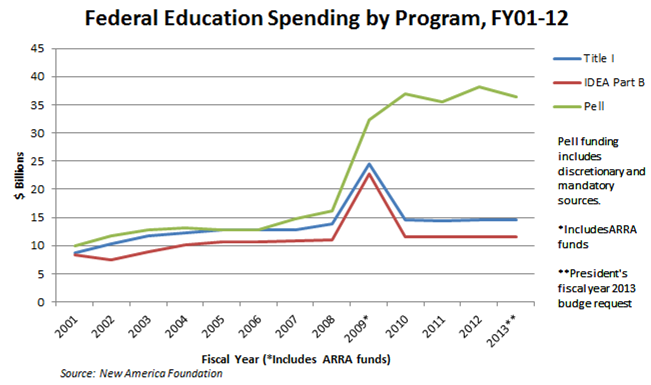
Here鈥檚 the kicker: That emergency supplemental funding lawmakers approved for Pell Grants will run out this year. So the program needs another infusion of funding of about $5.8 billion, according to the , just to keep it going in its current form. The following year that figure jumps to $8.7 billion. Over the next 10 years, the total gap is $76.5 billion.
Over the coming weeks and months, it鈥檚 time for lawmakers to starting thinking about smart ways to reform the Pell Grant program and put it on a sustainable funding path鈥攂ut also to ensure that the program serves low-income college students well. PreK-12 programs have a lot riding on that outcome.
More 国产视频 the Authors

Jason Delisle
Director, Federal Education Budget Project
Issues
Related

Children Belong in School Learning, Not Left to Languish in ICE Detention

A National Review of Early Childhood Cost Models: Findings on Children with Disabilities and Developmental Delays

Gender Equity in High-Quality Youth Apprenticeship: A Deeper Dive into the PAYA Data
