
In Erdogan’s Turkey, Less Freedom, More Terrorism
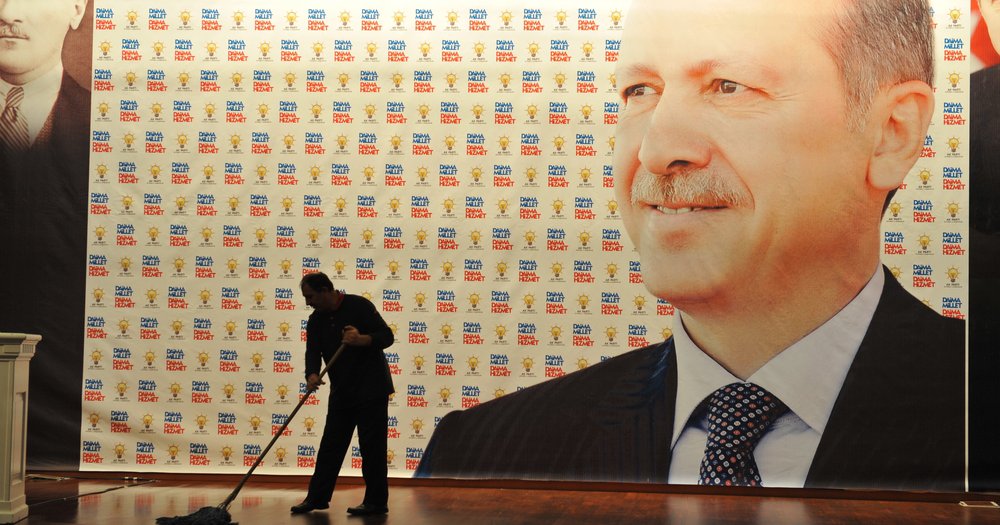
Democracies cannot stand without a strong foundation of an information base. This should be a universally recognized truth, but since much of the world seems to have forgotten: Justice, freedom, equality鈥攁ll such aspirations of a democracy are tested in an environment where there is free flow of information. Whenever that access to knowledge is distorted, restricted, or affected in any way, a democracy fails to endure. That is why a free press is necessary for freedom.
In essence, it would be an epic miscarriage of democracy if a state judiciary authority strips the nation of its right to access free press. And yet this is exactly what happened in Turkey on a Friday night (March 5), when Turkish police stormed into the country鈥檚 leading English daily, taking its staffers into custody under court orders.
On March 4, the headline of Turkey鈥檚 top opposition newspaper, Today鈥檚 Zaman, read, 鈥楥ourt appoints trustees to take over management of Zaman…鈥� Part of Feza Media Group, the court suggested a takeover of the management of Turkey鈥檚 chiefly regulated newspapers, the Zaman Daily, Today鈥檚 Zaman, and Cihan news agency using physical force, including 鈥渁rmed鈥� police inside the building and water cannons outside.
The next day, a police baton charged demonstrators outside the newspaper office, arresting reporters at Zaman for criticizing President Erdogan鈥檚 policies, accusing them of attempting to overthrow the government. Zaman鈥檚 management was then dismissed and, under a new leadership, the newspaper has since shifted to a rather pervasive pro-government stance.
Journalism has a long history of erosion in Turkey, where journalists of diverse background are routinely intimidated, threatened with legal action, and detained by the state. Some are imprisoned, tortured, and kept in custody for many years. The crime usually involves writing critically of the government. That is, doing their job.
Turkey鈥檚 media pool is humongous. There are around 300 private television stations and more than a thousand private radio stations are competing with the state broadcaster, TRT. Television, being the most influential news medium, is often run by influential businesses conglomerates, like the Dogan group, and hence often biased. If these biases do not align with state policies, the stations are deemed traitors and terrorists.
Journalists are habitually prosecuted when covering the government, the military, Kurdish issues, and political Islam, while broadcasts are frequently suspended for airing 鈥榮ensitive material鈥� on television or radio.
Kurdish reporters are unambiguously held on terrorism-related charges, as the country has rocked back and forth between peace and conflict with its Kurdish population over the last three decades. And now, crackdown on journalists from all backgrounds has consistently intensified as the Islamist-leaning government deepens its rigid policies against the Kurdish community and those who criticize the r茅gime in any way.
What鈥檚 most problematic in Turkey is when the state accuses journalists of being conspirators supporting terrorism. Last week (March 14) president Erdogan implored the government to 鈥渞edefine鈥� terrorism. He suggested that there was no difference between 鈥渁 terrorist holding a gun or a bomb and those who use their position or pen to support terror.鈥�
In the eyes of public, journalists whom the government then chooses to target immediately become enemies, and it befits the state to prosecute them as terrorists. It allows the state to justify and amplify its strategy to torture reporters, and to set an example of silencing a media that criticizes the r茅gime.
Kurdish media has been one of the most targeted, subjected to arrests and imprisonments over several years. When, in an interview with me, 33-year-old Omer Celik recalls his time in prison, he shudders. In 2011, Celik was arrested along with dozens of other Kurdish reporters in Istanbul, and ended up spending two years in Istanbul鈥檚 Khoceli Kandera prison. Many of his colleagues stayed in prison for much longer. 鈥淚 struggled between wanting to choose between my three identities; that of a journalist, that of a Kurd and that of a quiet slave of the state鈥� If I could stop doing my job as a journalist, I would be free from torture, but still I would not be free of discrimination,鈥� Celik told me in Diyarbakir, where he works for DIHA, a leading Kurdish news agency. In prison, he was kept in a closed room with little light, and was not permitted to speak to fellow prisoners, many of them journalists, even during breaks. The government accused him of joining the PKK, and going to Qandil鈥搕he main PKK base in Iraq鈥揻or training. Celik, who did not own a passport, said, 鈥淚 could not have gone to Qandil without a passport. They had no proof against me, but they still kept me in prison for two years.鈥�
Now is a particularly disturbing time for press in Turkey, a core ally of the United States in the fight against ISIS, and a NATO member. To objectively document Turkey鈥檚 fight against terrorism, its media needs to be free and intrepid. Especially amidst the heavy criticism that Turkey faces for aiding and abetting ISIS and instead solely fighting the PKK in order to diminish the long Kurdish struggle for freedom.
Indeed, it is also important to properly document Turkey鈥檚 crackdown on Kurdish rebels groups, and the ongoing violence in southern Turkey. In the past few months, during the curfews in southeast Turkey, the state has launched tanks and fired bombs at civilian targets, destroying entire neighborhoods and killing many civilians. For weeks before the curfew rested, images and information about such attacks were only available via social media, shared by local witnesses and victims, drawing little and delayed attention of human rights groups. For example, this by local journalists in Cizre shows civilians trying to collect dead bodies from the street and being shot at by Turkish forces. It received little attention from the UN and foreign media. The state has accused journalists of supporting terrorism, for covering the civilian casualties in the conflict between the PKK and the state.
In the absence of free media, critics say, the Turkish government will be able to continue such abuses without accountability. And while that may help Turkey in its goal with quelling its arch rivalry with Kurdish militants like the PKK, it would also mean fewer opportunities to investigate Turkey’s fight with ISIS. More than anything, though, it would mean that Turkey is posing a threat to its own democracy and freedom, which cannot and will not exist without a free press.
More 国产视频 the Authors
Related

“Getting the Golden Ticket”: Participants’ Perspectives on Lexington’s First Assembly

Civic Assemblies: A Framework for Community Colleges

Don鈥檛 START Now
