
Heather Hurlburt
Director, New Models of Policy Change
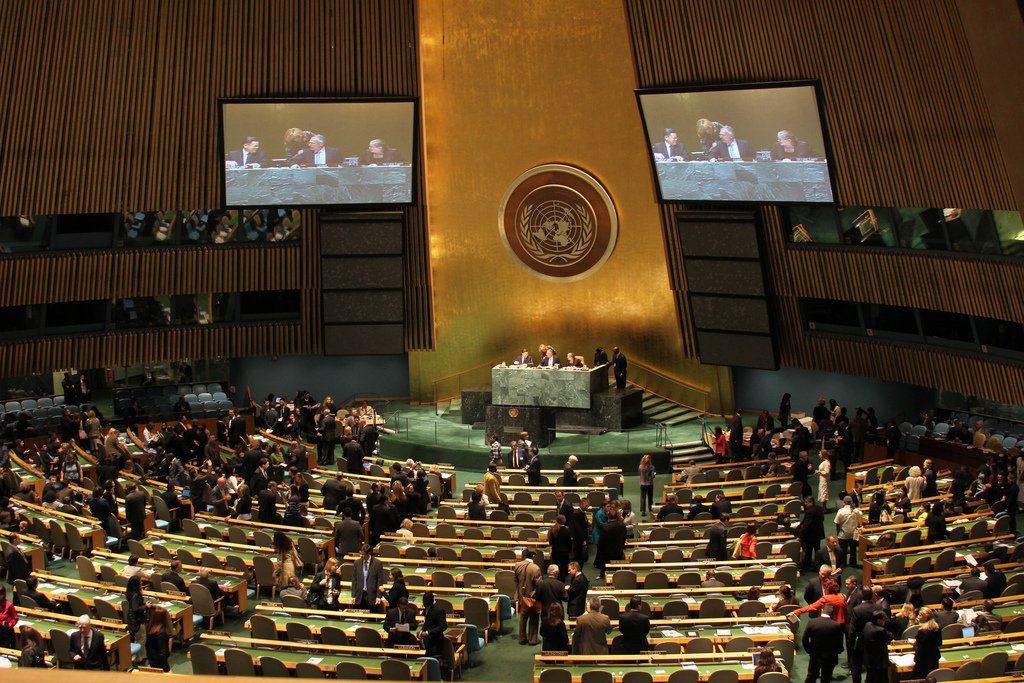
The open government agenda has largely sidestepped the international policy arena. Many of the thinkers who launched openness initiatives have made that choice deliberately, seeing foreign policy as either devoid of big data opportunities or actually inappropriate for public transparency for security reasons. After Snowden and other massive leaks of sensitive intelligence information, the arena may be perceived as too ideologically contested, as well. But this conclusion misses developments already happening in global governance鈥攏ot so much that government-held data is being opened to the public, but that governance itself is being opened to non-governmental inputs and actors.
It should be noted that open government did make an appearance in international policy when the Obama Administration launched the Open Government Partnership (OGP). The U.S. joined an initial 7 countries鈥攏ow up to 69鈥攊n holding civil society consultations, drawing up national action plans, and making commitments to increase transparency in areas from legislation to policing to. In addition to those changes on the government side, OGP has offered civil society groups a spark and a mandate for their work. Still, the appearance of open government as a foreign policy tool abroad has not changed the reality at home. The open government agenda sits uncomfortably with traditional ideas about secrecy and expertise in foreign affairs.
However, the expectation that foreign and security policymaking are the exclusive provenance of governments is under assault from another direction. 鈥溾�� 鈥攖he trend toward non-governmental entities, both civil society and private sector, joining national and international authorities at the negotiating table and in the trenches afterwards, when new rules and norms are being developed and implemented– arose independently of the open government movement, but it too is 鈥渙pening鈥� global governance dramatically. Perhaps the best known is last year鈥檚 Paris Climate Agreement, in which non-state parties could join nation-states in pledging to keep the global rise in temperatures below two degrees Celsius鈥攚hich more than 700, from corporations to municipalities to trade unions, did. Despite its clunky name, this variant of 鈥渙pen鈥� global governance is looking like the wave of the future鈥攆rom Internet governance to codes of conduct for mining and security contractors to reforming agriculture to promoting development.
The premise behind the open government movement鈥攖he one that鈥檚 gotten so much attention at home鈥攚as that governments are vast repositories of data鈥攚hich citizens have the right to know, and with which citizens will often be able to use to make change in ways that government cannot. It is perhaps an irony that the Administration which has made open government a byword at home and internationally has been more aggressive than any predecessor in protecting information in the national security space鈥攁nd has suffered more embarrassing failures to protect information. Actors from Russian and Chinese intelligence to contractors with dreams of grandeur have mocked the U.S. ability to keep information secret. Edward Snowden鈥檚 justification for his theft and release of reams of classified information, and the campaign mounted by his supporters, have argued that what others consider treason was in fact opening the government. As a result, talk about extending the open government agenda to the national security space will be met with more eye-rolling and outright hostility than eight years ago, not less.
But the addition of outside stakeholders to international norm-setting, rule-making and implementation offers potential by turning the 鈥渙pening鈥� in the opposite direction. Rather than mining data provided by a more open government, contemporary multi-stakeholder processes are contributing data, technology and analysis鈥攂ut also on-the-ground operators, political will, and cold cash鈥攖o governments and international organizations.聽To cite just two , technology whizzes deployed knowledge that few if any government bodies possessed to create and run ICANN (the Internet Corporation for Assigned Names and Numbers). GAVI, the global vaccine alliance, deployed the know-how of the pharmaceutical industry and the financial wherewithal of the Bill & Melinda Gates Foundation to address a problem on which national and international institutions lacked both resources and will.
Making the national security apparatus more open to inputs and collaboration is no small matter, either. The Agency for International Development, and in Obama鈥檚 first term the Department of State, built new bridges and a variety of intriguing pilot programs, but it is far from clear that these efforts have achieved scale to survive less-committed leadership, or that they have fundamentally altered the way American practitioners think about diplomacy and statecraft.
Indeed, a forthcoming review of one of the Administration鈥檚 most interesting innovations in foreign policy-making, the Atrocity Prevention Board, calls for improvements to its government-civil society interface that would permit non-governmental actors to serve as real-time sources of information and response鈥攏ot just an advocacy and fundraising adjunct or worse, a set of powerless critics. The recently-announced formation of an interagency represents a parallel opportunity. The Memorandum outlining the new group鈥檚 functions sees it setting research requirements,聽cataloging聽data gaps, and developing shared analyses of key data-driven questions, with 鈥減roduction and exchange of climate data and information with relevant stakeholders, including the United States Intelligence Community, and private sector partners, as appropriate.鈥� The experience of the Atrocity Prevention Board, and public-private partnerships at the State Department and elsewhere, demonstrates how challenging it is for the USG to be in open, listening mode, but also how rewarding.
It seems likely that, whether they regard it as part of an open government agenda or not, future national security policymakers will find it necessary and even advantageous to wrestle more analysis, policymaking and implementation processes 鈥渙pen鈥� to inputs from outside. The question they ought to be asking, and where domestic policy thinkers can be offering answers 鈥� what lessons do eight years of an open government agenda have to teach leapfrogging late adapters?
Director, New Models of Policy Change


