Amaya Garcia
Director, PreK-12 Research and Practice

Last summer, the Council of the District of Columbia held a hearing on a聽聽(e.g. translation and interpretation) at school. Many D.C. students, the majority of whom were English learners, provided testimony about how difficult it was to navigate day-to-day school routines when they did not know English. As my former colleague Isabella Sanchez wrote in a聽聽about the hearing, 鈥淥ne student had such a terrible first day at school that she did not want to return. She said she felt 鈥榠nferior and alone鈥� when she could not find anyone to help her navigate the confusing logistics of starting high school, or at least help her ask for lunch.鈥�
Experiences like this student鈥檚 could be one reason that that American ELs have聽听补苍诲听聽than their non-EL peers. Consider: the average graduation rate in the U.S. is 82 percent, while the average EL graduation rate is just 62.6 percent.
States, districts, and schools clearly have substantial work to do in boosting the graduation rates of their English learners. In Prince George鈥檚 County Public Schools (PGCPS), is the聽, 56 percent of ELs graduated high school within four years in 2014. That same year PGCPS partnered with the聽聽and local immigration advocacy organization聽聽to create聽.
Their effort was bolstered by a聽聽from the Carnegie Corporation of New York as part of their聽聽that aims to support school redesign. In PGCPS, those funds are used to both build the capacity of school administrators and staff via coaching, specialists, and a school design manager and to support their work integrating聽(CBE) into their school models. CBE provides students with flexibility to demonstrate their mastery of a topic in multiple ways, which means ELs have the opportunity to show their knowledge even if they don鈥檛 have strong English language skills.
The new high schools opened in the fall of 2015. Students must apply to the school and are admitted via lottery, which means that these are schools of choice. Once admitted, students are assigned to one of the two schools based on where they live in the county. That has resulted in very different populations of ELs between the two schools. The International High School at Langley Park enrolls a high number of 鈥渘ewcomers鈥� 鈥� kids who have recently arrived in the country and have very low levels of English proficiency. By contrast, at the聽, twenty percent of the incoming freshman class are classified as聽, many of whom have been classified as ELs since kindergarten. Many of these students have strong speaking and listening skills in English, but have not mastered reading and writing in English. Only fourteen percent of students are considered 鈥渘ewcomers.鈥� Partly as a result of these demographics, the school has a fairly even distribution of students across a range of聽聽English language proficiency聽.
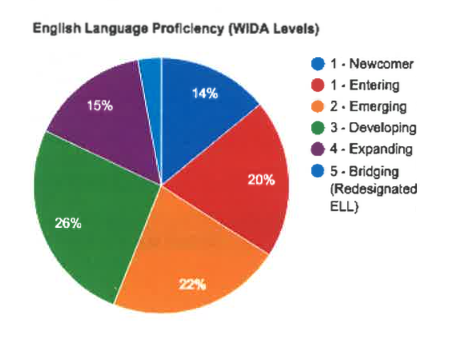
That diversity of ELP might seem challenging, but the school sees it as an opportunity. It follows the model for educating ELs, an approach that emphasizes student collaboration across lines of difference. In this case, students of different ELP levels, academic background, literacy levels, and native language are placed together in small groups to work together in projects. That allows students to teach and learn from one another. As the International HS at Largo鈥檚 instructional coach Andrew Sigal noted, grouping students together who speak different languages gives them an opportunity to use their developing English skills, since 鈥淓nglish is the language they have in common.鈥�
When I visited the school, the collaborative ethos stood out. Each student has her own laptop, which helped facilitate their work together. Students worked together to find answers on the internet or in-text and to troubleshoot problems. Teachers spent their time circulating to help groups that were stuck, review work, and answer questions.
Language and content integration is another key pillar of the Internationals鈥� model. That means all content teachers become language teachers by integrating language development into their content area instruction. As Sigal shared, it鈥檚 an 鈥渋nstructional shift to take a content-area teacher and say you鈥檙e going to be a language instructor as well.鈥� To support this 鈥渟hift,鈥� teachers participate in a seven week training over summer break and receive ongoing coaching and professional development. (For a district-wide approach to raising the language competencies of content instructors, see 国产视频鈥檚 recent report on the David Douglas School District.)
The program鈥檚 substantial resource requirements (material and human alike) have created some grumbling in the community. In recent years Prince George鈥檚 County Public Schools has undergone and faced severe budget constraints that have made it difficult to implement and sustain policies aimed at supporting their most vulnerable students. Over the summer of 2015, PGCPS School Chief Kevin Maxwell had his plans to . Yet Maxwell was able to preserve the funding for the two new international high schools. The quoted one school board member: 鈥淓nglish-language learners deserve specialized attention and instruction. But basic learners need specialized instruction and support so they, too, can become college-and career-ready. We鈥檝e got to be equitable.鈥�
At the same time, the Prince George鈥檚 branch of the NAACP the schools鈥� creation because . But from the perspective of Alison Hanks-Sloan, principal of the International High School at Largo, the school does not separate EL students to marginalize them, but to help them succeed. That is, the model does segregate ELs because of their unique language needs, but it also provides them with access to and opportunities to collaborate with peers who have different backgrounds and abilities (and frequently speak different non-English languages at home). 鈥淲e define segregation as a forced situation and our school is an option, a school of choice,鈥� wrote Hanks-Sloan in an email, 鈥淲e provide students who traditionally have not participated in specialty schools or academies in our district with an alternative opportunity for high school.鈥� 聽
The model’s design (ELs-only) may also be particularly justifiable in a county where ELs have persistently had lower graduation rates than their non-EL peers. As Hanks-Sloan argued, it was time for the district to take a different approach and provide EL students with a high-quality school option that would actually support their unique needs. 聽
Fortunately, evidence suggests that the Internationals鈥� model . Consider an example from New York, where several schools have used this model for many years. In 2011, EL graduation rates in New York City and New York state were only 37 and 36 percent respectively. By contrast, the 2011 four-year graduation rate for students in New York City was 64 percent. Even better, 79 percent of their 12th grade students were accepted into college. It鈥檚 hard to argue with those numbers 鈥� hopefully they鈥檙e a harbinger of similarly strong results for Largo鈥檚 ELs.
—This post is part of 国产视频鈥檚 Dual Language Learners National Work Group. . To subscribe to the biweekly newsletter, click here, enter your contact information, and select “Education Policy.”“
Director, PreK-12 Research and Practice