
Let Media Freedom Ring: An Interview with Dunja Mijatovic
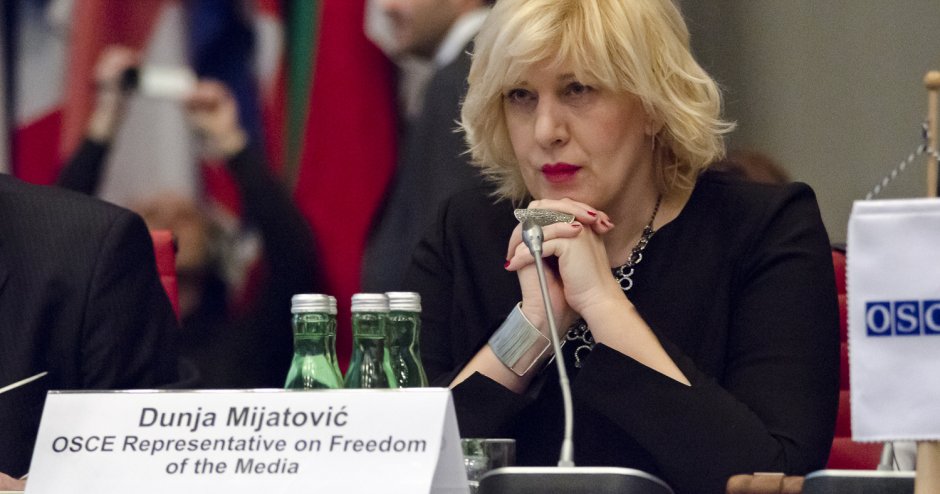
鈥淐ourageous journalists are really suffering nowadays.鈥�
So said Dunja Mijatovic, who should know. In the event that you don鈥檛, here are the numbers: 118 journalists were killed last year, the end of an eight-year period during which one died every week. 221 journalists were jailed last year, the second-worst year on record.
What’s remarkable about Mijatovic鈥檚 cognizance of the plight of reporters today is that, as the Representative on Freedom of the Media to the Organization for Security and Cooperation in Europe, she’s in a unique position to help. Where you might think governments don’t want pesky journalists shining a light on their actions, the, which is composed of 57 participating states (including the United States), believes you can’t have security without a free press (along with the usual stuff, from arms control to democratization to human rights).
Adding to the personal risk for reporters, internet freedom is on the for the fifth consecutive year. Free media outlets are under pressure in and. Award-winning journalist Khadija Ismayilova faces a nine-year sentence in a case that seems to be connected to exposing state corruption in. Journalists were charged for covering police brutality in the.
Enter Mijatovic. As her time in the position , we spoke briefly to the Representative about the challenges of fighting for media freedom, what common challenges exist from Bosnia to Boston, and how her job鈥攁nd the state of journalism in the world鈥攈as changed.
You became Representative in 2010. How has the job/issues facing it changed in the past five years?
The challenges are greater. The problems are more present and more visible. This is related to conflict in certain areas in OSCE, but also outside鈥攖errorism, extremism, and many other things. I would say, after almost six years, it seems we are living in a more dangerous time. A time to be more concerned about our human rights, our fundamental rights in general.
Aside from what it says on 鈥攚hat is it that you, personally, are trying to do in this position?
The main issue is really to protect one of our fundamental human rights: expression. With that, freedom of the media. The other is safety of journalists, offline and online. The mandate, if you look at it, is quite broad. It depends on what you see and think is important鈥� [The OSCE Representative on Freedom of the Media] is the only inter-governmental media watchdog in the world. I have direct access to the governments, but I鈥檓 also working closely with civil society. And to help journalists in prison for the work they did, the charges they are facing. The problems are really different in different areas. But across the whole region, journalism is in danger. Courageous journalists are really suffering nowadays.
What do you see as being the biggest threats to media freedom in Europe today and why/what are the most pressing situations?
Safety, online and offline, the fight against terrorism and extremism鈥攊t depends about which region in the OSCE you are talking. I鈥檓 looking not just at specific countries, but the challenges journalists are facing globally. The latest project we did recently was on. This is something happening across the region, in all democracies. When it comes to intervention, it鈥檚 really a case-[by]case basis. There鈥檚 almost not a day where I do not have to intervene. But I鈥檓 also trying to work with journalists. You also have an issue related very much to propaganda related to Ukraine. Soon鈥攑robably in the next two weeks鈥擨鈥檓 going to issue a publication on how to deal with and tackle this really controversial issue. [Between the time of this interview and the time of publication, the OSCE and Reporters without borders .]
Do you get the sense that Americans think of issues of media freedom in Europe鈥攊ncluding places like Georgia, like Azerbaijan鈥攁s being relevant to them/us? And how would you convince the American media and politicians and people that, say, [the television channel most sympathetic to the opposition in Georgia] matters?
I don鈥檛 know that, to be honest with you. But each and every participating state, including the United States, has an obligation to the OSCE. In my job, I do not really go into this, do I have to convince an American or a Brit or a Bosnian. 鈥 had many interventions in the United States on this . I think that it is relevant in the same way that everything that鈥檚 happening in media freedom in the United State is relevant to Europe. I react on certain cases that I see as something to be a threat to journalists or media freedom in general. 鈥he most powerful thing I have in my toolbox is my voice, in order to raise attention or a little red flag when I see that there are problems. And the problems are across the region. All these things need to be discussed 鈥hat I鈥檓 also calling for is more cooperation for human rights organizations across the region.
You’re originally from Bosnia. Do you think the fact that you’re from the Balkans or so-called “Eastern Europe” lends you a different perspective?
Probably. Coming from a post-conflict environment, post-war environment, experiencing how important it is to preserve our fundamental values, particularly in times of conflict and not to take it for granted, gives me this additional perspective. Like when I was in Crimea last year鈥攖he media was the first to be a target. But then again, the time is also changing, and we have more and more new challenges, and that鈥檚 why I think it鈥檚 important to look at the threats the way they are and to try to tackle it by raising a voice, and also by working with civil society and journalists.
And finally 鈥� We鈥檝e spoken about what鈥檚 gotten worse, but how have they improved? Is there a situation in which you’ve seen media freedom increase?
There are countries trying to adopt better laws. But then again, I can think of my part of the world, the Balkans. Very good laws were adopted, but then when we talk about implementation鈥t鈥檚 not present yet. There are examples of journalists being released from prison鈥攚hat I would say little steps鈥攖hat I welcome. I鈥檓 not pessimistic, but I鈥檓 realistic. It would be very difficult to say that there are 鈥渟uccess stories,鈥� just based on the statements I鈥檓 making every day. Positive changes are very rare, unfortunately.
This interview has been condensed and edited.
More 国产视频 the Authors
Related

“Getting the Golden Ticket”: Participants’ Perspectives on Lexington’s First Assembly

Civic Assemblies: A Framework for Community Colleges

Don鈥檛 START Now
