
Abbie Lieberman
Senior Policy Analyst, Early & Elementary Education

I recently visited the Day Early Learning Lilly Family Center in Indianapolis, a non-profit child care center serving children between the ages of six weeks and four years. The center director, Vanessa Fletcher, welcomed my colleague and I with open arms. She gave us a tour of the building, saying hello to teachers, giving out hugs to students, and picking up toddlers in classrooms along the way. 聽She pointed out the different parts of the pre-K classrooms, such as the dramatic play area and the science center. She told us about the curriculum her school uses and how it aligns to the state鈥檚 early learning standards. Ms. Fletcher holds a bachelor鈥檚 degree in early childhood education and it was clear that she had a strong understanding of how young children learn and grow.
Lead teachers at聽Lilly Family Center聽are required to have at least an associate鈥檚 degree and most have a bachelor鈥檚 degree. All teachers interested in furthering their education are eligible for scholarships to help them earn their bachelor鈥檚 degree. We saw teachers who were responsive and engaged with the children.聽Ms. Fletcher explained that many staff members have been working at the center for more than 20 years. (The cook, who makes healthy meals in the center鈥檚 full service kitchen, has been there for 40!). High teacher turnover is common in child care centers. It鈥檚 clear that children in this center are learning, and there are聽.聽Almost all children leave Lilly Family Center ready for kindergarten according to the state鈥檚 developmental assessment.
While there are multiple factors that determine child care quality, it鈥檚 the nature of the interactions between the teacher and the child that are most important. These interactions are where learning happens. Research reveals聽聽and again that out of all in-school factors, teacher have the largest impact on student success. Principals are a close second. The same is true for birth-to-five early childhood programs:聽. Lead teachers and center directors in child care centers need to have a strong understanding of child development, how young children learn, and how to have high-quality back-and-forth interactions with them.
Unfortunately, too many states have low expectations for the child care workforce. Late last year, our team released聽, a comprehensive report ranking states on 65 indicators in seven policy areas that promote strong literacy skills by the end of third grade. We included two indicators to gauge the quality of the child care workforce:
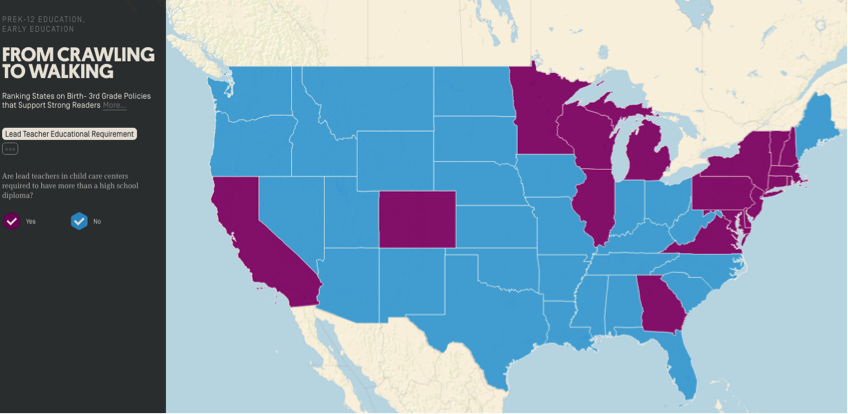
Using data from聽, we found that as of 2013, educational requirements were significantly lower for educators in licensed child care centers than for teachers and leaders in preK-12 public schools. Only 18 states and Washington, D.C. (displayed below in pink) require lead teachers in child care centers to have more than a high school diploma. Seventeen states don鈥檛 even require a high school diploma. While almost all states require elementary school teachers to hold at least a bachelor鈥檚 degree, Rhode Island is one of the few that requires something similar for teachers in licensed child care. 鈥淗ead teachers,鈥� or Education Coordinators, in Rhode Island must hold a bachelor鈥檚 in early childhood education
Developmental science makes clear that the early years are crucial for children鈥檚 developmental growth and learning, yet teachers and caregivers throughout the country are not required to have any background or training in early childhood education prior to entering the field. While child care was once seen primarily as a work support for parents, we 聽that children鈥檚 brains are developing rapidly in the early years and that positive interactions and relationships with adults play a large role in fostering their learning.
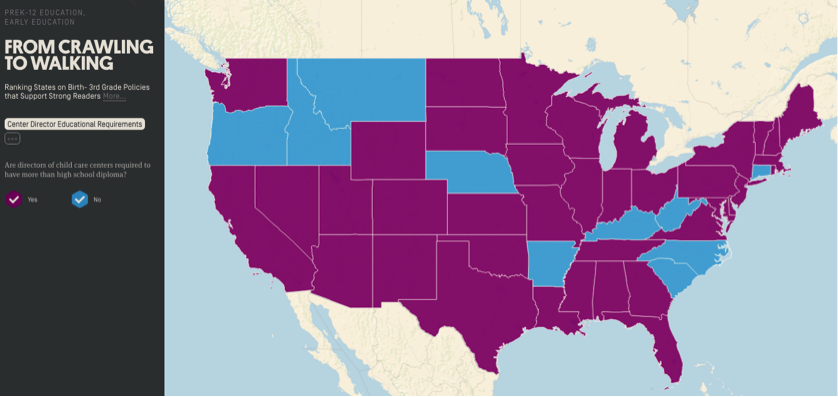
Ten states (shown below in blue) do not require center directors to have more than a high school diploma and a few of these don鈥檛 even require that.
Running a child care program is similar to being an elementary school principal. Like a principal, center directors are responsible for hiring, training, evaluating, and retaining high-quality instructors. They oversee the facility, make sure the environment is safe and appropriate for young children, communicate with families, and usually choose a curriculum and assessments. Elementary school principals usually need to have a masters degree, a separate principal license or credential, and years of experience in the classroom before leading their first school. Yet center directors in a handful of states do not need to have any college credit or courses, increasing the likelihood that they are underprepared to fulfill the many important duties associated with this job.
According to , 12 states require center directors to have a Child Development Associate (CDA) credential and 21 states require them to have more than a CDA credential or an associate degree in early childhood education. Only one state, New Jersey, requires child care center directors to have a bachelor鈥檚 degree, but in any subject. The Department of Defense鈥檚 (DoD) early education program is the only one that requires a bachelor鈥檚 degree in early childhood education or a similar field. (The Hechinger Report recently published explaining how and why the DoD is leading the way.)
In Indiana, where the Day Early Learning Lilly Family Center is located, must have an associate鈥榮 degree in early childhood education or a related field. Lead teachers in child care centers are not required to have more than a high school diploma. The Lilly Family Center is licensed, nationally accredited, and has earned the highest rating on the state鈥檚 QRIS, . Child care quality varies substantially throughout the state, however, and the quality seen at Lilly Family Center is likely the exception as opposed to the rule. While education requirements are not the only factor impacting the quality of instruction and care, research suggests that they can have a positive impact.
In the National Academy of Sciences and Institute of Medicine鈥檚 seminal report, , experts recommend strengthening the competency-based qualification requirements for child care professionals. The report specifically recommends that programs transition to a minimum qualification of a bachelor鈥檚 degree with specialization in early childhood for all lead teachers working with children from birth through age eight. The rationale is that this 鈥渋s likely to contribute to improving the quality of professional practice, creating coherence in qualification systems such as credentialing and licensure, stabilizing the workforce, and improve consistency in high-quality learning experiences and optimal outcomes for children鈥︹��
Ted Maple, President and CEO of Early Learning Indiana which runs the Lilly Family Center and many other child care centers in the Indianapolis area, identified compensation as one of the greatest barriers to attracting and retaining quality teachers. Even though the Day Early Learning Centers pay relatively well compared to other centers in the Indianapolis area, it can be difficult to compete with public school districts that have more resources. 聽
Many child care teachers across the country make and rely on . 聽It鈥檚 unrealistic to expect providers to attract and retain teachers with higher education qualifications if they are not paid at least a decent wage. In comparison, public benefit from higher salaries, health care, paid sick leave and vacation days, and a 10-month work year. As the early childhood field, states, and local programs consider how to move towards the bachelor鈥檚 degree requirement for all lead teachers, compensation including benefits will have to be a major part of the conversation. 聽The National Academy of Sciences and Institute of Medicine are looking to start a study on financing early care and education with a highly qualified workforce, pending funding.
Ensuring that teachers and caregivers have a deeper understanding of child development, how young children learn new concepts, and the science of adult-child interactions is an important step to improving the quality of child care centers. But without improving wages, benefits, and working conditions, it will be nearly impossible 聽to attract and retain high-quality early educators.
听“
Senior Policy Analyst, Early & Elementary Education


