
Meeting Special Needs: Invest Early, Save Later

I started my education career as an early childhood special educator. In my first days and weeks on the job, I learned an astounding amount. These lessons ranged from the clich茅, but truly essential, 鈥減atience is a (very helpful) virtue鈥� to the less clich茅, but arguably no less essential, 鈥渋f you plan an activity that uses glitter, expect to find it on everything you own for the next six-to-nine months.鈥� Among these guiding mantras for navigating daily classroom life, I also learned that when it comes to providing free appropriate public education () for children with disabilities, money is inextricably, often frustratingly, linked.
Funding for early childhood special education is complex (see the graphic below)鈥攖ied to federal, state, and local funding sources. Federal law requires local education agencies (LEAs) to provide free appropriate public education under the Individuals with Disabilities Act (IDEA), but LEAs are largely responsible for picking up the tab. Under Part B of IDEA, Congress is authorized to provide up to 40 percent of the average per pupil expenditure for children with special needs, but, in most states, federal funds account for an average of only 16 percent of estimated costs, according to some聽estimates.
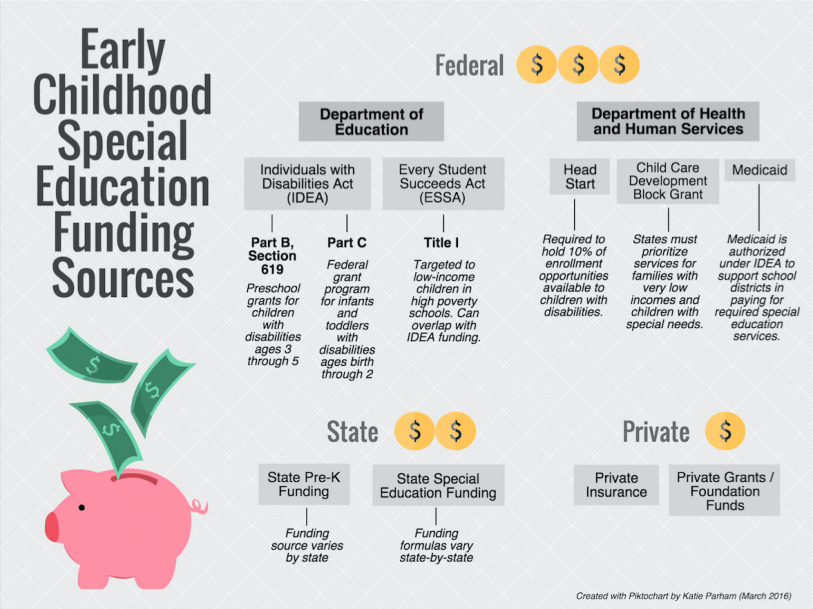
What this funding gap can mean on the day-to-day level is a tension between the provision of legally-mandated services and the money necessary to support them. Full-time paraprofessionals, specialized resources, and qualified special educators (already to come by) all require funding for support. Underfunded special education programs often face perverse incentives that can lead to decisions far from the best interest of students. Lack of funding to support the hiring of a paraprofessional for a student with severe needs, for instance, can lead to incentives to delay a formal evaluation of the child, keep the child in a restrictive classroom environment, or worse鈥攍ead well-meaning but cash-strapped administrators to find a reason to move the student to a new educational institution entirely.
In 2013, cut $2 billion from the Department of Education鈥檚 budget, eliminating $600 million from federal special education funding and leading to budget shortages in special education programs around the country. Despite this recent shortfall, funding for early childhood special education could be on the rise next year. Earlier this month, President Obama released his FY 2017 , which included a number of funding updates to preschool special education funding. While special education funding for school-aged children (K-12) would stay the same under the proposed federal budget, funding for children with special needs ages birth through five would see an increase in several areas.
Under IDEA Part B Section 619, preschool grants supporting children with disabilities ages three through five would see a $35 million funding increase in the new budget. And, under IDEA Part C, special education grants for infants (ages birth through two) and families would be allocated an additional $45 million over last year鈥檚 spending levels. Within this $45 million, $15 million is reserved for the Department of Education to provide supporting model programs for early screening, referrals, and early intervention services.
This last element鈥攕creenings鈥攊s very important as early care and education programs play a crucial role in the early identification of children with exceptionalities, enabling schools to support the individualized needs of children from their first year. (Developmental screenings were used as an indicator of states with strong birth-through-3rd grade policies in 国产视频鈥檚 recent report, .)
Additionally important, early education can help reduce special education costs later in a child鈥檚 educational career. A from Duke University in North Carolina last year found that a child鈥檚 attendance in North Carolina鈥檚 鈥淪mart Start鈥� or 鈥淢ore at Four鈥� programs reduces the likelihood that a child will need special education in third grade by 39 percent. There are financial as well as educational benefits to this reduction. The lead author of the Duke report, Clara Muschkin, noted that special education nationwide costs almost twice as much on average than general education. A reduction in the number of students with special needs, therefore, can have long-term financial benefits for states and school districts.
Also worth noting in the Duke study is that 鈥淢ore at Four,鈥� specifically targets low-income or otherwise disadvantaged four-year-olds. Children from low-income families are likely to have access to high-quality pre-K, but are also likely than higher-income peers to be classified as having special needs during their educational career. It makes sense, therefore, that Muschkin and her team found a reduction by 32 percent in special education placements for graduates of the 鈥淢ore at Four鈥� program versus a 10 percent reduction for the comparison program, 鈥淪mart Start,鈥� which did not strategically target students from low-income families.
Given these results, it is also good news that in addition to the previously mentioned budget increases in the proposed FY 2017 budget, Obama鈥檚 latest proposal once again puts $75 million toward a new federal-state designed to provide all low- and moderate-income four-year-old children with high-quality pre-K. This initiative, partnering with all 50 states, would allocate funds to states based on the number of children in each state from low- and moderate-income families.
According to the Department of , the number of children served under IDEA has increased under both Part C (children birth through age two) and Part B Section 619 (children ages three through five) since 2004. As the department鈥檚 most recent annual notes, 6 percent of the population of U.S. children ages three through five receives specialized education services annually under IDEA, along with 2.8 percent of children ages birth through two. As these population percentages have continued to increase, appropriate funding to support the needs of children in school settings is essential and a solid investment for school districts more broadly. Here鈥檚 hoping the President鈥檚 increased budget allocations for early childhood special education become a reality. “
More 国产视频 the Authors
Issues
Programs/Projects/Initiatives
Related

Confronting Harmful Federal Disability Policy in Health and Human Services

Federal Early Education Update: March 2026

A Bureaucratic Shakeup Threatens Future Child Care Research
