
More and Poorer Poor in California
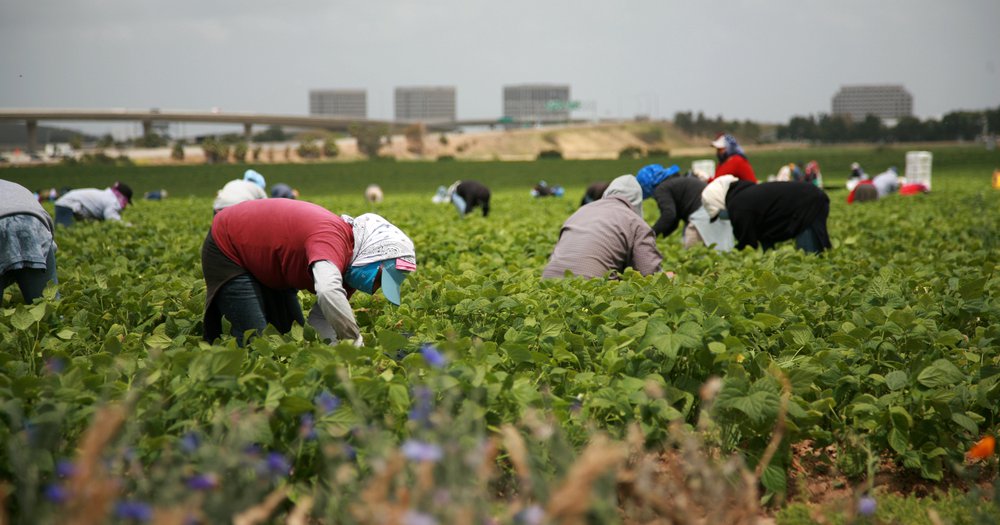
Earlimart, Tulare County 鈥� After a day of picking grapes for $9.25 an hour, Eva Montes waits in line for food aid in the parking lot of the Veterans Memorial building in Earlimart, a community of 8,537 people.
鈥淵ou can鈥檛 make enough money for what you spend,鈥� Montes says in Spanish while waiting with other farmworkers for her number to be called. Today she鈥檒l take home a box of bagged greens and other produce distributed by a local non-profit.
鈥淪ometimes, you don鈥檛 earn enough to buy things for what the children need for school, or food for the house, or personal expenses 鈥� like house payments or bills.鈥�
Montes is part of a growing economic problem in California: low wage workers are getting poorer, and there are more of them.
There were about 354,800 Californians working full-time and year-round in 2013 living under the federal poverty limit, according to the nonprofit California Budget and Policy Center. That鈥檚 3.1 percent of California鈥檚 full-time workforce, double the rate it was 35 years ago.
鈥淎 low-wage worker today earns less than a similar worker would a generation ago,鈥� said Luke Reidenbach, policy analyst with the center, which researches how state policy affects low- and middle-income Californians. 鈥淓ven as the economy grows, that鈥檚 not resulting in an increase of their hourly wages, and so over time the value of their wages has eroded.鈥�
Pay for California鈥檚 bottom 20 percent of wage-earners has declined by 11.3 percent since 1979, when adjusted for inflation, according to the center.
Other research has tried to calculate the tax cost of California鈥檚 working poor. UC Berkeley Labor Center, a liberal-leaning research group, estimates low-wage California workers and their dependents received $14.3 billion a year in cash assistance, health care, food stamps and tax credits between 2007 and 2012.
The California Department of Health and Human Services doesn鈥檛 have its own estimate on how much the state spends on public assistance for working people, and declined to comment on the accuracy of the labor center鈥檚 estimate.
Looking at another measure that takes public assistance benefits and regional costs of living into account, almost 8 in 10 Californians considered poor by the government鈥檚 standards in 2012 lived in a family where someone worked, according to the nonprofit, nonpartisan Public Policy Institute of California.
鈥淎t the very least, we would expect work to lift people out of poverty,鈥� Reidenbach said.
These economic trends are part of what has ignited a movement among labor and policymakers to raise the minimum wage beyond California鈥檚 scheduled $1 increase to $10 an hour on Jan. 1, 2016.
Researchers say the new $10 minimum is expected to bump a family of three with one full-time, year-round worker above the federal poverty limit. But others say when regional living expenses are considered, a family of three living in the Los Angeles region, the San Francisco Bay Area and other expensive parts of the state will have trouble making ends meet on one person鈥檚 minimum wage job.
Who Are the Working Poor?
Overall, more low-wage workers are older than they were in 1979, although on average they are younger than the workforce as a whole, according to the UC Berkeley Labor Center.
More than half of today鈥檚 low-wage workers in California are Latino, according to the labor center, and 40 percent were born outside the United States. As a whole, the share of the working poor that had some college education is 9 percent more than it was a generation ago. The majority of low-wage workers, 53 percent, have only a high school education or less.
The working poor also live in urban areas, where they work as cashiers, cooks, waitresses, maids and nursing aides.
Fausto Hernandez Garcia, 56, of Los Angeles is one of them. He searches for cardboard and scrap metal on his days off to supplement the $9 an hour he is paid at a car wash. He claims he鈥檚 not always paid for the hours he works.
Juan Valentin, 26, of Stockton says he, his wife and his two young children are 鈥渓iving by the day,鈥� scraping by on his $10.50-an-hour job at a bagged lettuce company. His savings are only enough to buy a dress for his 5-year-old daughter, he said.
Kazoua Yang, 23, is paid $9.25 an hour as a cashier at a grocery store in Fresno. Before her boyfriend got a steady job, their family of three needed food stamps and qualified for Medi-Cal.
鈥淧art of this problem is the quality of low-wage work,鈥� Reidenbach said. 鈥淚t鈥檚 not just about effort; it鈥檚 not just about family conditions; it鈥檚 about whether or not the jobs that are available to people are paying enough to allow them to make ends meet.鈥�
Forecasting more low-wage jobs
The top five occupations that are projected to grow the highest number of jobs by 2022 will be low wage — under $12 an hour, according to California鈥檚 Employment Development Department. That includes personal care aides, retail workers, and food prep and service staff.
According to the UC Berkeley Labor Center, some of those workers may need public assistance. The labor center says more than half of fast-food workers and nearly half of homecare and childcare workers rely on some form of public assistance.
鈥淲hen jobs don鈥檛 pay enough for people to survive and support their families, it means we have a lot of (taxpayer) money targeted into those working families,鈥� said Ken Jacobs of the labor center.
The struggles of the working poor have received new attention at the state Capitol; anti-poverty committees have formed, and this past legislative session, another minimum wage increase was proposed, as well as bills to ease the burden of bankruptcy, wage garnishment, and to remove a cap on cash assistance.
Now, two competing state ballot proposals to raise the minimum wage to $15 statewide, one by 2020 and the other by 2021, are trying to qualify for the 2016 election.
Meanwhile, 15 local governments from San Diego to Emeryville in the San Francisco Bay Area have voted to raise the minimum wage to as high as $15 an hour over the next five years.
The California Business Roundtable, a Sacramento-based lobbying group for large employers in the state, hasn鈥檛 yet taken a position on raising the minimum wage.
鈥淲e鈥檙e taking our time,鈥� said Robert Lapsley, president of the business roundtable, which says its membership doesn鈥檛 employ a lot of low-wage workers.
Lapsley said the business community understands there鈥檚 a large 鈥渦nderclass鈥� in California, and it鈥檚 still evaluating its role in reducing poverty. 鈥淲e have to be able to figure out a way to provide some balance.鈥�
Lapsley said the state鈥攏ot individual cities鈥攏eeds to take the lead in figuring out the right approach to raising the minimum wage, including accounting for regional economic differences.
鈥淲hat may be good in one spot in terms of $15 does not necessarily apply in another spot,鈥� he said. 鈥淟.A. has a much higher cost of living even (compared) to Northern California.鈥�
Lapsley says policy discussions about raising the minimum wage so that one worker鈥檚 earnings could keep a family out of poverty is 鈥渢he wrong debate.鈥� Instead, he said, the focus should be on strengthening the state鈥檚 manufacturing sector, and creating higher-paying jobs that low-wage workers can move into.
鈥淎 minimum-wage job has always been the role of an entry-level position into the workforce,鈥� Lapsley said. 鈥�(Those jobs are) to help get people initially trained and then move into a 鈥� different job so that they have a long-term future.鈥�
Farmworkers on the food line
The Rural Foundation for Community Advancement organizes food giveaways several times a month in Earlimart. Produce is given on 鈥渧egetable day鈥�; the rest of the time, it鈥檚 packaged goods. Organizers make sure the event takes place in the late afternoon.
鈥淚f we give it from 2 p.m. to 4 p.m., we catch everybody that鈥檚 coming from work,鈥� said Domingo Trevino, vice president of the nonprofit foundation. 鈥淓ven if they鈥檙e working, they鈥檙e barely surviving.鈥�
Forty-four percent of workers in the southern Central Valley earn a low wage, the highest percentage among all California regions, according to UC Berkeley.
Food aid from the Fresno-based Community Food Bank serves an average of 285,000 people monthly in Fresno, Madera, Kings, Tulare and Kern counties. The food bank is funded through a mix of taxpayer dollars and private donations, including from Walmart.
鈥淚t has moved from being supplemental (food) assistance, so just a couple days, to individuals really reliant on it for weeks at a time,鈥� says Natalie Caples, program director of the food bank.
Maria Veronica Manriquez joined dozens of others in Earlimart on a hot day to wait for some of the food bank giveaways. Manriquez鈥� husband is a seasonal agricultural worker, and the family earns between $16,000 and $24,000 a year. The mother of two said she recently had to stop working to take care of a sick child and is now receiving food stamps.
鈥淭o survive here, you have to both work,鈥� Manriquez said. 鈥淲hen only one person works it is more difficult.
鈥淭hey need to raise the wages, not the (price) of products,鈥� said Manriquez, noting the high cost of eggs. 鈥淚t鈥檚 not enough for us 鈥� that鈥檚 the truth.鈥�
This article was originally reported and published by .
More 国产视频 the Authors
Related

“Getting the Golden Ticket”: Participants’ Perspectives on Lexington’s First Assembly

Civic Assemblies: A Framework for Community Colleges

Don鈥檛 START Now
