
Myanmar’s Moment
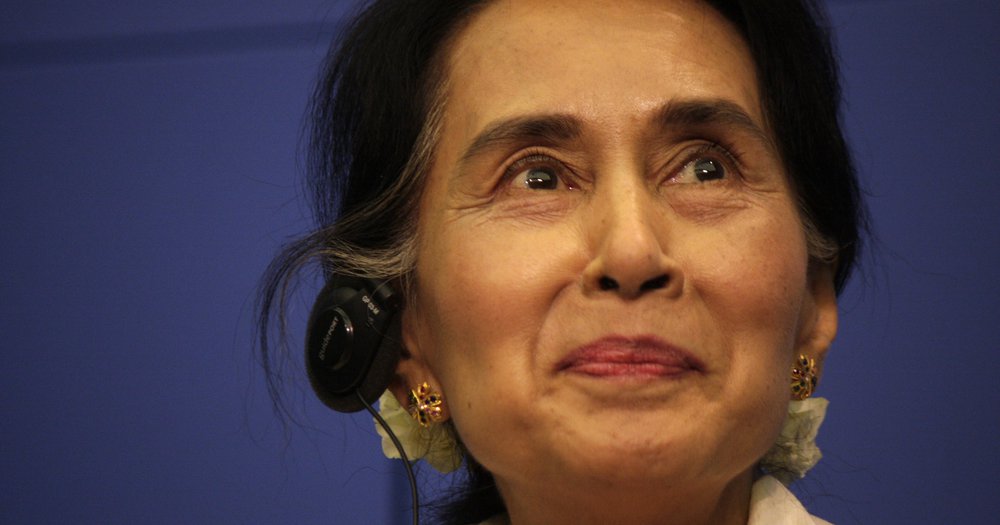
The people of Myanmar began lining up before dawn to be able to vote in the nation鈥檚 first open general election in 25 years, held on November 8. The results were stark: The opposition National League for Democracy (NLD), led by Nobel Peace Prize laureate , won a , taking nearly 80 percent of seats up for election across the country.
Myanmar’s people voted for change. But what will their votes really change in Myanmar?
In some ways, this was a d茅j脿 vu moment. The results mirror, almost exactly, those from the last open general election, which took place in 1990. That vote was held in the aftermath of massive street protests against military rule and a brutal crackdown in 1988. The NLD won a landslide victory then, too, but the military refused to recognize the results. Instead, army leaders imprisoned Aung San Suu Kyi and hundreds of other NLD members and continued to rule the country directly for another two decades. Yet after after over 15 years of house arrest, Aung San Suu Kyi was able to lead her party to another commanding victory this year. And this time, a reversion to military rule seems unlikely.
The vote itself was far from perfect. Hundreds of thousands were disenfranchised, including voters in conflict zones and vulnerable , who face systematic persecution by a government and wider public that consider them to be illegal immigrants despite their generations-old presence in Myanmar. Muslim politicians, including a , were also disqualified from competing, amidst a climate of intensifying anti-Muslim sentiment driven by .
Still, by regional standards, the election outcome was a rare bright spot. Myanmar鈥檚 neighbors in Southeast Asia have suffered consistent democratic setbacks of late. The army overthrew an elected government in Thailand in May 2014, and military leaders show any time soon. In Cambodia, the ruling party recently against the opposition, which has struggled to combat the strong-arm tactics of the . In Malaysia, corruption allegations against the current prime minister have contributed to the acceleration of a using a draconian sedition law. Meanwhile, Laos and Vietnam remain one-party states, where opposition is not tolerated and peaceful activists face arbitrary imprisonment and .
The democratic regression in Southeast Asia reflects a larger global trend. With the potential exception of Tunisia, countries impacted by the Arab Spring have turned from inspiring examples of people power into anti-democratic basket cases, plagued by civil strife and regime crackdowns. Meanwhile, a resurgent Russian autocracy is moving against democratic developments in neighboring countries (although some, like Poland, ). , the advance of democracy has stalled globally, with no more “free” countries in the world today than there were 10 years ago. And as Yascha Mounk notes, even many full-fledged liberal democracies seem to be backsliding as they increasingly turn toward illiberal populism.聽
So the apparent emergence of a democratic opening in a country that was once among would seem to represent a significant achievement. The Obama administration and see the election as validation of a policy designed to cautiously embrace Myanmar鈥檚 reform process, which began in 2011, and extend an olive branch to the generals.
Yet despite its relative success, Myanmar is still far from democratic today. The country鈥檚 , introduced in 2008 by the then-ruling military junta in an attempt to guide the country on a path toward provides the military with inordinate powers and no civilian oversight.
The military appoints 25 percent of sitting parliamentarians, diluting the power of the NLD鈥檚 commanding electoral majority. The constitution bars Aung San Suu Kyi from assuming the presidency, since her two sons hold British passports. And the military retains effective veto power over constitutional amendments, meaning that if Aung San Suu Kyi hopes to become president one day, she needs the support of the generals.
Furthermore, the commander-in-chief of the armed forces, who reports to no one, controls key ministries, including Defense, Home Affairs, and Border Affairs. That means that an NLD government will have little power on its own to mediate and bring an end to more than .
Finally, and perhaps most problematically, military leaders have that they do not intend to surrender their privileged position in Myanmar politics quickly. Despite the decisive public rebuke of their leadership, the generals still see themselves as the country鈥檚 protectors.
In addition to carefully managing an evolving relationship with the still-powerful military, the new NLD government will face a host of other potentially explosive issues when it formally takes power in April. and violence against ethnic and religious minorities threaten the transition. A years-old peace process with ethnic minority armed groups remains stuck. The new government must also find ways to address the impacts of decades of brutality and human rights violations by former military regimes.
This doesn鈥檛 negate the importance of the November elections, nor does it necessarily doom the country鈥檚 democratic prospects. Despite the challenges, Myanmar actually has several key factors working in its favor. As opposed to some of its neighbors, like Thailand, Myanmar does not suffer from dramatic polarization, which could undermine effective governance. The nation has been able to unite rather easily around Aung San Suu Kyi, who commands enormous respect in almost every corner of the diverse country.
Myanmar also benefits from a global movement, developed during the years of oppressive military rule, to support Aung San Suu Kyi and push for democracy. Having spent decades campaigning for a tougher international line against Myanmar鈥檚 military regime, the movement now faces an inflection point. It鈥攁long with foreign governments like the United States鈥攎ust navigate the coming road carefully, keeping up the pressure for further reforms without undermining the success of the new government.
This election was a decisive victory for the forces of democracy, and may well have a positive impact in the region and beyond. But it is only a first step. Myanmar鈥檚 new leaders must now prove to themselves, their country, and the world that they are capable of turning Myanmar鈥檚 moment into more.
More 国产视频 the Authors
Related

“Getting the Golden Ticket”: Participants’ Perspectives on Lexington’s First Assembly

Civic Assemblies: A Framework for Community Colleges

Don鈥檛 START Now
