
New Data Needed Despite Survey of Early Childhood Spending Across the U.S.

This post originally appeared on our sister blog, .
States invested slightly more money into early childhood education in 2013 compared to 2012, according to a from the National Conference of State Legislatures (NCSL). That鈥檚 a reassuring trend, given that most states are still treading water after the financial recession. But it may not be the whole story.
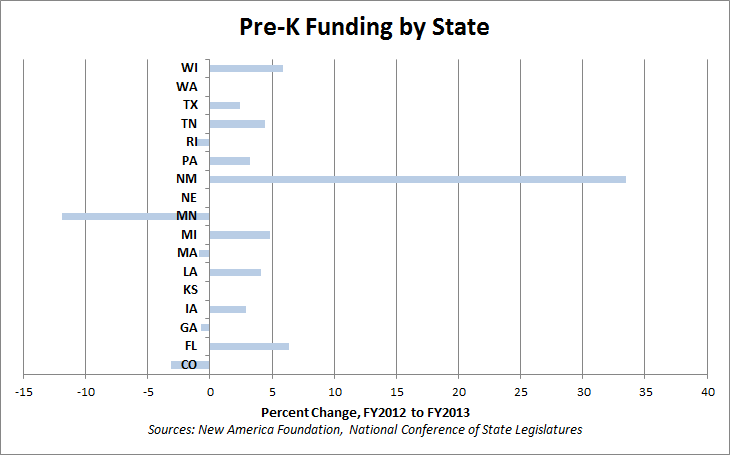
NCSL鈥檚 survey looks at 21 regionally, politically, and financially diverse states. Twelve of them increased funding for child care in fiscal year 2013 (one, Ohio, did not provide information); 10 increased funding for pre-K (one, Illinois, didn鈥檛 respond and two, Arizona and Mississippi, don鈥檛 have state pre-K programs); and 14 increased funding for home visiting programs. Thirteen states also increased funding for other early childhood efforts, though Ohio and Georgia didn鈥檛 offer any further information beyond those categories.
The increased funding for state pre-kindergarten is especially encouraging, given that the National Institute for Early Education Research (NIEER) published an last year showing an 鈥渦nprecedented funding drop鈥� in pre-K spending. It wasn鈥檛 all good news: Minnesota decreased pre-K spending by almost 12 percent, and Colorado鈥檚 3 percent decline in spending adds to an ongoing three-year trend. Still, New Mexico reversed its own three-year trend with a 33 percent increase in funding.
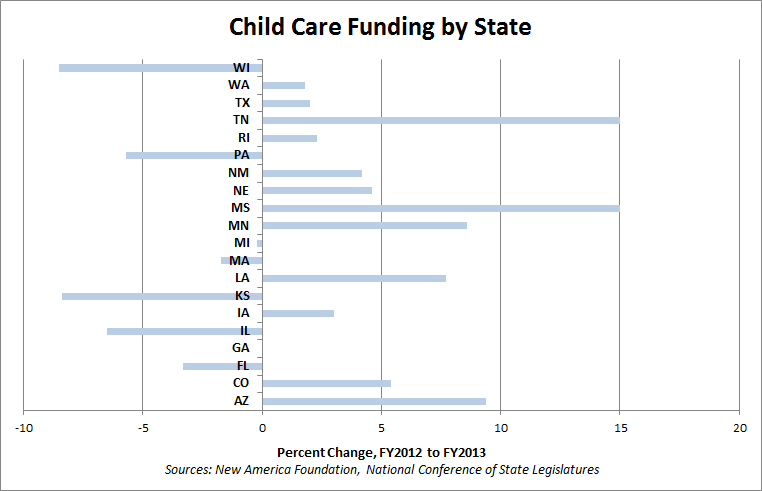
According to the report, child care funding stabilized over the past year, too. Prior NCSL surveys from fiscal year 2010 to 2012 found that 17 of 21 states made severe cuts to child care funding. This year, 12 increased funding, and only 7 cut spending on child care. This year鈥檚 increases came in spite of a slight in federal child care spending, so many of the increases came from: 1) increased state spending or 2) redirecting federal Temporary Assistance for Needy Families (TANF) dollars to child care subsidies.
听
Home visiting increases were significant, too, totaling nearly $50 million across these 21 states in 2013. But most of the increase in that category was driven by an increase in the federal Maternal, Infant, and Early Childhood Home Visiting (MIECHV) program. MIECHV provided more money to states in 2013 ahead of its scheduled end in fiscal year 2014, though President Obama鈥檚 2014 budget request included an extension and more funding for the program through 2025.
Unfortunately, the survey sheds no light on the effects of this year鈥檚 across-the-board federal spending cuts, known as sequestration. The report is based on a December 2012 survey of states 鈥� a full three months before sequestration was implemented in March 2013, and only three months into the 2013 federal fiscal year.
To date, there is available from the White House or agencies about the systemic effects of the cuts 鈥� but it almost certainly led to declines in funding for most, if not all, of these states. It鈥檚 likely that even increases in state funding may not have been adequate to maintain their early childhood funding benchmarks for many states, especially given increasing costs in other sectors like health care. The sequester cut federal Head Start spending, home visiting funds, and the appropriations-funded portion of child care mid-year.
And this isn鈥檛 all. There are additional federal spending cuts scheduled for next year, thanks to the same law that put in place sequestration, the Budget Control Act of 2011 (BCA). With states still struggling to recoup their recession-era revenue shortfalls, the additional $18 billion cuts to all discretionary spending mandated by the BCA next year will leave Congress with some tough choices (or with more across-the-board cuts).
For these reasons (and others), we at Ed Money Watch are looking forward to next year鈥檚 NCSL survey. It may offer the first clear picture of how budget battles on Capitol Hill are affecting the United States鈥� youngest children.
Issues
Related

Quality Principles for Workforce Pell Programs

