
Spandana Singh
Policy Analyst, Open Technology Institute
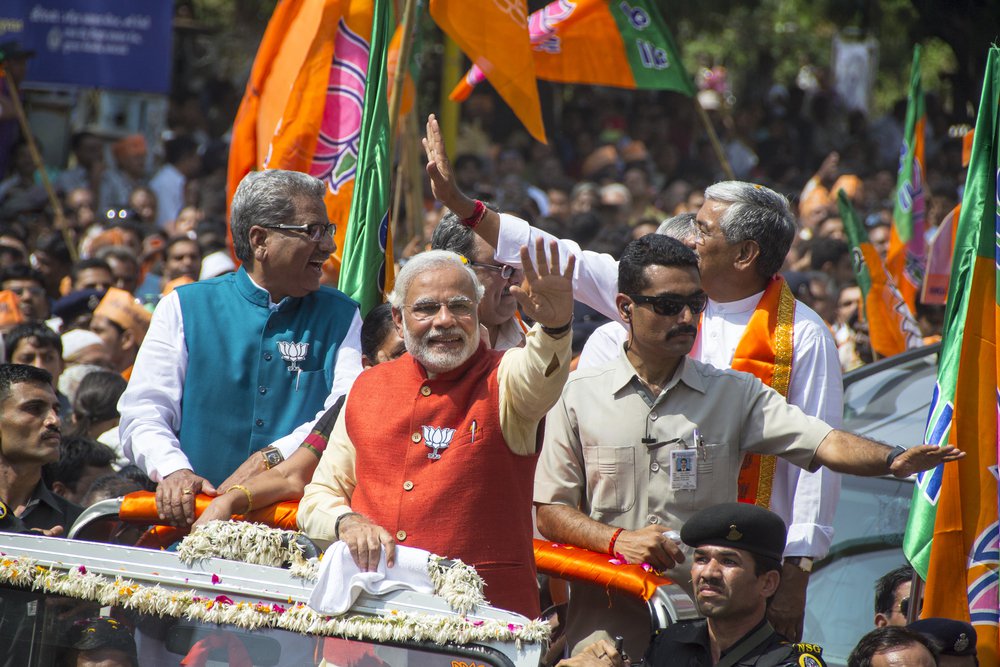
鈥淭echnology, if used well for public good, can deliver lasting prosperity to mankind and a sustainable future for our planet.鈥�
That was Indian Prime Minister Narendra Modi, speaking recently at the , an information and communications technology forum centered on addressing core challenges and successes in the ICT field. Since his election in 2014, Modi has been an advocate for increases in technological capacity and infrastructure to boost economic growth and trade. He鈥檚 also sought to enhance the delivery of basic services. One of his landmark programs, for instance, is the initiative, which aims to jettison India鈥檚 label and shelter the nation from future crises through improved business conditions and increased foreign direct investment and manufacturing. In addition, Modi鈥檚 program hopes to fuel inclusive growth via improved internet access, connectivity, and digital literacy.
Naturally, these moves have stoked controversy. More specifically, many critics have pointed out that India is a nation with pressing challenges: its (14.5 percent of the total population), its of violence against women, and its status as the (732 million people). These issues won鈥檛 be solved by technological silver bullets alone.
Yet these criticisms suffer from a critical flaw: the fact that they perpetuate arguably outdated models of growth. Many of these arguments are rooted in the conventional line of thinking (often adapted from theories like ) that assumes that in order for a developing country to achieve modernization and economic growth, it has to follow a linear development model that divvies up progress into stages. Modi鈥檚 administration, however, seems to be bolstering a new model鈥攐ne with the potential to reinvigorate India鈥檚 development.
According to linear conceptions of development, India鈥攁nd other developing countries like it鈥攐ught to focus first on delivering, in both quantity and quality, basic necessities: health care, education, water and sanitation facilities, food. Only then should the country turn to investing more aggressively in flashy projects that promote higher levels of modernization.
But here鈥檚 the rub. If countries like India followed this rigidly linear model, eventually they鈥檇 succeed in delivering quality services at scale, but by the time these results, which can take decades to achieve, are visible, core industries like IT, which allow a nation to be competitive, would likely be dominated by developed nations. Developing nations would, once again, be at a disadvantage and subject to a聽 Rostow 2.0 model. Just take a look at history. This either-or approach contributed to India鈥檚 missing out on the advantages of the Industrial Revolution, something the government is determined not to recreate with the rising . An emphasis on linear development also often encourages the , (for instance, , which, despite massive economic and technological growth, still has pressing inequality and socioeconomic challenges), and that may yield alternative models of development.
Modi鈥檚 approach to growth seems to be an attempt to implement such an alternative model. Rather than investing in either the provision of basic offline necessities or the development of enhanced technological capacity, Modi and his administration have an eye to doing both, simultaneously. Through programs such as Make in India, India can become a nation that鈥檚 strong infrastructurally and technologically and can compete on a global scale. It鈥檚 likely that, in the initial stages of this initiative, Indian elites and already-established businessmen will benefit more than the average person. However, through programs such as Digital India, the administration is also working to bring India鈥檚 rural population (the majority of which comprises the country鈥檚 ) into the fold.
What has this looked like? By galvanizing , a government-established telecom infrastructure provider that operates under the , the government hopes to deliver broadband connectivity services of at least 100 Mbps to nearly 625,000 villages. Moreover, the administration has prioritized further developing initiatives like the , which has enhanced digital integration in rural communities by establishing .
At the same time, the Indian Government has worked to invest in offline services. One example of this is the , or Clean India Mission, whose objective is to eliminate open defecation and promote increased hygiene by building 12 million toilets in rural areas of the country. The government also recently announced a that would provide free health care to some 500 million people. As well, these two spheres of offline and online development have coalesced via initiatives such as the , which has attempted to prevent the leakage of funds and enable the average person to side-step corrupt institutions and access services such as healthcare and banking with greater ease.
There鈥檚 no doubt that this new model of development has had its fair share of and . That鈥檚 to be expected, especially in the world鈥檚 largest democracy, where offline and online development will continue to spark crucial conversations on issues ranging from data protection, to privacy, to corruption, to surveillance and institutional and cultural barriers to empowerment and progress. On top of that, given that this is a relatively new model, it will surely take time to strike a truly effective balance between online and offline progress.
Even so, the direction India appears to be going in is bracing. It demonstrates a novel approach by an emerging nation to prioritize both competitiveness and the provision of basic needs, and to integrate these areas as smoothly as possible. The results will only be visible once the dust settles, but as other nations reassess their own growth priorities, India鈥檚 new model may be a wise reference point for understanding key lessons and challenges in the years ahead.
Policy Analyst, Open Technology Institute


