Stephen Burd
Senior Writer & Editor, Higher Education

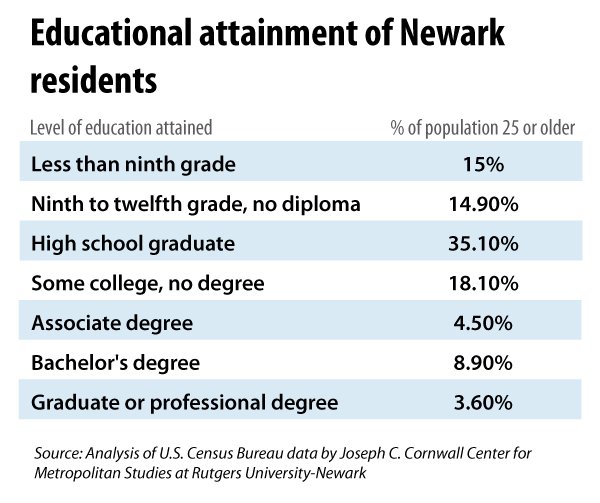
Creating a college-going culture in Newark, N.J., may seem farfetched. After all, Newark residents aged 25 or older are聽聽of school before earning a high school diploma as to have earned any type of college degree.
But a collection of city officials, college leaders, community-based organizations and corporations is aiming to reverse such trends. They are all working together, as part of the聽聽(NCLC), in a bold effort to raise college attainment rates in this long-struggling city.
Today, only 17 percent of adults in Newark聽. Comparatively, more than 30 percent of Baltimore residents hold a postsecondary degree. Nationally, the share with such credentials is about 37 percent.
The NCLC is seeking to increase the share of Newark residents with postsecondary credentials to 25 percent by 2025. To reach this goal, would have to hold a college degree or certificate鈥攁bout 22,000 more than currently do, according to Rutgers University鈥檚 , which is coordinating the NCLC鈥檚 efforts.
But this undertaking is not just about meeting a target鈥攊t鈥檚 also about changing the mindset of the city鈥檚 students. 鈥淲e want to see our young people, whether they are in third grade or fifth grade, ninth grade or twelfth grade, come to see that postsecondary education is the only way to go, that things don鈥檛 end at high school,鈥� says , Newark鈥檚 philanthropic liaison. 鈥淭o see everybody understand that as a given, that鈥檚 really our collective dream.鈥�
The story of the collaborative dates back to 2011 when local foundations and city officials were considering starting , guaranteeing to pay the tuition of Newark students who attended college in the city. But after looking at to raise college aspirations, they realized that creating such a program would be too expensive. 鈥淭he philanthropic base is not as big as you find in many other cities,鈥� says , director of the Cornwall Center.
Despite this stumbling block, talks about how to increase college attainment continued, and in 2014, Rutgers University-Newark received to create the collaborative and pursue the 鈥�25 by 25鈥� goal. Newark is that Lumina is funding in hopes of raising college attainment rates. (Disclosure: Lumina Foundation is among the of The Hechinger Report.)
鈥淩esearch shows a direct correlation between thriving cities and education beyond high school,鈥� , Lumina鈥檚 president and CEO, when the grant creating the collaborative was announced. 鈥淚ncreased attainment delivers stronger local economies, greater individual earning power and better quality of life. Every community in America wants that, and we鈥檝e designed this work to give civic leaders the tools they need to be successful.鈥�
Since receiving the Lumina grant, the Cornwall Center has managed to bring 60 organizations to the table, including the Mayor鈥檚 office, Newark Public Schools, the city鈥檚 five colleges, a network of college readiness and pre-college programs, and companies headquartered in Newark, such as Panasonic and Audible. Members of the NCLC say that having so many groups working together on behalf of Newark鈥檚 students is a victory in and of itself. 鈥淭he fact that folks are realizing that this is bigger than any one organization is really remarkable and a breakthrough for the city, which has been poor for far too long,鈥� says Robert Clark, a senior adviser to the Superintendent of Newark Public Schools. (Clark鈥檚 boss, Cami Anderson, last week.)
The collaborative is attacking the problem of low college attainment rates on many fronts. It is primarily focused on getting high school students into and through college. But it鈥檚 also working with groups that are trying to get disconnected youth back into school, and others that focus on helping adults earn credentials.
This summer, the NCLC is working with 800 high school students who are taking part in the city鈥檚 youth employment program. Members of the collaborative will meet with these students one day a week for six weeks to help them start thinking about applying to college. After the 鈥淪ummer Leadership鈥� program is over, the NCLC will continue to keep in touch with these students and encourage them to pursue higher education.
The collaborative has also started meeting with incoming freshmen the summer before they start college to help them navigate the transition. In addition, companies involved in this effort鈥攊ncluding Panasonic and Audible鈥攁re offering paid summer internships to students once they鈥檝e completed their first year of college.
The NCLC includes 30 pre-college access programs that help motivate and prepare students to apply to college. The groups are seeking to develop common methods for keeping track of students as they move into and through college.
Meanwhile, the colleges in the city鈥擝loomfield College, Essex County College, the New Jersey Institute of Technology, Pillar College, and Rutgers University-Newark鈥攈ave pledged to enroll a greater number of Newark students. For example, Rutgers from 6 percent to 10 percent among first-year students, and from 11 percent to 17 percent among transfer students. The colleges in NCLC are also working together to align their standards so community college students from Essex County College, for example, can make a seamless transition into four-year institutions.
Will the collaborative meet its 鈥�25 by 25鈥� goal?
Members of the NCLC are optimistic and hope that their efforts will serve as a model for other urban areas. 鈥淚f we can move the needle on this, it really shows that this could work, not just here but other places,鈥� says Johnson. 鈥淲e can be that living experiment about urban cities and issues of disadvantaged young people and neighborhoods that are under-resourced.鈥�
Still, some strike a more cautious note, saying that progress may not come as fast as some would like. 鈥淲e have to find a way for people both nationally and locally to understand that Newark鈥檚 problems grew up over decades and decades of the wrong things happening in this city, and you don鈥檛 turn that around in a year,鈥� says , chancellor of Rutgers University-Newark. 鈥淪o we can鈥檛 let people get discouraged and give up.鈥�
This is an exciting effort that could have a big payoff for Newark. But before the collaborative can meet its goals, it will have to overcome one major shortcoming. That will be the subject of my next column.
This post ran first in .“
Senior Writer & Editor, Higher Education