Stephen Burd
Senior Writer & Editor, Higher Education
For years, Washington University in St. Louis has held the dubious distinction of being in the country.
That鈥檚 about to change.
In January, the university a plan to double the proportion of Pell Grant recipients that it enrolls by 2020. Under the plan, Wash U. will spend at least $25 million a year for five years to increase the share of students receiving Pell Grants, federal grants that go to students from families making less than $60,000 annually, to 13 percent. 鈥淚mproving the socioeconomic diversity of our student body is not just important; it鈥檚 critical to our success as a university,鈥� Holden Thorp, the university鈥檚 provost and executive vice chancellor for academic affairs, said in .
Wash U.鈥檚 decision comes at a time when there is increasing attention from , the , and even the about how well selective colleges are serving low-income students. In a period of growing inequality, many are concerned that colleges, in their pursuit of prestige and revenue, are increasingly catering to the rich and leaving the most financially needy students behind.
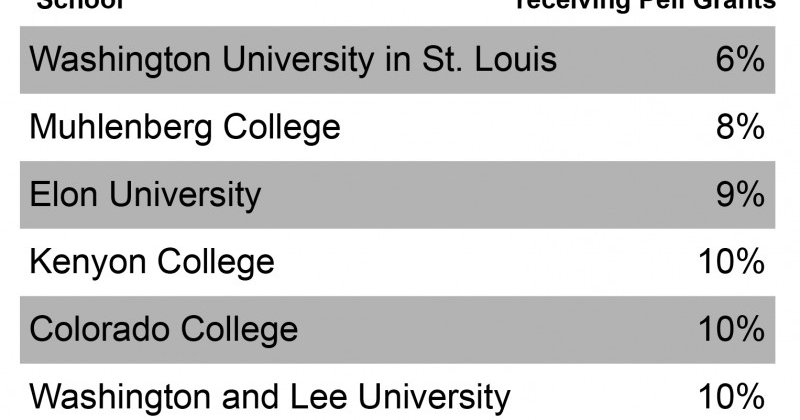
With those concerns in mind, I decided to determine which college is in danger of replacing Wash U. as the nation鈥檚 least socioeconomically diverse campus. Judging by data available from the U.S. Department of Education, there are six colleges in the running鈥擟olorado College, Elon University in North Carolina, Kenyon College in Ohio, Muhlenberg College in Pennsylvania, Washington and Lee University in Virginia, and Whitman College in the state of Washington.
At these six colleges, no more than 10 percent of students received Pell Grants, which go to students from families making less than $60,000 per year, in 2012-13, the latest year for which federal data are available. Two of the colleges had under 10 percent鈥擬uhlenberg at eight percent and Elon at nine percent.
The leaders of most of these liberal-arts institutions said in interviews they are trying to increase the share of low-income students they enroll. (The president of Washington and Lee declined to be interviewed for this column.)
鈥淚t鈥檚 clear to us that we can do better than where we are and where we鈥檝e been in recent years,鈥� says , president of Kenyon College.
The one exception is Muhlenberg College, which says it has no intention of following Wash U.鈥檚 lead. 鈥淛ust trying to increase the number of Pell Grant recipients might be good for PR but may be bad policy for our college,鈥� says , the outgoing president of Muhlenberg.
To be fair, Washington University鈥檚 endowment dwarfs Muhlenberg鈥檚 鈥� is nearly half a million dollars, whereas Muhlenberg鈥檚 is only $50,000. In other words, Muhlenberg can鈥檛 just decide on a dime to spend an additional $25 million in aid each year.
But this isn鈥檛 just a question of money. Helm, , doesn鈥檛 think it would be healthy for Muhlenberg to make a concerted effort to recruit and finance substantially more Pell-eligible applicants. If it did, it would have to spend its entire supporting them, and wouldn鈥檛 have any left for middle-income students who are also struggling to pay the school鈥檚 .
鈥淲e鈥檙e not going to be a school that serves the very, very rich and the very, very poor,鈥� he says. 鈥淚 don鈥檛 think that would be fair to middle-income students, the college, or the country.鈥�
There may be, however, another reason that Muhlenberg is wary of substantially increasing its pool of Pell Grant recipients. The college devotes a significant share of its institutional aid to the pursuit of high-achieving students, who often come from well-to-do families.
A page on Muhlenberg鈥檚 website, entitled acknowledges that the college and many of its competitors often use institutional aid as a 鈥渞ecruiting tool.鈥�
鈥淚t used to be that you could try for that reach school and if you got in, you didn鈥檛 have to worry because everybody who got in, who needed money, got money,鈥� the college鈥檚 financial aid office states. 鈥淭oday, however, as colleges are asked to fund more and more of their own operation with less and less assistance from government, foundations, and families, they are increasingly reluctant to part with their money to enroll students who don鈥檛 raise their academic profile.鈥�
Muhlenberg provides 鈥渕erit aid鈥濃�攚hich is not based on financial need鈥攖o about 32 percent of its freshmen, with an average award of nearly $12,500 per student, that the college reports to magazines that publish college rankings.
In contrast to Muhlenberg, leaders of the other four institutions I interviewed say they are taking steps to enroll more low-income students.
The school that seems most likely to break out from the pack is Colorado College, which is making 鈥渁 real effort鈥� to become more socioeconomically diverse, according to , the college鈥檚 president. Over the last several years, the college has raised $10 million, which , to increase the amount of aid it can provide to first-generation college students with significant financial need.
Colorado College has also with , a nonprofit organization that acts as a matchmaker between elite colleges and historically underrepresented students. 鈥淲e are really diversifying the pool of highly qualified low-income students that we enroll,鈥� Tiefenthaler says.
Kenyon College hasn鈥檛 gone quite as far as Colorado. But the school has seen 鈥渟teady upticks鈥� in the number of low-income and first-generation college students it admits, according to Decatur. As part of its effort to become more diverse, Kenyon simplified its admissions application, removing extra essays that it had required students to write. The school found that the application鈥檚 length was discouraging first-generation students from applying.
Decatur thinks that this change, which occurred before he came to Kenyon in 2013, has paid off. 鈥淲e鈥檝e seen increases in the socioeconomic diversity of our application pool,鈥� he says.
For , Kenyon admitted 408 minority students, up 9 percent from last year, and 128 first-generation college students, the second most the college has admitted in the last decade.
On the West Coast, Whitman College has struggled in recent years with its socioeconomic diversity. During the financial crisis of 2007-08, the college鈥檚 endowment took a beating. In reaction, the institution significantly reduced its spending on need-based financial aid, and, as a result, the share of Pell Grant recipients on campus plunged.
, Whitman鈥檚 president, says the college is now making a concerted effort to reverse those cuts and attract many more low-income students. This June, the college will complete that is expected to raise $50 million for endowed scholarships, many of which will go to first-generation students.
鈥淲e have a responsibility to increase access wherever we can,鈥� says Bridges, who is leaving Whitman at the end of the school year .
Meanwhile, Elon University is in the middle of a 10-year campaign to double the amount of need-based institutional aid that it awards. 鈥淓lon must not become a gated community open only to those of privilege,鈥� the college , 鈥渁nd our classrooms and campus life will be much richer when we recruit more students from diverse backgrounds who challenge and lead us by sharing their own life stories鈥︹��
believes that Elon, which has the smallest endowment of the six colleges, is making 鈥渟low progress鈥� in increasing the proportion of Pell students it enrolls. 鈥淲e are digging hard into this issue of access, because it makes a big difference in the quality of the kind of community we aspire to be,鈥� he says.
It鈥檚 clear that none of these colleges is likely to come close to doubling the share of Pell Grant recipients they enroll, as Wash U. hopes to do. But with the exception of Muhlenberg, all of the college presidents who agreed to be interviewed are taking steps to avoid having their institutions become the least socioeconomically diverse in the country over the long run.”
Senior Writer & Editor, Higher Education