
The Philosophical Case Against the White-Wine Emoji
This article in , a collaboration among , , and .
In July, the Unicode Technical Committee was a bit of a buzzkill: It announced that for now, it would not add a white-wine emoji to Unicode鈥檚 standard emoji mix. The noted that the UTC鈥檚 Emoji Subcommittee would 鈥淐ontinue to consider 鈥榳hite wine鈥� emoji for future addition.鈥� If certain news outlets are to be believed, white-wine drinkers everywhere were devastated. In a piece titled, 鈥淭he Petition for the White Wine Emoji Has Been Sadly Rejected,鈥� People its readers to continue the fight and 鈥渒eep hope alive that one day you鈥檒l see a white-wine emoji at a keyboard near you!鈥� Food & Wine magazine that the white wine emoji 鈥渉as generated plenty of support and, frankly, seems inherently logical.鈥�
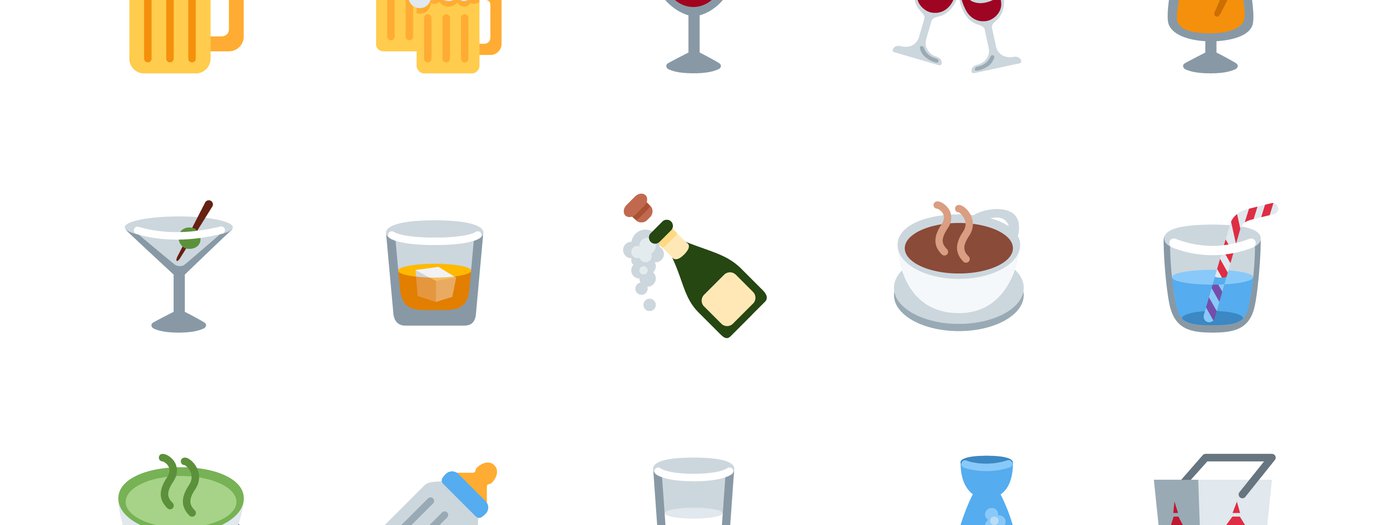
The issue is not that the UTC is made up of teetotalers or beer partisans. In fact, there are already emoji options to display a glass of red wine and . But what Kendall-Jackson and other winemakers behind proposed to Unicode was the option to expand the wine glass emoji so that users could choose red, pink, or white wine. Unicode already has a standardized approach such that distinct emoji forms like the and display the correct colorings across platforms, but the organization is continuing to deliberate when it will offer different color options for objects.
The UTC previously addressed skin tone modifiers back in 2015 to allow human emoji to be more diverse. But adding color options for objects like wine glasses would introduce additional complexity to support across platforms. And perhaps the UTC is understandably wary of a slippery slope: If it accepts the white-wine emoji, it might soon be asked to add many other color variations, including other beverages鈥攍ight vs. dark beer, black coffee vs. lattes instead of the catch-all 鈥溾�� we have currently鈥攁nd potentially all other emoji, from rocket ship to frog.
Further color varieties will complicate a pictogram palette that, , consists of 3,019 emoji. But it seems to me that the more interesting question surrounding the white-wine emoji debate is less about numbers and more philosophical in nature, namely, whether emoji are supposed to represent broad emotions and concepts or something more specific.
Before continuing, I should disclose my stance on this white-wine emoji issue: I have struggled to conjure strong feelings either way. My colleague Heather Schwedel for Slate last August, before this most recent petition, and raised an argument that resonated with me. 鈥淚 feel pretty confident in saying that no one鈥檚 life will be meaningfully improved, or even meaningfully affected, by the existence of the white-wine emoji, if and when the proposal is successful,鈥� she wrote. In other words, there just doesn鈥檛 seem to be much value-add, at least from a utilitarian perspective.
But reasonable people could disagree. White-wine enthusiasts, people with red wine allergies, or those who care a lot about proper wine-food pairings (馃悷馃馃悥) might well take the opposite view.
Schwedel also noted the particularly high level of corporate lobbying behind the campaign, which Kendall-Jackson is spearheading with brands like La Crema and Yellow Tail. Although Unicode forbids emoji that represent specific brands, corporate lobbying for preferred emoji appears to be commonplace. The pickup truck emoji that will be released in 2020 was . This backdoor emoji-politicking seems more devious to me than traditional advertising. Instead of just grabbing attention like the old days, these companies seemingly want to influence language itself.
This raises another question: Is emoji a language? Linguistics professor Vyvan Evans told the in 2015 that emoji are a 鈥渧isual language鈥� that has already eclipsed Egyptian hieroglyphics. (In his 2017 book, , Evans described emoji as a coded system of communication rather than a language.) [Update, Sept. 27, 2019, 1:05 p.m.: This article was updated to better reflect Vyvan Evans鈥� perspective on the role of emojis.] Whereas David J. Peterson, a language creator perhaps best known for his work on Game of Thrones, emoji are not a language because of the lack of shared rules. Personally, I鈥檓 more sympathetic to Peterson鈥檚 argument since my friend groups often use emoji differently. (The can mean either 鈥渁 little awkward鈥� or 鈥渉orrifying,鈥� depending on the sender.)
Whether or not emoji qualifies as a language, it鈥檚 fair to say emoji have language-like characteristics. Linguist Gretchen McCulloch has proposed that emoji are to make our digital communication more like talking face-to-face. Great literary works are currently being , and with interpreting emoji in legal cases. So it鈥檚 sensible that concepts from non-pictographic languages might also apply to emoji. Traditionally, is the idea that language standards must be maintained, unwanted influences should be resisted, and rules should be preserved for correct usage. One prescriptivist example from English was the that it鈥檚 wrong to end a sentence with a preposition like 鈥渢o鈥� or 鈥渇rom.鈥�
If we鈥檙e looking for prescriptivist or correct rules for emoji, we might consider the perspective of Shigetaka Kurita, the Japanese designer who has been credited as creating the first widely used set of 176 emoji in 1999. ( has shown that SoftBank released an earlier set of 90 emoji in 1997, but that model of mobile phone did not sell well, and its emoji were not supported across other devices.) Kurita told 鈥檚 Jacopo Prisco in 2018 that he envisioned his set of emoji as ideograms to represent broad ideas, and that contemporary emoji might have strayed from this founding principle. 鈥淏ecause it makes inputting them too difficult, there might also now be too many [emoji],鈥� Kurita said. This traditional view of emoji might support the status quo: one emoji representing wine rather than color variants.
It just so happens that each platform has made the decision to depict wine glass as red wine.
Another linguistics concept that parallels the emoji debate is the notion of a formal language planning body. Since 1635, France has had the , a council of 40 members that makes decisions about the French language. Other European countries have similar bodies, but as John Edwards notes in his , government-sponsored language academies have never appeared in England or America. In the United States it was more common to have 鈥渙ne-man institutions鈥� like Noah Webster鈥檚 dictionary, which helped formalize Americanized spellings such as color instead of colour.
In the emoji context, the equivalent of a language planning body would be the , which decides on the list of emoji and has been implicated in the white-wine debate. But while the Acad茅mie fran莽aise consists mostly of writers and scholars, the Unicode Consortium is decidedly more corporate. Full members represent large tech companies like Apple, Microsoft, Google, and Facebook. , the emoji reference website, was one of the few members that did not represent any specific tech platform, but nonetheless had voting rights.
When we spoke, Emojipedia鈥檚 founder said that while he was highly supportive of adding different skin tones, which mattered to the representation of billions of people globally, he was hesitant at this time to jump into wine color variations. 鈥淵ou鈥檇 soon run into questions of what colors are supported for which emoji, and what the defaults should be,鈥� he said. The Unicode committee was also facing issues of technical prioritization. Burge felt more strongly about adding skin tone support for family emoji鈥攖he current defaults include 馃應 and 馃懆鈥嶐煈︹�嶐煈︹�攖han having multiple types of wine depicted. He is also in favor of offering the ability to change an emoji鈥檚 direction, for example, pointing the left or right.
Burge suggested that the status quo had been misrepresented in most popular media.
The current Unicode emoji, , was simply 鈥渨ine glass鈥� and did not need to be 鈥渞ed wine,鈥� specifically. It just so happens that each platform has made the decision to depict wine glass as red wine. 鈥淎 simpler solution for something like wine would be if vendors like Apple or Google just showed an empty wine glass. More flexible for all wine drinkers!鈥� Burge said. This strikes me, however, as the wrong solution. A full glass or a half-full glass of wine suggests fun鈥攖hough the degree of the latter . But an empty wine glass is thoroughly ambiguous. (Me, on the receiving end of 鈥渆mpty wine glass鈥� emoji: Oh man! Is the party over? 馃槵.)
A reasonable reader might ask, after all of this, whether I have developed a stronger personal opinion about the white-wine emoji. The answer is not really. But I have firmed up my belief that decisions like this should be carefully considered and incorporate the perspective of independent voices in addition to clearly self-interested parties. Perhaps we could take a note from the Acad茅mie fran莽aise and include professional , linguists, and cultural scholars along with Big Tech in these emoji decisions. Because I suspect that future disputes over coded communication might involve higher stakes than shades of wine. And if that context means additional time is required to consider this specific proposal, then I and more zealous advocates of would do well to just pop a bottle and wait.
More 国产视频 the Authors
Related

“Getting the Golden Ticket”: Participants’ Perspectives on Lexington’s First Assembly

Civic Assemblies: A Framework for Community Colleges

Don鈥檛 START Now
