
Problematic Pre-K Data in the U.S. Census, Part 1

This post was written by Megan Carolan, policy research coordinator at the , who will be providing consulting support to the and the pre-K side of the this year. We are happy to have her on board as a guest blogger for Early Ed Watch.
Data plays a crucial role in education policy, particularly in the world of early childhood, but good data for decision-making is not as readily available as people may think.聽 The Census numbers on preschool attendance are a key example. The 2010 (ACS) from the U.S. Census Bureau asks heads of households about enrollment of children in 鈥渘ursery school or preschool鈥� but has several methodological problems.
In this post we鈥檒l take a look at how the questions are framed.
Consider the vagueness of the first question (see image below). Parents may not know how to report a certain setting: does a child鈥檚 Head Start program count as 鈥渘ursery school, preschool?鈥� The antiquated word 鈥渘ursery school鈥� might conjure images of the more traditional nursery school setting 鈥� affiliated with a church, and offering only part-day, part-week care 鈥� resulting in under reporting. The inclusion of 鈥渉ome school鈥� in the question instructions may lead parents to wonder what qualifies as home-schooling in the younger years. Would having a 3-year-old stay home with Grandma mean that that box should be checked?
And what about child care? Many of today鈥檚 child care centers have a teachers trained to provide 3- and 4-year-olds with a good learning experience but they still may not specifically label their programs as 鈥減reschool.鈥� Parents may wonder if their center’s 4-year-old program qualifies as a preschool program.
Or consider the new 鈥渢ransitional kindergarten鈥� in California that serves 4-year-olds who are considered too young for kindergarten. The state does not call that pre-K. Likewise, Wisconsin鈥檚 Four-Year-Old Kindergarten Program and Pennsylvania鈥檚 Kindergarten for Four-Year-Olds are that, combined, enroll over 50,000 children whose setting may easily be misreported in this question. Failing to explicate to which category a setting belongs is an invitation for messy data.

The question also specifically asks parents to only answer the question if their child was enrolled during the previous three months. The survey itself is monthly, so answers may vary significantly based on timing. Parents who receive a survey in September may report their child was not enrolled because their program did not maintain summer hours. Children also may change settings throughout the course of the year, perhaps moving from the care of a family member to a child care settings when they move up a state subsidy waiting list, or moving from a local public preschool program to a private program because spaces becomes available. It would be difficult for any one measure that tracks the changes in setting of each child, but indicating a date for respondent鈥檚 reference (i.e., 鈥淎s of September 1, 2012鈥︹��) would ensure all respondents used the same starting point.
As with all Census questions, the survey relies on parent reporting of participation rather than data from school districts or the states. In the question about public and private enrollment, this may result in including children enrolled in public and private settings without distinguishing them from each other. The lines between public and private can be quite blurry in pre-K, with private providers using public dollars (such as subsidies or contracts with states) to provide children with a preschool experience. The physical setting 鈥� a private preschool on a public school campus or a private space sublet to a publicly funded program 鈥� can trigger confusion too.
Stay tuned for Part 2, which will show how many policy groups and advocacy organizations are relying on this questionable data, explore the roots of the problems and suggest how to start fixing them.
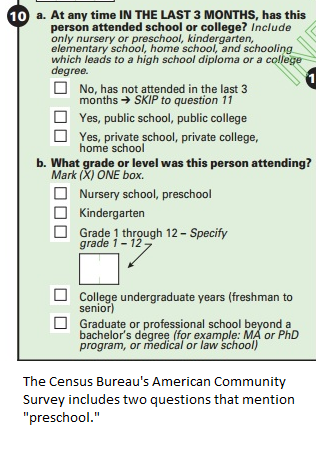
The American Community Survey mentions “preschool” in two questions, but parents are likely to be confused about how to answer them. See below for a larger copy of this image.
Issues
Programs/Projects/Initiatives
Related

A National Review of Early Childhood Cost Models: Findings on Children with Disabilities and Developmental Delays

Prioritizing Students with Disabilities in AI Policy
