
Problematic Pre-K Data in the U.S. Census, Part 2

This is the second of a two-part series written by guest blogger Megan Carolan, policy research coordinator for the National Institute for Early Education Research. Yesterday, Megan . Today鈥檚 post explores the roots of the issue, describes how often the questionable data are cited and suggests how to start fixing the problem.
To understand why the Census Bureau鈥檚 handling of pre-K enrollment data may be somewhat unimpressive, it is important to understand its motivations. In a helpful section on their website which , the bureau lays out the goals of this question:
鈥淓ducational attainment and school enrollment data are needed for use in assessing the socioeconomic condition of school-age children. Government agencies also require these data for funding allocations and program planning and implementation. These data are needed to determine the extent of illiteracy rates of citizen in language in minorities in order to meet statutory requirements under the Voting Rights Act.鈥�
The also notes that these data help develop adult education and literacy programs; help the Department of Justice fight discrimination in education; and give employers valuable information when considering local labor forces. All of these reasons seem to be geared towards adults. None of their reasons are 鈥渢o explore current trends in early childhood education,鈥� 鈥渢o provide schools valuable information in preparing for incoming students,鈥� or 鈥渢o assist education policymakers in targeting early education programs where they are most needed.鈥� The very phrase 鈥渟chool-age children鈥� indicates this data collection is not designed around 3- and 4-year-olds whose care and education frequently exists beyond the walls of the public school system. In short, the reasons behind the data collection by the Census Bureau differ significantly from those of policymakers and advocates who are seeking more data.
Why does this one question matter? The figures from the ACS on pre-K enrollment are utilized far and wide across the field. According to , enrollment in 鈥渘ursery school, preschool鈥� was 4,985,508. It鈥檚 hard to make sense of what percentage of preschool-age children are served because the question does not ask for a distinction based on age. High numbers of both 3- and 4-year-olds are enrolled in care, and this ambiguous question may also be including 5-year-olds not yet ready for kindergarten or younger children in Head Start programs. 聽
Using this enrollment figure as a starting point, the Annie E. Casey Foundation estimated in their that in the United States were enrolled in preschool. Several other research and advocacy organizations rely on ACS鈥� measure of preschool enrollment including Education Week in its annual ; the in its College Completion Agenda; the intergenerational policy advocacy group ; and , a data resource provided by the Center for Public Education. Judging by the frequent citation of these statistics, many policymakers and advocates assume they are an accurate representation of preschool enrollment, even though in a , employees used three different surveys, including the ACS, to estimate Head Start enrollment, noting that because of these shortcomings, one survey is not accurate enough.
The best that can be said for this question is that at least the Census asks about preschool enrollment rather than ignoring it. On the other hand, as acknowledged by , this question 鈥渋s so convoluted that we consider the data from it to be effectively useless. Even at the federal level, the U.S. government has no idea how many children are enrolled in pre-K.鈥�
Fixing problems in pre-K data will not be easy. As illustrated in 国产视频鈥檚 (FEBP), early childhood education data is notoriously difficult to collect and compare. The release of pre-K data in FEBP was accompanied by .
The accompanying Counting Kids and Tracking Funds in Pre-K and Kindergarten sums it up:
鈥淧re-K and kindergarten data at the local level are labyrinthine and disorganized, hampering any ability to craft policies for equitable access and funding. States must collect more complete and comparable data from school districts and CBOs if policymakers and the public are to understand the state of education for young children in their communities and states.鈥�
They key words are 鈥渃omplete鈥� and comparable鈥� – the problem isn鈥檛 lack of data, per say, but rather relying too heavily on data that doesn鈥檛 answer the right questions. School districts and state boards of education are hesitant to sign on for additional data reporting given their current burdens, resulting in researchers and policymakers making the best of what鈥檚 available.
Where do data wonks go from here? For one thing, organizations and policymakers need to take care to be mindful of the caveats and limitations of the data these use publicly, recognizing that no one data point can represent the entire picture. No one organization is going to fix the problem of convoluted early education data alone, but the field can be well-served by bringing multiple stakeholders to the table to discuss their data needs and concerns.聽 The is leading this charge to bring state-level data systems up to par to include child, program and staff level information. A 鈥渄ata summit,鈥� or and assist federal officials, including those at the Census Bureau, could also improve utilization of existing data while making clear where increased collection efforts are needed. The 国产视频 Foundation鈥檚 Counting Kids report makes a similar recommendation, highlighting the two key tasks of this brain trust:
- Incorporating pre-K data from both CBOs and school districts into existing education data systems; and
- Capturing better data on enrollment, funding, and dosage for both pre-K and kindergarten at the school, school district, and state levels.
Ensuring that early education data can be linked to existing education data is crucial to ensuring children鈥檚 educational needs are met, but it is an area where most data collection efforts still lag. Data collection is not the most glamorous aspect of improving early childhood education, but a good head count of where children are, and how many are served, is absolutely crucial to building a high-quality system and making sure pre-K is available to the children who need it most.
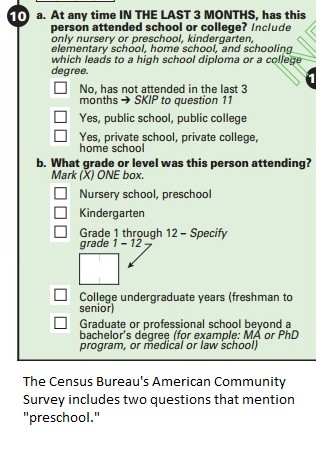
To see a larger image of these questions in the American Community Survey, and to understand why they are problematic, see of this blog series.
Issues
Programs/Projects/Initiatives
Related

A National Review of Early Childhood Cost Models: Findings on Children with Disabilities and Developmental Delays

Prioritizing Students with Disabilities in AI Policy
