Aaron Loewenberg
Senior Policy Analyst, Early & Elementary Education

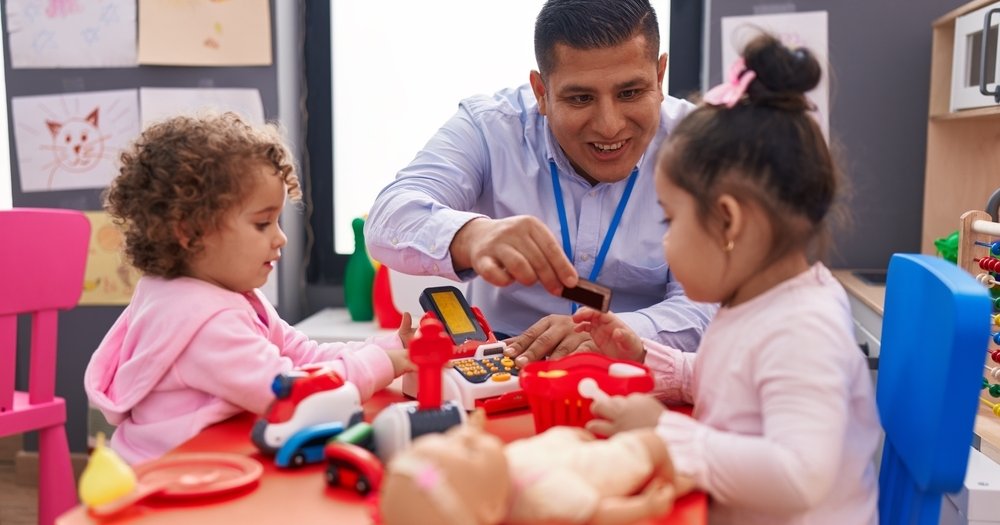
Among children between the ages of three and five, just under聽聽receive care and education from someone other than a parent. The settings in which children receive these services vary greatly. There are formal, classroom-based settings such as state-funded pre-K, Head Start, and private child care centers. But children also receive care and education in informal settings such as home-based family child care and home-based care provided by nonparental caretakers like nannies or babysitters.
According to a聽聽published in the journal聽Child Development, there are significant differences in the quality of care received by children enrolled in formal, classroom-based settings compared to their peers in informal settings. The study finds that children enrolled in formal settings, such as state-funded pre-K and child care centers, receive higher quality care and enter kindergarten with better math and reading skills compared to children receiving care from a family child care home or nonparental caretaker.
In order to gain a better understanding of quality differences between early education settings a team of researchers from the University of Virginia, Stanford University, Cornell University, and the Urban Institute analyzed data using the聽, a nationally representative study that tracked 14,000 children from infancy in 2001 to kindergarten entry. Though these data are now about 10 years old, it represents the most current, nationally representative data available on early childhood education (ECE) quality. It includes interviews with parents and child care providers about the specific characteristics of their ECE setting. The researchers supplemented these data with direct observational measures of a subsample of classrooms.
The researchers divided measures of ECE quality into five categories: ratios, safety, caregiver characteristics (such as credentials), activities and curriculum, and observational measures of quality. For the observational measures of quality, the researchers utilized tools for measuring the quality of learning environments, such as the聽, and caregiver traits using the聽.
What the study found was striking variation in quality between formal, classroom-based ECE, and informal settings, such as family child care homes. According to聽, a researcher at the Urban Institute and one of the study鈥檚 authors, 鈥渢he variations in quality were consistent on almost every measure we looked at.鈥� Perhaps most importantly, these quality differences held up even when researchers controlled for family and child characteristics.
One of the most striking variations was in the category of caregiver characteristics. While 56 percent of teachers in formal settings possessed a college degree in early childhood education, this was true for only 9 percent of teachers in informal settings. This is not surprising since聽聽now require a bachelor鈥檚 degree for pre-K teachers and聽聽of Head Start teachers now have a BA, while only a聽聽require family providers to have even a high school diploma or GED. The study also found that teachers in formal settings are much more likely to participate in ongoing training than their counterparts in informal settings (80 percent vs. 16 percent).
The study also highlighted vast differences in how children in different ECE settings spend their time. Teachers in formal settings reported higher rates of engaging in math and literacy activities on a daily basis. Perhaps most striking was the difference found in television viewing time between settings. While teachers in formal settings reported spending almost no time watching television each day (an average of about six minutes per day), teachers in informal settings reported nearly two hours of daily television exposure.
These differences in quality between settings are important because they translate to differences in child outcomes at kindergarten entry. After assessing children on early math and reading skills at age five, the researchers found that children who attended formal ECE settings had substantially stronger reading and math skills compared to peers who attended informal settings. And Greenberg聽聽that these academic gaps are fully explained by quality differences, meaning that they hold even when family and child characteristics, such as income and parental education are controlled for.
What can the policy community learn from this research? The study points out that many families prefer informal child care settings because they鈥檙e generally more affordable and offer more flexible hours than formal settings.聽鈥�It can be really appealing to families to have a provider down the street, but we want to make sure they鈥檙e getting enriching learning experiences as well,鈥� says Greenberg.
I鈥檝e written聽聽about ways in which family child care networks, such as聽聽in Connecticut, have been shown to improve quality among these providers. (I also聽聽All Our Kin鈥檚 Executive Director to learn more about how the program operates.) Increasing investments into similar models that provide professional development, coursework, and one-on-one expert consultations to family child care providers could go a long way towards ensuring that the children in these settings are receiving high-quality learning opportunities.
There is also a need to help parents become better-equipped at comparing levels of quality between different ECE settings and providers. Currently,聽聽rate their child鈥檚 ECE provider as either 鈥減erfect鈥� or 鈥渆xcellent鈥� despite wide variations in actual quality. Continuing to research and invest in state聽聽that have the goal of providing easy-to-understand ratings of providers is one way to empower parents to choose a high-quality provider, whether that provider operates in a formal or informal setting.
厂辞辞苍,听聽will have more on this study and what it means for strategies to help improve the quality of informal care providers. Stay tuned.
Senior Policy Analyst, Early & Elementary Education