
Quick Question. Why Are We Still Staring into Putin’s Eyes?
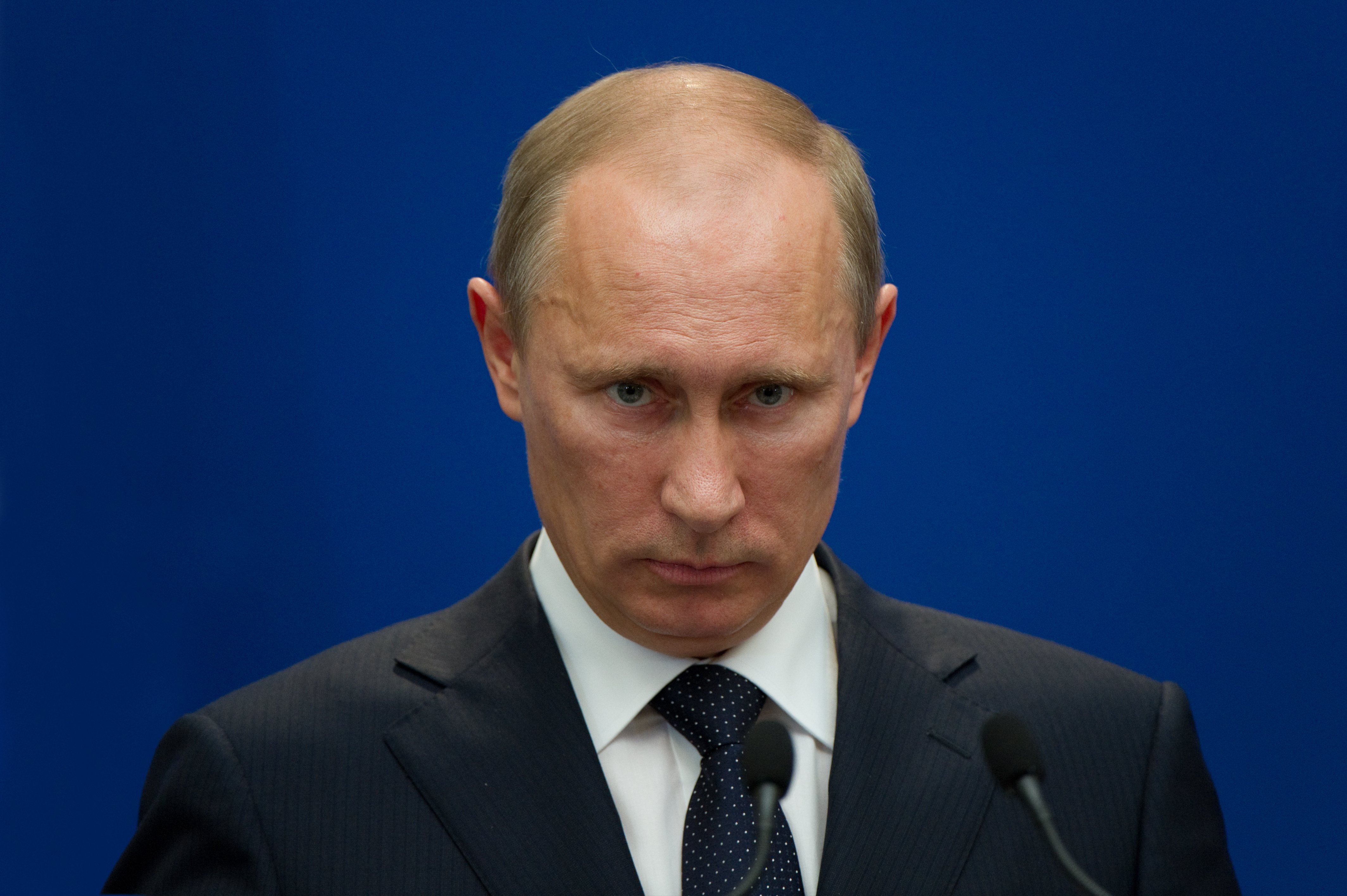
Politicians and pundits alike think they are mind readers. Not in general, of course. But certainly when it comes to Russian President Vladimir Putin. President Bush and Senator McCain did not boast of seeing a friend and a foe, respectively, in, say, German Chancellor Angela Merkel鈥檚 eyes. Donald Trump does not say that he understands men like Chinese President Xi Jinping and can therefore promise that the two will get along famously. But the inner workings of Putin鈥檚 mind, and predictions based on it, are fair topical game.
Putin . Politicians and pundits have not waited to hear what he has to say, measuring it against what he has said before, or against the facts as they are in Russia and the ever-worsening situation in Syria (the likely topic of his speech). Instead, they have allowed this tendency of staring into Putin鈥檚 eyes for answers to trickle into their assessment of the situation in Syria, and of . If analysis is based primarily on mind-reading and eye-gazing, it will lead to a simultaneous mystification and over-simplification of Russian affairs, and, ultimately, to poor policy.
Russia, long a backer of the Assad regime, is , arriving, according to US officials, by fighter jet at an airfield, which it developed, and which it subsequently sent surface-to-air missiles to defend. According to some US officials, Russia is expected to soon start , although it is unclear whether this move is to protect Syria from ISIS or Assad from the Syrian rebels.
Russia鈥檚 reassertion of itself into this issue has inspired two things: First, an announcement by (this it made only after that it is ultimately weakening itself–a point it has made before, and one that seems to –and admitting that it does not understand ). And second, a d茅luge of pieces predicting what Putin really wants in Syria.
Based on these articles and commentaries, we now know that . Or is it that ? Wait, no, . Or maybe .
We do not know which, if any, of these things are true (although they collectively cover most possible outcomes). Here is what we do know:
We know that Putin does not want a non-Western leader overthrown by Western powers, , and (the president of which, it should be noted, is, in the minds of some, a Western leader). This could be because Putin fears his own forced removal, or it could be because he does not believe it is the place of Western leaders to insert themselves into other countries鈥� political affairs. And we know that this is a stance that Putin has held firmly for years. It was Russia that claimed that Syrian rebels, not the Assad regime, were, and that worked (and ) tirelessly to keep a US-led coalition .
We also know, however, that Putin views terrorism–specifically of the Islamic extremist variety–as a threat not just to international order and stability, but to Russia itself. He came to and consolidated power in no small part by . He was famously to call then-President George W. Bush on September 11, 2001. After the 2013 Boston bombings, he condemned the ethnically Chechen Tsnarnaev brothers in the strongest possible terms–while implying that , and that, if they do, it is surely not Russian. And yet we know that the violence in Syria is indeed : In June, ISIS established its northernmost state in , and a large portion of ISIS鈥檚 foreign-born fighters who have joined in both Iraq and Syria are from Chechnya.
We know that ISIS in the North Caucasus is not Putin鈥檚 only domestic problem. Putin has gone from the leader who promised stability and prosperity to one who presents himself as a war leader, keeping his country safe by and . We know that Boris Nemtsov, , was shot dead in the street several months ago. We know that this past weekend (including famed figure Alexey Navalny) 鈥渇or turnover of power鈥� in Moscow.
We know that, although he has said he will step down, in line with the Russian constitution, by (even if one excludes his years as Prime Minister, he will have ruled Russia for twenty years), that Putin does not want to turn over power, and that he has proven quite adept at doing what he feels he needs to do (imprison oligarchs; arrest activists; take Crimea) to keep it.
And we know that whatever Putin does decide to do–and, for that matter, next week–will result from a mix of these factors. But that, ultimately, is all we know. And there is a difference between analyzing these factors, which we know, and Putin鈥檚 internal musings, which we do not.
Or, to put it another way: Talk of what鈥檚 in a man鈥檚 eyes makes for a soundbite. Not for sound, biting policy.
More 国产视频 the Authors
Related

鈥淧eace Through Strength鈥� Is Hard to Read

“Getting the Golden Ticket”: Participants’ Perspectives on Lexington’s First Assembly

Civic Assemblies: A Framework for Community Colleges
