
Senate Appropriations Panel Approves 2014 Spending Bill

听
For more details on early education in the Senate Appropriations Committee Labor-HHS-Education bill, check out听听from our sister blog,听Early Ed Watch.
The Senate Appropriations Committee last week to approve a for the Departments of Labor, Health & Human Services (HHS), and Education. (Fiscal year 2014 starts this October 1.) That development is a reminder that key funding decisions for education programs are wending their way through Congress, and that the House and Senate could not be further apart in their proposals.
While the House hasn鈥檛 yet published or voted on an education appropriations bill for 2014, it indicated earlier this year that it would reduce overall funding substantially 鈥� from $150 billion in 2013 to $122 billion next year 鈥� for the Departments of Labor, Health & Human Services (HHS), and Education.
Why the big cut? The House wants to conform to the spending limit by the Budget Control Act of 2011, which requires total appropriations funding be cut by $18 billion from fiscal year 2013 to 2014, to $966 billion. But the House also wants to hold defense spending harmless in those cuts, with domestic programs making up the difference. (For more details, check out our April issue brief on this issue, , and our May post, .)
Senate Democrats, meanwhile, are ignoring the $966 billion overall appropriations limit for fiscal year 2014, and instead drafting bills within a $1.058 trillion limit. The president, for his part, supports that higher level.
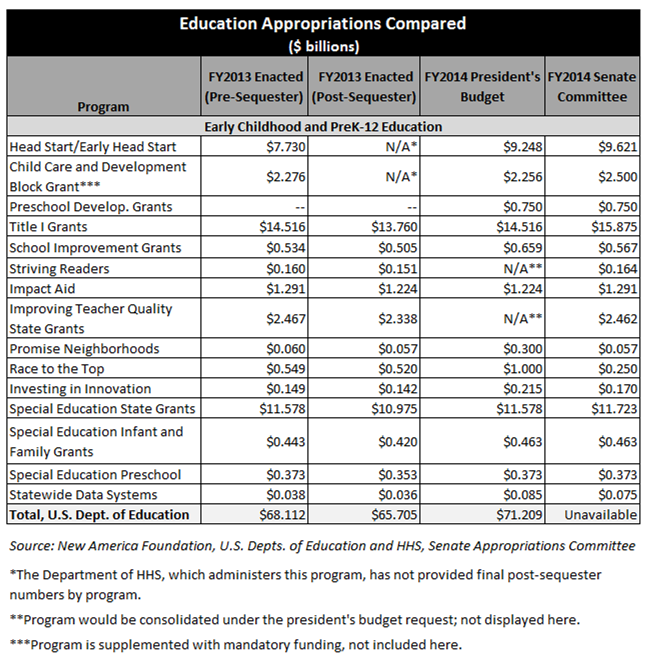
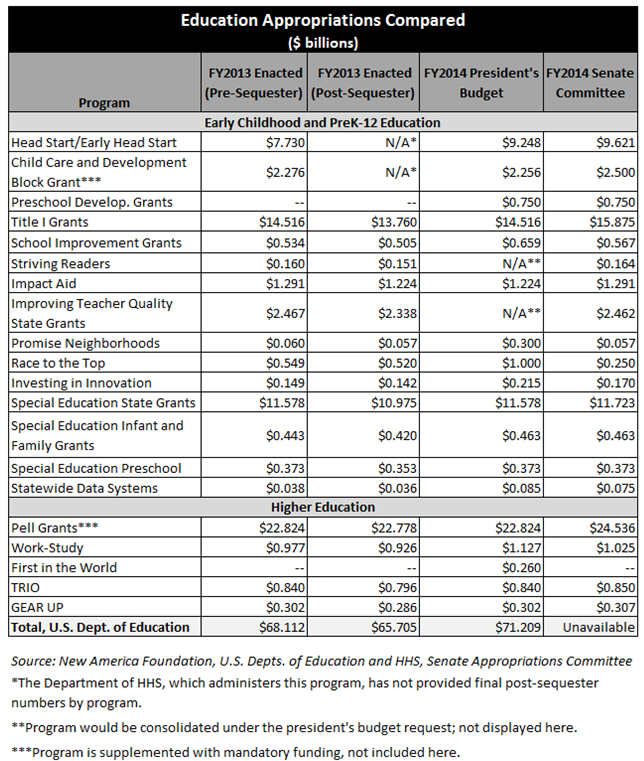
Leaving aside the gulf between the House and Senate, the Senate鈥檚 committee-passed Labor, HHS, and Education bill totaling nearly $166 billion gives us some clues about senators鈥� priorities in the budget fight that looms in the latter half of the year. (See table below for more details.)
For most programs, the Senate appropriations bill would reverse the across-the-board spending cuts (sequestration) that took effect earlier this year, and would actually increase funding for many programs. The Senate Appropriations Committee would increase the two largest federal K-12 programs, Title I grants to school districts and special education grants to states, from 2013 levels, even over the pre-sequester total. The committee would also reverse sequestration for Improving Teacher Quality State Grants and the Teacher Incentive Fund, but wouldn鈥檛 increase funding over those levels. It would bump up Impact Aid slightly from 2013 pre-sequester totals.
Under the bill, the Obama administration鈥檚 signature competitive grant programs, Race to the Top (RTT) and Investing in Innovation (i3), receive funding for new competitions next year. The Department of Education would run a Race to the Top college affordability and completion competition, rather than the early learning and K-12 ones it has already run. But the bill would appropriate only $250 million for the competition, shy of the $548 million it received last year pre-sequester and well short of the administration鈥檚 requested $1 billion. It would fund i3, meanwhile, at $170 million, above the $149 million provided in 2013. The committee also approved a healthy increase in funding for state data systems, from $38 million last year to $75 million.
Another of the administration鈥檚 own initiatives gets a mention, too: . The Senate Committee explains that the president鈥檚 鈥淧reschool for All鈥� program isn鈥檛 included in the appropriations bill because the administration requested mandatory funding for it, which is provided outside the appropriations process. (Sen. Patty Murray [D-WA] has she plans to introduce this portion of the pre-K plan separately.) But the Senate panel did include the president鈥檚 requested $750 million for Preschool Development Grants to help states build systems, as well as a $1.6 billion increase to Head Start, much of which will go to the White House鈥檚 proposed Early Head Start-child care partnerships.
On the higher education side, the Committee maintains a maximum Pell Grant award of $4,860, which, when combined with supplemental entitlement funding, brings the total figure to an estimated $5,785. It also awarded small funding increases to several pet projects, including international education and the high school intervention programs TRIO and GEAR UP. The president鈥檚 request for $250 million for a First in the World higher education competition was not granted.
In total, funding for the Department of Education 鈥� and for discretionary spending across these three agencies 鈥� would increase next year. But as explained above, it鈥檚 so far from what the House has indicated it will support that the two committees may as well be on different planets. It鈥檚 too early to say what the ultimate House-Senate agreement looks like for fiscal year 2014 education funding, but not too early to predict that a lot of squabbling lies ahead.
Issues
Related

Quality Principles for Workforce Pell Programs

