Terrorism in America 19 Years After 9/11
Abstract
Nineteen years after the 9/11 attacks, the terrorist threat to the United States and around the world looks very different than it did on that day when 19 foreign hijackers who had entered the United States on temporary visas killed almost 3,000 people in a matter of hours.
This annual report assesses the threat of terrorism to the United States 19 years on from 9/11.
Downloads
Introduction
September 11, 2020 marks the 19th anniversary of the 9/11 attacks. Over nearly two decades, the terrorist threat to the United States has changed markedly. The year 2020 marks another moment of substantial change in the threat: Some threats appear to have diminished, while others have grown.
In December 2019, the United States saw its first deadly attack since 9/11 that was coordinated and potentially directed by a foreign terrorist organization, Al Qaeda in the Arabian Peninsula. But in 2020, as of this writing, the United States has seen the fewest jihadist terrorism cases since 2008. The jihadist threat to the U.S. homeland continues to appear relatively limited and mostly homegrown and inspired rather than directed from abroad.
However, in 2020 the United States has continued to face a growing threat from terrorism motivated by ideologies other than jihadism, particularly from individuals with far-right views, but also from individuals motivated by Black nationalism, ideological forms of misogyny, forms of targeted violence that are difficult to categorize politically, and to a lesser extent by far-left views. As a result of this year鈥檚 events鈥攖he pandemic, a renewed protest wave over police brutality and racism, and the coming presidential election鈥�2020 has entered a particularly pronounced period of social polarization that may result in an escalation in terrorism.
Meanwhile, ISIS, which loomed large in American thought on the terrorist threat five years ago, has largely diminished as a potential national security threat. On October 26, 2019, the United States conducted a raid in Syria that killed Abu Bakr al-Baghdadi, ISIS鈥檚 leader and self-proclaimed caliph. The United States and its partners continue to deny territory in Syria and Iraq to ISIS, and have largely cut the flow of foreign fighters to Syria and Iraq and of returnees to the United States and Europe. Even so, the group remains resilient, and jihadist groups, including ISIS, have persisted after the loss of their leaders in the past. Future events could result in a renewed major ISIS threat, especially because it is far from clear that ISIS鈥檚 territorial holdings are essential to whatever potential threat it poses to the United States.
In this environment, the United States continues to wage counterterrorism wars across the Greater Middle East. With 47 airstrikes in Somalia as of September 4, the United States continues to conduct strikes in the country at a high pace; 2019 was the record at 64 operations. In Yemen, the United States has waged a lower-level war, but U.S. covert strikes make it difficult to assess the true number and impact of American strikes. In Pakistan, on the other hand, 2020 marks the second year with no known U.S. drone strikes, suggesting that the drone war may have ended, though its covert nature raises questions about the meaning of such a halt in strikes. The United States also continues its wars in Syria, Iraq, and Afghanistan.
This moment should serve as an impetus for a long-overdue public and governmental reassessment of U.S. counterterrorism objectives and methods to see whether they are truly responsive to the threats the United States faces today. The Trump administration鈥檚 approach, particularly its intense but misplaced focus on an envisioned Antifa terrorist threat that is not based on data, does not contribute to this reassessment.
This year鈥檚 terrorism assessment is divided into three sections, in addition to this introduction. The first section examines the threat inside and to the United States both from jihadists and followers of other ideologies. The second section examines the fate of ISIS and the conduct of the United States鈥� counterterrorism wars abroad. The concluding section discusses how the trends discussed in the first two sections point towards the need for a long overdue re-examination of American counterterrorism policy.
Key Findings
- For the first time since 9/11, a foreign terrorist organization coordinated a deadly terrorist attack in the United States.
- On December 6, 2019, Saudi military trainee Mohammed Saeed al-Shamrani killed three sailors at Naval Air Station Pensacola. Al Qaeda in the Arabian Peninsula (AQAP) claimed the attack, and the U.S. Department of Justice confirmed that Shamrani was in contact with the group before the attack and was radicalized before he entered the United States.
- AQAP鈥檚 role in the attack should drive a public review process of the attack鈥攐ne that should expand to review U.S. counterterrorism more broadly鈥攖o determine the character and extent of the attacker鈥檚 ties to AQAP and whether it illustrates a new organizational threat or evidence that, inevitably, the United States can鈥檛 have permanent 100 percent security from such attacks.
- Despite the attack in Pensacola, jihadist activity in the United States in 2020 has remained limited.
- There have been seven individuals accused of jihadist-terrorism related activity in the United States in 2020 as of September 4, 2020, potentially putting 2020 on track to have among the lowest number of cases in a decade. These cases include two non-lethal attacks inspired jihadist ideology. In the other cases, arrests were made before any act of violence or did not involve the plotting of terror attacks domestically.
- Far-right terrorism in particular, and terrorism inspired by ideologies and movements other than jihadism, continues to pose a challenge for the United States.
- So far this year, there have been two far-right attacks, killing four people. There has also been one attack in which an individual motivated by ideologically framed misogyny killed one person and one attack in which an individual motivated by far-left views killed one person. In two of these attacks, the alleged perpetrators assert they acted in self-defense.
- The increased social polarization鈥攄riven by the confluence of the pandemic, resultant lockdowns, protests of those lockdowns, the killing of George Floyd while he was in the custody of Minneapolis Police, the resultant protests and militarized government response, and the coming 2020 U.S. presidential election鈥攃ould fuel significant acts of terrorism in the next months.
- Of the four deadly attacks in 2020, three occurred at or in the vicinity of protests and were closely tied to the growing polarization of the United States in recent years.
- Beyond the deadly attacks in 2020, a number of non-lethal acts of political violence have occurred in the vicinity of protests and counterprotests.
- Over the course of 2020, multiple armed protests have raised concerns about potential acts of violence.
- The Trump administration鈥檚 intense focus on Antifa is not justified by data.
- According to 国产视频鈥檚 data, no individual inspired by or affiliated with the Antifa movement conducted a deadly attack until the shooting in Portland, Oregon on August 29, 2020.
- Antifa is a loose movement, not an organization. While individuals who consider themselves part of the movement can commit terrorist violence, there is no overarching organization, and portraying Antifa as a large terrorist organization holds substantial free speech risks.
- ISIS has diminished as an immediate driver of threats to the United States and the West more broadly.
- On October 26, 2019, the United States killed ISIS鈥檚 leader and self-proclaimed caliph Abu Bakr al-Baghdadi.
- The United States, its partners, and other regional powers continue to deny territory to ISIS in Syria and Iraq, although the United States maintains a military presence in both countries and it is unclear how plans for a potential withdrawal might reshape ISIS鈥檚 fortunes.
- ISIS鈥檚 loss of territory along with greater enforcement efforts has essentially cut the flow of foreign fighters to Syria and Iraq and of returnees back to the United States and Europe, and the organization has not recovered.
- Even so, ISIS remains resilient as a terrorist organization, and it is not clear that ISIS鈥檚 loss of territorial holdings have diminished whatever potential threat it may pose to the United States.
- U.S. counterterrorism warfare continues across the Greater Middle East, South Asia, and East Africa. However, not every counterterrorism war is escalating.
- The U.S. counterterrorism war in Somalia maintains a steady pace of strikes. In 2020 as of September 4, there have been 47 air or drone strikes, the second highest count on record since the United States began its operations in Somalia in 2003. The number of strikes could still surpass the current peak of 64 operations in 2019 before the year ends.
- In Pakistan, on the other hand, the United States has not conducted a drone strike in more than two years, suggesting the drone war there may be over.
- In Yemen, the United States continues to conduct strikes at a low level, but there is evidence of U.S. covert strikes, making it difficult to assess the extent of the counterterrorism campaign.
- In Libya, the United States has not conducted any strikes in 2020 as of September 4. However, in 2019, 国产视频 recorded seven U.S. strikes in Libya.
- The United States also continues operations and a military presence in Syria, Iraq, and Afghanistan.
The Threat at Home
The year since the publication of our previous annual terrorism assessment on September 18, 2019 has been marked by a number of major events, including the first deadly jihadist attack known to have been coordinated and potentially directed and carried out by a foreign terrorist organization since 9/11鈥攖he December 2019 attack in Pensacola, Florida that killed three American sailors.1 However, the jihadist threat in the United States has remained muted overall. On the other hand, terrorism inspired by far-right ideologies and movements, and to a lesser extent ideologically framed forms of misogyny, Black separatism and nationalism, and far-left views have also posed a threat. The immense social polarization of U.S. society in 2020 as a result of the pandemic, protests over police brutality, and the coming presidential election has helped fuel this threat and creates the potential for a substantial increase in terrorist violence. Finally, the Trump administration鈥檚 intense and largely exclusive focus on Antifa misunderstands the nature of the threat at home.
The Pensacola Attack: A Rare Deadly Attack with Foreign Terrorist Organization Involvement
For more than 18 years following the 9/11 attacks, no jihadist foreign terrorist organization directed or provided operational advice to a deadly terrorist attack in the United States. On December 6, 2019, that changed when Mohammed Saeed al-Shamrani, a member of the Saudi military stationed in the United States for training, shot and killed three sailors at Naval Air Station Pensacola.2 Two months later, in February 2020, Al Qaeda in the Arabian Peninsula (AQAP) released a video claiming the attack and including images of a will that the video said was provided to them by al-Shamrani.3 However, the video did not provide clear evidence of AQAP鈥檚 role in the attack, leaving open the possibility that the group was exaggerating its involvement.
On May 18, 2020, however, the Department of Justice and the Federal Bureau of Investigation (FBI) released a statement that confirmed key aspects of AQAP鈥檚 claim and provided further detail on the attack鈥檚 development based on material from al-Shamrani鈥檚 phone after the FBI broke its encryption.4 The FBI confirmed that al-Shamrani did indeed send the will shown in the AQAP claim video, putting to bed any possibility that AQAP might have faked its connection to the plot. It also found that al-Shamrani had been radicalized by 2015 and had been plotting the attack before entering the United States in 2017. 鈥淸P]reparations for terror began years ago,鈥� the statement reads. 鈥淗e had been radicalized by 2015, and having connected and associated with AQAP operatives, joined the Royal Saudi Air Force in order to carry out a 鈥榮pecial operation.鈥欌�� Finally, the FBI said that al-Shamrani had 鈥渟pecific conversations with overseas AQAP associates about plans and tactics鈥� for months while in the United States.
The information in the FBI statement makes clear that the Pensacola attack was the first deadly attack in the United States in which a foreign terrorist organization is known to have enabled the attack through online communication about specific operational details.5 It also raises the possibility that AQAP may have played a more significant role in the plot, providing direction and material aid in addition to communicating with the attacker. However, whether the plot is best understood as a case of a foreign terrorist organization virtually enabling an attack, or whether the organization actually directed and carried out the plot itself, is unclear. The answer depends on the character of al-Shamrani鈥檚 ties with AQAP before entering the United States, details of which remain unknown.
In addition to the known involvement of a foreign terrorist organization, the Pensacola attack is differentiated from other deadly attacks in the United States by another factor鈥攊t is the first post-9/11 deadly jihadist attack by a foreign national lacking permanent residency.6
However, it is important to note that this attack does not validate the Trump administration鈥檚 call for a travel ban or emphasis on immigration restrictions as a counterterrorism measure. Al-Shamrani was a Saudi, a country that is not on the travel ban list and whose rulers are close to the Trump administration. Al-Shamrani was also in the United States for military training, approved by the U.S. government, and did not enter as an immigrant. While numerous steps may be taken to reform or change the military training program to close vulnerabilities, according to Cato鈥檚 Alex Nowrasteh, al-Shamrani is the only individual to conduct an attack while having the kind of visa he had, warning against emphasizing a lack of border security as the key vulnerability in this case.7
The Pensacola attack does, however, raise a number of key questions about American counterterrorism policy and objectives. Most importantly, does the attack represent a developed capability on the part of AQAP to plot and carry out external attacks against the American homeland? Or was the attack an anomaly that shows that 100 percent security from foreign terrorist attacks over two decades is impossible?
These lingering questions emphasize the importance of public, congressional oversight and debate over American counterterrorism policy. Congress should hold hearings about the attack in Pensacola and use the hearings as an opportunity to reevaluate the United States鈥� overall counterterrorism approach and whether it is working almost two decades after 9/11.
2020: Few Jihadist Cases, Limited Threat
In 2020, so far, there have been very few alleged jihadist terrorism crimes in the United States.8 According to data collected by 国产视频, there have been seven cases of jihadist terrorism-related activity in the United States as of September 4, 2020.9 That would make 2020 the year with the fewest such cases in more than a decade, although there will likely be further cases as the year ends.10 In comparison, 2008 saw five cases, no year since 2008 has seen fewer than 15 cases, and 2019 saw 27 cases.
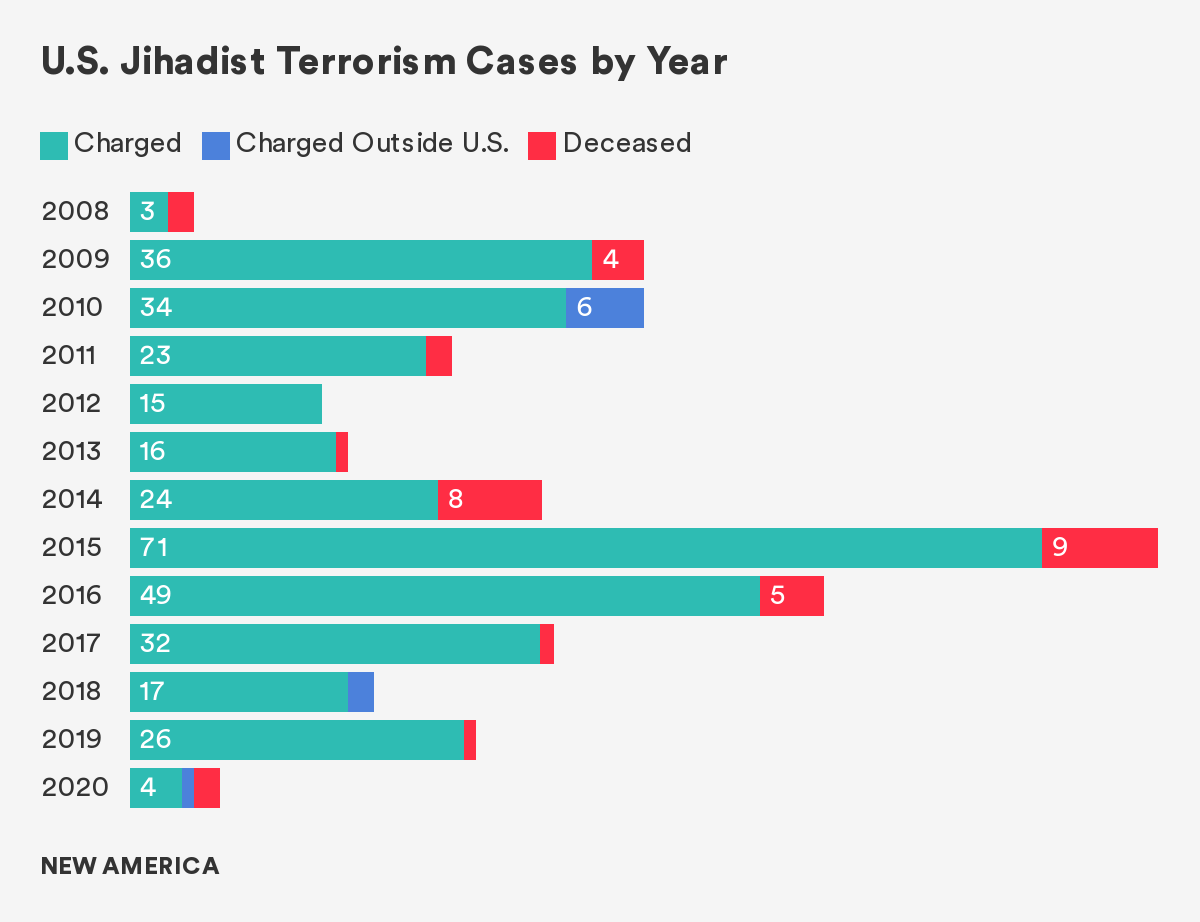
So far in 2020, there have been no deadly jihadist terrorist attacks, with the last one in Pensacola on December 6, 2019, as mentioned before. However, 2020 saw two attacks that were not deadly, other than for the alleged perpetrators.
On May 21, 2020, Adnan al-Sahli, a Syrian born U.S. citizen, crashed his vehicle into the entry barrier at Naval Air Station Corpus Christi in Texas and fired shots that injured a guard before al-Sahli was shot and killed.11 Al-Sahli reportedly had a social media presence that included support for AQAP, potentially relevant given the targeting of a naval air station, as in the Pensacola attack, and the FBI treated the case as terrorism-related.12
The second incident occurred on May 29, 2020, when two police officers shot and killed a woman who threatened them with a knife in Temple Terrace, Florida.13 The woman was later identified as Heba Momtaz al-Azhari, the 21-year-old sister of Muhammed Momtaz al-Azhari, who had been arrested earlier in the week for allegedly plotting a terrorist attack in support of ISIS, and who had previously faced terrorism charges in Saudi Arabia related to the Syrian civil war.14 The state attorney for the district that includes Temple Terrace concluded that the police officers鈥� actions were justified and that she had been carrying out an unprovoked attack seemingly motivated by her brother鈥檚 arrest.15
These two incidents, along with other attacks and attempts since ISIS鈥檚 loss of its capital of Raqqa and later complete territorial collapse, provide a reminder that even with ISIS鈥檚 decline abroad, the jihadist terrorist threat in the United States will continue, because much of the threat has been homegrown and, while inspired by jihadist ideology, did not rely on material support from foreign terrorist groups.16
Overall, the low number of cases in 2020 so far suggests that the United States homeland remains very well protected from jihadist terrorism directed from abroad. The rise of ISIS sparked significant fears about the terrorist threat from abroad, but even while the United States initiated the counter-ISIS war, the United States did not have credible evidence of any specific ISIS-directed terrorist plots against the U.S. homeland.17 Now, five years after the initiation of that war, it is clear that ISIS managed to inspire and brand an unprecedented wave of jihadist violence in the United States and in some cases was communicating online with plotters, but there is no evidence of a strong ISIS capability to direct or carry out attacks in the United States from abroad, as many at the time feared.
That said, the deadly Pensacola attack and previous attacks that were, by luck, not lethal鈥攊ncluding the 2009 Christmas Day bomb plot, when Umar Farouk Abdulmuttalab, who was trained and directed by AQAP, detonated a bomb aboard a flight over Detroit which luckily failed to properly explode; and a 2010 case in which Faisal Shahzad, a Pakistani-American trained by the Pakistani Taliban, left a car bomb in Times Square that failed to explode鈥攄emonstrate that the threat of attacks with foreign terrorist organization involvement is unlikely to ever be fully banished, emphasizing the importance of specific investigations and general societal resilience to terrorist attacks. One hundred percent security is impossible, but the United States鈥� record of avoiding organizationally directed attacks on the homeland is impressive.
Nevertheless, caution is required in assessing the meaning of counts of terrorism cases, particularly before a year is over. The number of cases can reflect prosecutorial decisions rather than the threat itself, and often cases can become public later in the year or even after a year is over as they are unsealed or discovered by reporters. In the age of the novel coronavirus, there may be a second set of caveats related to the effect of the pandemic.18
An examination of the cases that have occurred in 2020 suggests that the United States鈥� layered defenses continue to operate well. Of the seven jihadist terrorism cases in 2020 as of September 4, four were monitored by informants. One of the cases involved an individual facing charges in Iraq for crimes alleged to have occurred there 14 years ago, with no clear allegations of more recent activity.19 There are significant questions regarding the reliability of evidence in other cases involving Iraqis facing extradition for terrorism-related charges in Iraq.20 The two attacks described earlier in this section鈥攖he shooting at Naval Air Station Corpus Christi and the stabbing in Florida鈥攃onstitute two of the three cases that are not known to have involved monitoring by informants. But regarding the stabbing incident by Heba Momtaz al-Azhari, an undercover FBI agent had investigated her brother, whose arrest allegedly motivated her attack.21 The third such case involves an individual accused of making false statements in a terrorism investigation, and little detail is available about the investigation鈥檚 methods.
The Terrorist Threat Beyond Jihadism and the Trump Administration鈥檚 Response
While the jihadist threat to the United States has been somewhat muted compared to recent history, the United States continues to face a threat of terrorism from individuals inspired by a range of ideologies and political views, including far-right views, ideologically framed misogyny of various forms, Black nationalist, separatist, and supremacist views, and far-left views. The year 2020 has brought a period of particularly pronounced political polarization that may pose a substantial threat of increased terrorism and other forms of targeted violence.

According to 国产视频鈥檚 tracking, the United States has seen four deadly terrorist attacks, killing six people, inspired by ideologies other than jihadism in 2020 as of September 4. The first was a far-right attack that killed two people, inspired in part by libertarian anti-government ideology, the nascent so-called Boogaloo movement, and the dynamics surrounding the current wave of protests over police brutality. On July 29, 2020 amid ongoing protests over police brutality, Steven Carrillo and Robert Alvin Justus Jr. allegedly drove a van to the Ronald V. Dellums Federal Building and U.S. Courthouse in Oakland, California, where they shot and killed a security guard and injured another guard.22 They then drove away. Their escape led to a manhunt that discovered a van matching the description of that involved in the initial attack in Ben Lomond, California that had firearms and explosives in it. When law enforcement came to Carrillo鈥檚 residence in the same town, he opened fire on them, killing a sheriff鈥檚 deputy and injuring another deputy.
According to the Department of Justice, 鈥淐arrillo appears to have used his own blood to write various phrases on the hood of the car that he carjacked. The phrases relate to an extremist ideology that promotes inciting a violent uprising through use of militias.鈥�23 That referenced ideology was the Boogaloo movement as filtered through Carrillo鈥檚 particular interpretation of libertarian politics.24 Carrillo also appears from his social media activity to have been influenced in his decision to carry out an anti-government attack by the heavy policing of the police brutality protests.25 Carrillo reportedly met his alleged co-conspirator through a Boogaloo-associated Facebook group.26
The Boogaloo movement is a new and nascent movement in which people with varying ideological reference points have coalesced around a meme that foresees a coming civil war in the United States, though those associated with the movement tend to hold to forms of right-wing, anti-government libertarianism.27 The specific attack conducted by Carrillo, and the movement鈥檚 rise more generally, illustrate the ways in which a growing sense of apocalypticism can combine with the availability of firearms and online spaces to generate terrorist violence. The Carrillo attack is not a lone instance of alleged terrorist plotting emerging out of the Boogaloo movement. In Nevada, three men were charged in June 2020 with plotting to use Molotov cocktails and explosives to spark violence surrounding the protests over the death of George Floyd.28
The second deadly attack in 2020 was inspired by ideologically framed forms of misogyny, specifically ideas steeped in the so-called Men鈥檚 Rights Movement. On July 19, 2020, a gunman shot and killed the son of U.S. District Judge Esther Salas and injured her husband at their home in New Jersey. The FBI identified the primary suspect as Roy Den Hollander, a self-identified "anti-feminist" lawyer was found in what is believed to have been a suicide on July 20, 2020. Hollander's website includes numerous anti-feminist writings, among them a 152-page document that included the statement, "Things begin to change when individual men start taking out those specific persons responsible for destroying their lives before committing suicide." Hollander reportedly had terminal cancer. In a long memoir, Hollander referred to Salas, before whose court he had represented a woman challenging the draft's male-only form, as "a lazy and incompetent Latina judge appointed by Obama."29
The third deadly attack in 2020 was a far-right attack that occurred on August 25, 2020 during a protest in Kenosha, Wisconsin against the police shooting of Jacob Blake. Kyle Rittenhouse, a 17-year-old from Illinois, allegedly shot and killed two people and wounded a third.30 Rittenhouse had traveled from his hometown of Antioch, Illinois (about 21 miles away from Kenosha, Wisconsin) and appears to have mingled there with a largely ad-hoc militia group in Kenosha called the Kenosha Guard, which had put up a call for people to travel to Kenosha on Facebook, though importantly it is not clear that he had a relationship with the group. His social media activity reportedly shows support for Trump and police with many posts regarding Blue Lives Matter but no explicit posts tied to militia or white supremacist groups, and according to Facebook, which took down the Kenosha Guard鈥檚 Facebook page after the fact, Rittenhouse was not a member of the group鈥檚 Facebook page.31
In a video prior to the shooting, Rittenhouse said that he had traveled to Kenosha to protect property and was carrying his long gun for self-defense. The first shooting occurred after Rittenhouse left the car dealership he claimed to be protecting. According to a timeline in the complaint filed against Rittenhouse, Joseph Rosenbaum, one of the victims, followed Rittenhouse and appeared to throw a plastic bag at him that did not hit him.32 Rittenhouse appears to be pursued by a group including Rosenbaum. During this, an unknown individual shot into the air for unclear reasons (its muzzle flash is visible in a video of the incident) and Rittenhouse turned towards the shot and fires in that direction shooting and killing Rosenbaum. Rittenhouse proceeded to flee, and made a call to a friend whom he told 鈥淚 just killed somebody.鈥� Another video then shows Rittenhouse running as others give chase saying that he shot someone and trying to confront him. A man jumped towards him and Rittenhouse shot again and missed. At that point Anthony Huber approached with a skateboard and appeared to try and wrestle the gun away from Rittenhouse, and Rittenhouse shot Huber, who later died from the wound.
According to the complaint, Rittenhouse then sat up and pointed his gun at Gaige Grosskreutz. The complaint states, 鈥淕rosskreutz freezes and ducks and takes a step back. Grosskreutz puts his hands in the air. Grosskreutz then moves towards the defendant who aims his gun at Grosskreutz and shoots him, firing one shot. Grosskreutz was shot in the right arm. Grosskreutz appears to be holding a handgun in his right hand when he was shot.鈥� Rittenhouse then walked towards police with his hands up though they did not arrest him at the time. On August 26, Rittenhouse was arrested and charged with first-degree homicide.33 Further charges were filed on August 27. Wisconsin is an open carry state, but as he was younger than 18, Rittenhouse could not legally open carry. Rittenhouse鈥檚 lawyers contend that he was acting in self-defense.
The fourth deadly attack in 2020 was a far-left attack that occurred on August 29, 2020, in Portland, Oregon, when a man shot and killed Aaron J. Danielson, a supporter of the far-right group Patriot Prayer that had been involved in prior brawls in Portland and at times had brought firearms to protests.34 The attack followed protests earlier in the day during which part of a caravan of Trump supporters participating in an event called 鈥淭rump 2020 Cruise Rally鈥� drove through the city. Video appears to show Danielson at the far-right rally earlier in the day with a companion Chandler Pappas who is carrying a paintball gun. Members of the caravan shot paintball guns and mace at protesters along their drive.
The shooting occurred later that night. According to the New York Times鈥檚 analysis of two videos, two men 鈥渃an be seen crossing the street, apparently to confront Mr. Danielson and Mr. Chandler.鈥�35 Someone says 鈥淗ey, we got some right here. We got a couple right here.鈥� Pappas contends that it was the shooter who said it, and Danielson reached for and sprays his mace at which point the shooter shot and killed him.
On September 3, 2020, police attempted to arrest Michael Forest Reinoehl, a 48-year-old man, for the shooting, killing him in the attempt.36 The U.S. Marshalls Task Force stated, 鈥淚nitial reports indicate the suspect produced a firearm, threatening the lives of law enforcement officers. Task force members responded to the threat and struck the suspect who was pronounced dead at the scene.鈥� Earlier in the day Reinoehl had done an interview with VICE TV, in which he appears to confess to the shooting and claimed it was in self-defense stating, 鈥淚 could have sat there and watched them kill a friend of mine of color, but I wasn鈥檛 going to do that.鈥�37 However, an arrest warrant unsealed after Reinoehl鈥檚 death analyzes surveillance footage that appears to show Reinoehl following and tracking Danielson and Pappas prior to the attack.38
Reinoehl was influenced by left wing politics. A Portland resident, he had gone downtown to provide 鈥渟ecurity鈥� for protesters amid the caravan, and appears to be visible in videos clashing with the far-right protesters earlier in the day. He described himself as 100 percent anti-fascist though not a member of any Antifa group.39 Reinoehl鈥檚 social media included descriptions of protests in Portland as war and references to revolution including, saying 鈥淚t's escalating to a point where, you know, they're trying to disrupt us in every way, that's illegal. They're shooting at us. They're sending people that are starting fights… it's warfare, this is stuff they've done overseas for years and years and years and years; but now they're doing it to us鈥� Every Revolution needs people that are willing and ready to fight,鈥� and 鈥渋f the police continue to pick on and beat up innocent citizens that are peacefully voicing their objections, it must be met with equal force,鈥� adding, 鈥渨e truly have an opportunity right now to fix everything… it will be a fight like no other! It will be a war and like all wars there will be casualties.鈥�
In addition, two attackers influenced by Black supremacist and specifically anti-Semitic forms of Black Hebrew Israelite ideology as well as anti-government views shot and killed four people in an attack on a Jersey City kosher grocery store on December 10, 2019.40 The attackers had a bomb and had reportedly scoped other potential targets as well.
These five deadly attacks in 2020 and late 2019 illustrate the range and diversity of motivations behind terrorism in America today. Some movements鈥攏otably far-right anti-government and white supremacist movements鈥攈ave more developed networks and a greater history of recent violence in America. But the character of terrorist threats in America largely involves lone actors with limited organizational support for their attack and an increasingly online, remixed or syncretic, and highly individualized set of ideological and political framings. The widespread availability of firearms increases the ease of committing mass violence. Together, these characteristics should warn against viewing the threat as the province of any one movement or ideology.
Policymakers should also be cautious about overhyping the terror threat. The number of deadly attacks remains small and recent deadly attacks have involved lone actors or pairs of individuals. It would be a dangerous mistake鈥攐ne with the potential to escalate the threat and harm civil liberties鈥攖o adopt heavy-handed policing methods against communities and movements as a whole based on potential scenarios of how that threat could escalate further. Instead, focusing on specific terrorist threats, violent acts, and plotting and preparation activity has greater potential to contain and de-escalate risks. However, it is also important to note how protests involving armed individuals and militias or street fighting can open space for deadly attacks that may have little preparation activity specific to the act of violence. This is visible in claims鈥揾owever contested or false – of self-defense by the alleged perpetrators of the deadly attacks in Kenosha, Wisconsin and Portland, Oregon.
The number of deadly attacks does not capture the full threat of non-jihadist terrorism today, and there is reason for substantial concern about the threat picture. Systemic factors and political polarization have increased the level of threat and are likely to continue to do so. Regardless of the specifics of what would constitute an appropriate and effective policing stance, the nature of the current threat emphasizes the importance of broader societal efforts to change these systemic factors and help deflate the current heightened threat.
In assessing the threat, it is important to look beyond the deadly attacks that constitute the tip of the iceberg and consider the number of arrests, non-lethal attacks, and the broader political context in which attacks happen. Last year saw major far-right terrorist attacks in Christchurch, New Zealand and El Paso, Texas that point to the globalization of far-right movements and their tactical use of mass casualty attacks on public spaces.41
The United States in 2020 is experiencing extreme political polarization fused with often apocalyptic imagery. This stems in part from the impact of the coronavirus pandemic and the lockdowns that emerged as a response, which have fueled protests, including multiple armed protests with far-right movement participation, that call for repealing lockdown orders.42 Demands that people wear masks have escalated into semipolitical interpersonal violence on several occasions.43 In March 2020, a man, influenced by conspiracy theories about the government response to the coronavirus, attempted to crash a train into a naval hospital ship that was docked at the Port of Los Angeles and tasked with responding to the pandemic.44
The pandemic has had an immense economic impact on the American population, with unemployment surging to levels not seen since the Great Depression and as many as 32 percent of U.S. households are finding themselves unable to pay their rent.45 More than 170,000 Americans have died of coronavirus鈥攍ikely even more given the limitations of the count.46 Wars are often cited as a radicalizing force; more Americans have died from the pandemic than in the Vietnam War or in World War I, and more than 50 times as many people have died as those in the 9/11 attacks.47 Globally, more than 750,000 people have died from coronavirus since the start of the pandemic. It is not difficult to see why people might be radicalizing in this environment.
Beyond the impact of the pandemic, on May 25, George Floyd was killed while he was in the custody of Minneapolis police, touching off a renewed wave of protests over police killings, brutality, and systemic racism, some of which saw violence.48 Three of the four deadly non-jihadist attacks in 2020 occurred in the vicinity of protests and counterprotests.
Atop both of these dynamics, the November 2020 U.S. presidential election is widely seen as a turning point for American politics that is likely to have major consequences, including potentially for American democracy itself. As two of the authors of this report argued in 2018, the terrorist threat in America is driven in large part by the extent to which these broad social phenomena shape the public discussion and people鈥檚 perceptions, because most terrorism in America is committed by lone attackers or small cells, without major organizational direction, who radicalize or organize largely online and act in an environment where widespread availability of firearms makes the jump to violence an easy step to take.49
A large number of non-lethal attacks in 2020, as well as arrests for alleged non-jihadist terrorism-related activity often surrounding protests, points to a much larger problem of extremist violence and the potential for more deadly terrorist attacks. According to research by Ari E. Weil, the deputy research director at the Chicago Project on Security and Threats of the University of Chicago, there have been at least 66 cases in which a vehicle hit protesters in the United States since the May 25 killing of George Floyd with charges filed in at least 24 cases.50
One case that did not result in a deadly terrorist attack illustrates the broader outlines of the threat beyond the deadly attacks this year. On March 24, 2020, a man under investigation for a domestic terrorism plot was shot and killed when the FBI tried to arrest him in Missouri.51 The man was reportedly being investigated for a plot to bomb a hospital out of anger over his city鈥檚 coronavirus lockdown order and held anti-government and white supremacist views.
In addition, according to reporting by ABC, the Missouri man had been identified to the FBI by another terrorism suspect with whom he had contact, Jarrett Smith, an active duty soldier who was arrested in September 2019.52 Smith was arrested after discussing a potential plot to bomb the headquarters of a major American news network with an FBI informant.53 Smith had his own contact with a former soldier named Craig Lang with whom Smith discussed his plan to fight in Ukraine with the far-right Azov Battalion, a plan that he later abandoned. 54 On April 9, 2018, according to a criminal complaint filed in August in Florida鈥檚 Middle District, Craig Lang and another former soldier, Alex Jared Zwiefelhofer, carried out an armed robbery during which they murdered the married couple whose house they robbed.55 The robbery was allegedly part of an effort to fund travel to fight against the Venezuelan government. This plot and the networks of connections it reveals point to the potential for much greater extremist violence.
Facing the current polarized environment, the Trump administration has adopted a policy approach that misrepresents what the threat is鈥攕pecifically focusing upon an organizational terrorist threat from the anti-fascist or Antifa movement. On May 31, 2020, Trump tweeted that he would designate Antifa as a terrorist organization, an action that is not possible under current laws given the lack of domestic designation authorities.56
国产视频 focus on Antifa as an organizational threat also misrepresents what Antifa is, portraying it as both an organization and as responsible for major terrorist violence. Yet Antifa is not an organization but rather a loose network and movement.57 Conceptualizing Antifa as a terrorist organization rather than a broad movement poses significant risks for eroding free speech, given the looseness of what Antifa means and the possibility that the term will come to mean any left wing activism, violent or not.
Moreover, Antifa is not a terrorist movement. According to 国产视频鈥檚 data, only one person has been killed in an attack associated with the movement or its ideology in the post-9/11 era.58 A separate tally by the Center for Strategic and International Studies (released prior to the deadly shooting in Portland, Oregon) found no murders attributable to Antifa in over 25 years.59 This is not to say that it is impossible for individuals to commit terrorism inspired by antifascism or that the movement does not include individuals who support such acts. But there is no evidence that the movement as a whole embraces terrorism nor evidence that many individuals influenced or tied to the movement have carried out deadly terrorist violence. While the attack in Portland provides a reminder that deadly political violence can come from a wide-range of ideological perspectives including the far-left and ideas tied to the Antifa movement, inflating a single incident into a broad organizational threat is an extreme form of threat inflation.
Citations
- Peter Bergen, David Sterman, and Melissa Salyk-Virk, 鈥淭errorism in America 18 Years After 9/11鈥� (国产视频, September 18, 2019), source
- This section draws upon: David Sterman, 鈥淲e Need More Oversight on US Counterterrorism Policy in the Wake of AQAP鈥檚 Confirmed Involvement in the Pensacola Attack,鈥� Responsible Statecraft, May 22, 2020, ; Peter Bergen, 鈥淔BI Delivers to America a Chilling Reminder about Al Qaeda,鈥� CNN, May 18, 2020,
- Colin Clarke, 鈥淭he Pensacola Terrorist Attack: The Enduring Influence of Al-Qa`ida and Its Affiliates,鈥� CTC Sentinel 13, no. 3 (March 2020),
- 鈥淎ttorney General William P. Barr and FBI Director Christopher Wray Announce Significant Developments in the Investigation of the Naval Air Station Pensacola Shooting鈥� (Department of Justice Office of Public Affairs, May 18, 2020),
- Prior to the Fort Hood attack in 2009, during which he killed 13 people, Nidal Hasan corresponded with Anwar al-Awlaki, but there is no evidence that they communicated about the specifics of the attack itself. Foreign terrorist organizations have communicated with people who carried out non-lethal attacks in the United States about their attacks as well as with those who plotted but failed to carry out attacks. AQAP in the past also fully directed and carried out an attack in the United States that luckily failed to kill anyone when Umar Farouk Abdulmuttalab, who trained in Yemen, detonated a bomb on a flight over Detroit but the bomb failed to fully explode. However, according to 国产视频鈥檚 tracking, no deadly post-9/11 attack in the U.S. has involved either specific communication regarding the plot or direction from a foreign terrorist organization.
- Peter Bergen et al., 鈥淭errorism in America After 9/11鈥� (国产视频), accessed September 4, 2020, source
- Alex Nowrasteh, 鈥淭he Pensacola Mass Shooting and Terrorism,鈥� Cato Institute (blog), December 6, 2019,
- This section draws in part upon David Sterman, 鈥淚s the U.S. On Track for a Record Low Year in Jihadist Terrorism?,鈥� 国产视频 (blog), April 17, 2020, source
- 国产视频 data on jihadist-terrorism related cases includes anyone inside the United States who has been charged in U.S. courts for jihadist terrorism-related activity, American citizens and residents charged in foreign courts for jihadist terrorism related activity, and people who died before being charged with a crime but who are widely reported to have engaged in jihadist criminal activity that would have fallen into one of the above categories had they not died.
- Bergen et al., 鈥淭errorism in America After 9/11.鈥�
- 鈥淔BI: Only 1 Attacker in Corpus Christi Naval Base Shooting,鈥� Associated Press, May 26, 2020, ; Dakin Andone et al., 鈥淭exas Naval Base Shooter Believed to Have Expressed Support for Terrorist Groups Online,鈥� CNN, May 22, 2020,
- 鈥淔BI: Only 1 Attacker in Corpus Christi Naval Base Shooting.鈥�
- Josh Fiallo and Luis Santana, 鈥淲oman Shot, Killed after Charging Temple Terrace Officer with Knife, Officials Say,鈥� Tampa Bay Times, May 30, 2020, ; Spectrum News Staff and Dave Jordan, 鈥淲oman Killed in Officer-Involved Shooting Was Sister of Terror Suspect,鈥� Spectrum News, May 29, 2020,
- 鈥淭ampa Man Charged with Attempting to Provide Material Support to ISIS鈥� (Department of Justice Office of Public Affairs, May 27, 2020),
- 鈥淪tatement Concerning May 29, 2020 Shooting of Hiba Momtaz AlAzhari鈥� (Office of the State Attorney of the 13th Judicial Circuit, July 21, 2020),
- Bergen, Sterman, and Salyk-Virk, 鈥淭errorism in America 18 Years After 9/11鈥�; David Sterman, 鈥淲hy Terrorist Threats Will Survive ISIS Defeats,鈥� CNN, October 23, 2017,
- David Sterman, 鈥淒ecision-Making in the Counter-ISIS War: Assessing the Role of Preventive War Logic鈥� (国产视频, November 15, 2019), source
- The government may be less focused on prosecuting and reporting terrorism crimes in the short-term as a result of the focus on the pandemic and its disruption to normal procedures. Extremists may also simply be temporarily hunkered down due to the virus but still plotting. There is some evidence from the cases charged this year that coronavirus can disrupt activity. For example, Muhammad Masood, a 28-year-old Pakistani doctor charged with attempting to provide material support by traveling to join ISIS, had his alleged travel plans disrupted by coronavirus, according to the press release announcing charges in the case. See: 鈥淧akistani Doctor Charged with Attempting to Provide Material Support to ISIS鈥� (Department of Justice Office of Public Affairs, March 19, 2020),
- 鈥淔eds: Man Charged in 2006 Iraq Slayings Should Remain Jailed,鈥� Associated Press, May 16, 2020,
- Ben Taub, 鈥淭he Fight to Save an Innocent Refugee from Almost Certain Death,鈥� New Yorker, January 27, 2020,
- 鈥淭ampa Man Charged with Attempting to Provide Material Support to ISIS.鈥�
- 鈥淭wo Defendants Charged with Murder and Aiding and Abetting in Slaying of Federal Protective Service Officer at Oakland Courthouse Building鈥� (Department of Justice Office of Public Affairs, June 16, 2020),
- 鈥淭wo Defendants Charged with Murder and Aiding and Abetting in Slaying of Federal Protective Service Officer at Oakland Courthouse Building.鈥�
- Rob Fadeboe, 鈥淪uspect in Ambush Murder of Santa Cruz Deputy Angered by Police Tactics,鈥� KRON4, June 9, 2020, ; Katie Shepherd, 鈥淎n Officer Was Gunned down. The Killer Was a 鈥楤oogaloo Boy鈥� Using Nearby Peaceful Protests as Cover, Feds Say.,鈥� Washington Post, June 17, 2020,
- Fadeboe, 鈥淪uspect in Ambush Murder of Santa Cruz Deputy Angered by Police Tactics.鈥�
- Nate Gartrell, 鈥淪teven Carrillo, Boogaloo-Associated Suspect in Killing of Two Bay Area Officers, Has First Court Appearance in Federal Death Penalty Case,鈥� The Mercury News, June 24, 2020,
- On the Boogaloo movement see discussion in: Jon Lewis, 鈥淩ethinking Domestic Terrorism Law After Boogaloo Movement Attacks,鈥� Lawfare, July 27, 2020, ; Robert Evans and James Wilson, 鈥淭he Boogaloo Movement Is Not What You Think,鈥� Bellingcat, May 27, 2020,
- Derek Hawkins, 鈥淔ederal Authorities File Charges against 3 Alleged Boogaloo Followers in Nevada,鈥� Washington Post, June 4, 2020,
- 鈥淪tatement Concerning May 29, 2020 Shooting of Hiba Momtaz AlAzhari鈥�; Nicole Hong, William K. Rashbaum, and Mihir Zaveri, 鈥溾�楢nti-Feminist鈥� Lawyer Is Suspect in Killing of Son of Federal Judge in N.J.,鈥� New York Times, July 22, 2020,
- Akane Otani, 鈥淲ho Is Kyle Rittenhouse and What Happened in the Kenosha Shootings?,鈥� Wall Street Journal, August 29, 2020, ; Haley Willis et al., 鈥淭racking the Suspect in the Fatal Kenosha Shootings,鈥� New York Times, August 28, 2020, .
- Neil MacFarquhar, 鈥淪uspect in Kenosha Killings Lionized the Police,鈥� New York Times, August 27, 2020, ; Hannah Allam, 鈥淰igilante? Militia? Confusion And Politics Shape How Shooting Suspect Is Labeled,鈥� NPR, August 28, 2020, .
- This description of the incident draws upon: Willis et al., 鈥淭racking the Suspect in the Fatal Kenosha Shootings鈥�; Clarissa-Jan Lim, 鈥淧rosecutors Released A Timeline Of 17-Year-Old Kyle Rittenhouse Shooting Three People At A Kenosha Protest,鈥� BuzzFeed, August 28, 2020, .
- Lim, 鈥淧rosecutors Released A Timeline Of 17-Year-Old Kyle Rittenhouse Shooting Three People At A Kenosha Protest鈥�; Akane Otani and Erin Ailworth, 鈥淜yle Rittenhouse Faces New Charges in Deadly Kenosha Shooting,鈥� Wall Street Journal, August 28, 2020, .
- Evan Hill et al., 鈥淗ow the Fatal Shooting at a Portland Protest Unfolded,鈥� New York Times, September 3, 2020, .
- Hill et al.
- Hallie Golden, Mike Baker, and Adam Goldman, 鈥淪uspect in Fatal Portland Shooting Is Killed by Officers During Arrest,鈥� New York Times, September 4, 2020, ; Jon Passantino, Bob Ortega, and Majile de Puy Kamp, 鈥淪uspect in Fatal Portland Shooting of Right-Wing Activist Killed during Attempted Arrest, US Marshals Say,鈥� CNN, September 4, 2020, .
- 鈥淰ICE News Tonight: Thursday September 3, 2020,鈥� VICE News Tonight, September 3, 2020, ; 鈥淢an Linked to Killing at a Portland Protest Says He Acted in Self-Defense,鈥� VICE News, September 3, 2020, .
- Lewis Kamb and Hal Bernton, 鈥淧ortland Shooting Suspect Followed Right-Wing Activists after Spotting Them Downtown, Unsealed Arrest Warrant Says,鈥� Seattle Times, September 5, 2020, .
- Passantino, Ortega, and Kamp, 鈥淪uspect in Fatal Portland Shooting of Right-Wing Activist Killed during Attempted Arrest, US Marshals Say鈥�; Jim Carlton, Joe Barrett, and Rachael Levy, 鈥淲hat Is Known 国产视频 Michael Reinoehl, Suspect in Portland Shooting Killed by Law Enforcement,鈥� Wall Street Journal, September 4, 2020, .
- Joseph De Avila, 鈥淛ersey City Kosher Grocery Shooters Planned Attack for Months,鈥� Wall Street Journal, January 13, 2020, ; Michael Gold and Ali Watkins, 鈥淪uspect in Jersey City Linked to Black Hebrew Israelite Group,鈥� New York Times, December 12, 2020, ; Jason Hanna and Madeline Hocombe, 鈥淛ersey City Shooters Fueled by Hatred of Jewish People and Law Enforcement, State Attorney General Says,鈥� CNN, December 12, 2020, ; 鈥淓vidence of Extremist Ideology Emerges in Jersey City Attack,鈥� Anti-Defamation League, December 13, 2019, ; 鈥淐enter on Extremism Uncovers More Disturbing Details of Jersey City Shooter鈥檚 Extremist Ideology,鈥� Anti-Defamation League, December 17, 2019,
- Bergen, Sterman, and Salyk-Virk, 鈥淭errorism in America 18 Years After 9/11.鈥�
- Abigail Censky, 鈥淗eavily Armed Protesters Gather Again At Michigan Capitol To Decry Stay-At-Home Order,鈥� NPR, May 14, 2020, ; Peter Holley, 鈥淭he 29-Year-Old Bodybuilder Behind the Armed Effort to Reopen Texas,鈥� Texas Monthly, May 29, 2020, ; 鈥淭exas Bodybuilder Charged with Conspiracy to Sell Steroids鈥� (Department of Justice U.S. Attorney鈥檚 Office Northern District of Texas, June 13, 2020),
- For one list of such incidents see: Jennifer Mascia, 鈥淧eople Keep Shooting Each Other Over Coronavirus Restrictions,鈥� The Trace (blog), August 3, 2020,
- Bill Chappell, 鈥淭rain Engineer Says He Crashed In Attempt To Attack Navy Hospital Ship In L.A.,鈥� NPR, April 2, 2020,
- Alicia Adamczyk, 鈥�32% of U.S. Households Missed Their July Housing Payments,鈥� CNBC, July 8, 2020, ; Heather Long and Andrew Van Dam, 鈥淯.S. Unemployment Rate Soars to 14.7 Percent, the Worst since the Depression Era,鈥� Washington Post, May 8, 2020,
- 鈥淐OVID-19 Dashboard by the Center for Systems Science and Engineering (CSSE) at Johns Hopkins University (JHU),鈥� Johns Hopkins University, accessed August 13, 2020,
- Jiachuan Wu, Nigel Chiwaya, and Robin Muccari, 鈥淪eeing the Scale: Visualizing the 100,000 American Coronavirus Deaths,鈥� NBC, June 2, 2020,
- Evan Hill et al., 鈥淗ow George Floyd Was Killed in Police Custody,鈥� New York Times, July 28, 2020, ; Christian Davenport and Gregory Scruggs, 鈥淧rotests Explode across the Country; Police Declare Riots in Seattle, Portland,鈥� Washington Post, July 26, 2020,
- Peter Bergen and David Sterman, 鈥淭he Real Terrorist Threat in America,鈥� Foreign Affairs, October 30, 2018,
- Neil MacFarquhar, 鈥淒rivers Are Hitting Protesters as Memes of Car Attacks Spread,鈥� New York Times, July 7, 2020,
- Evan Perez and David Shortell, 鈥淢an under Investigation for Plotting an Attack at a Hospital Believed to Be Treating Covid-19 Patients Was Killed during an FBI Investigation,鈥� CNN, March 26, 2020, ; Matt Zapotosky, 鈥淢an Who Plotted to Bomb Hospital during Coronavirus Crisis Was Killed in Confrontation with FBI,鈥� Washington Post, March 25, 2020,
- Mike Levine, 鈥淔BI Learned of Coronavirus-Inspired Bomb Plotter through Radicalized US Army Soldier,鈥� ABC, March 26, 2020,
- Katelyn Polantz, 鈥淯S Army Soldier Arrested after Allegedly Discussing Bombing News Network,鈥� CNN, September 23, 2019,
- Mike Eckel and Christopher Miller, 鈥淔ormer U.S. Soldier Who Fought With Ukrainian Far-Right Militia Wanted For U.S. Murder,鈥� Radio Free Europe/Radio Liberty, September 26, 2019,
- 鈥淐riminal Complaint United States of America v. Alex Jared Zwiefelhofer and Craig Austin Lang鈥� (United States District Court for the Middle District of Florida, August 16, 2019),
- Maggie Haberman and Charlie Savage, 鈥淭rump, Lacking Clear Authority, Says U.S. Will Declare Antifa a Terrorist Group,鈥� New York Times, June 10, 2020, ; Peter Bergen, 鈥湽悠� Crazy Designation of Antifa as Terrorist Organization,鈥� CNN, June 1, 2020,
- Michael Kenney and Colin P Clarke, 鈥淲hat Antifa Is, What It Isn鈥檛, And Why It Matters,鈥� War on the Rocks, June 23, 2020, ; Mark Bray, Antifa: The Anti-Fascist Handbook (Brooklyn: Melville House, 2017).
- Bergen et al., 鈥淭errorism in America After 9/11.鈥�
- Lois Beckett, 鈥淎nti-Fascists Linked to Zero Murders in the US in 25 Years,鈥� Guardian, July 27, 2020,
ISIS and the U.S. Counterterrorism Wars Abroad
Abroad, the United States continues to face resilient jihadist insurgencies. Across the Greater Middle East and South Asia, Al Qaeda, ISIS, and their various affiliates continue to exist 19 years after the 9/11 attacks. However, ISIS continues to struggle following the elimination of its territory in Iraq and Syria and holds far less power than it did at its peak. Despite ISIS鈥檚 struggles, the United States should not expect to be able to deal the group a lasting defeat that eliminates it as a potential threat. Even so, the United States continues to wage counterterrorism wars across the region, some of which are escalating while others are proceeding at a slower pace.
ISIS: Still Weakened More Than a Year after Full Territorial Collapse
On March 23, 2019, U.S. Central Command (CENTCOM) announced the elimination of ISIS鈥檚 last bit of territory in Syria.1 In almost a year and a half since that date, ISIS has failed to mount a territorial resurgence. In addition, on October 26, 2019, the United States killed ISIS鈥檚 leader and self-proclaimed caliph in a raid in Syria.2
Other signs of ISIS鈥檚 weakness includes continued evidence that the foreign fighter flow to Syria and Iraq, particularly from the West has fallen to almost zero. For example, Europol鈥檚 report on terrorism in 2019, notes, 鈥淚n 2019 there were few attempts reported by EU foreign terrorist fighters (FTFs) to travel to conflict zones reported to Europol, with only Austria and Spain confirming one prevented case each. This follows the pattern of the decreasing numbers of jihadists travelling from Europe since 2016.鈥�3 In 2019, Europol estimated that about 5,000 Europeans had traveled to Syria and Iraq over the course of the conflict and put the number still in the region at 2,000.4 Europol has assessed that the flow of fighters has dried up for the past few years. For example, in 2019, it reported, 鈥渢he number of EU [foreign fighters] travelling to the Iraq and Syria conflict zone in 2018 was very low鈥� and similar language can be found in its 2018 and 2017 reports.5
Similarly, according to 国产视频鈥檚 tracking, in 2020 there were only two cases of individuals trying to travel abroad to join ISIS, and both were monitored closely by informants. Already in May 2017, then-National Counterterrorism Center Director Nicholas Rasmussen stated, 鈥淭he good news is that we know that the rate of foreign fighters traveling has steadily declined since its peak in 2014.鈥�6 Over the course of the conflict, about 300 Americans traveled or attempted to travel to fight in Syria.7
Nor has ISIS carried out any major attacks outside of Iraq and Syria or the areas where its affiliates remain in conflict so far this year. However, the deadly bombings in Sri Lanka over Easter 2019 that killed hundreds illustrate the group鈥檚 potential to at least inspire and link itself to major attacks abroad and the threat of another such attack should not be dismissed.8
However, ISIS remains resilient as a terrorist organization in Iraq and Syria. The group continues to carry out attacks at a pace below its peak in 2014, but not substantially below prior years.9 Emphasizing the group鈥檚 resilience, CENTCOM鈥檚 Commander General Kenneth McKenzie commented, 鈥淭here's never going to be a time鈥� when either ISIS or whatever follows ISIS is going to be completely absent from the global stage. So the future, even the brightest possible future, is not a bloodless future, but it can be a future which we would define as where local security forces are able to contain ISIS without significant external help.鈥�10 General McKenzie commented in August 2020 that there are plans to further shrink the U.S. military presence in Iraq and Syria, though details are sparse and it is likely the United States will maintain a presence in both countries for the foreseeable future.11 This should not be a surprise as the United States proved unable to defeat ISIS in its earlier forms, even with more than 150,000 U.S. troops in Iraq.12 The killing of Baghdadi, like so many supposed decapitation strikes before in the counterterrorism wars in Iraq and elsewhere, is unlikely to bring the group to an end.13 Indeed, a January 2020 Department of Defense Inspector General report stated that ISIS remained cohesive and capable after the loss of Baghdadi.14
ISIS鈥檚 resilience reflects the broader difficulty of achieving lasting defeat of terrorist groups. Counterterrorism policymakers warn of the overall difficulty and near impossibility of defeat as an objective when it comes to terrorists, even when efforts are heavily resourced.15 Furthermore, the decentralization of terrorist groups and their adoption of branding techniques makes it even more difficult to deal groups a lasting defeat. This makes it essential for policymakers to state exactly which objectives they seek, instead of using the rhetoric of defeat when they wage counterterrorism warfare; but unfortunately, across the political spectrum, references to defeat are far more common than specific, measured objectives.
America鈥檚 Counterterrorism Wars
America, for its part, continues to wage counterterrorism wars across the Greater Middle East. In Somalia, the United States continues to conduct strikes at a rapid pace. In Yemen, the United States has conducted a lower level of strikes, though the existence of covert strikes makes it difficult to assess the full extent of the counterterrorism war, and in Pakistan the drone war has marked its second year without a single strike, suggesting it may be over. In 2020, in Libya, the United States conducted no air strikes, according to 国产视频鈥檚 tracking. In 2019 in Libya, 国产视频, in collaboration with Airwars, counted seven U.S. air or drone strikes, and in an email to 国产视频, U.S. Africa Command (AFRICOM) stated that the United States had conducted 10 airstrikes against ISIS-Libya and Al Qaeda in the Islamic Maghreb terrorist targets (six total airstrikes in Libya in 2018, and four in 2019).16 The United States also continues to carry out direct military operations in Syria, Iraq, and Afghanistan with training, and advise and assist efforts in many other countries.

In Somalia, the United States is still conducting strikes targeting al-Shabaab and ISIS in Somalia at a high pace. As of September 4, the United States had conducted 47 strikes in Somalia in 2020, with more than four months left in the year.17 In 2019, the United States conducted 64 operations, 61 of which were air or drone strikes. Every year since 2016 has seen more strikes than any in any previous single year of the campaign, according to 国产视频鈥檚 tracking, and 2020 could well continue that trend.

In the last year, the United States has been accused of civilian casualties by human rights groups and international non-governmental organizations. According to Amnesty International, for example, on February 2, 2020, the United States, with the Federal Government of Somalia, conducted an airstrike targeting an al-Shabaab terrorist in the vicinity of Jilib, that killed at least one civilian.18 On July 28, 2020, AFRICOM released a statement that after further investigation of this strike, one civilian was killed, and three other civilians were injured.19
In Yemen, the United States has conducted strikes at a much lower pace in 2020. According to 国产视频鈥檚 tracking, the United States has conducted only four strikes in Yemen during 2020 as of September 4.20 Of these strikes, one targeted not AQAP or other jihadist groups but Iranian Islamic Revolutionary Guard Corps (IRGC) figures in Yemen as part of the retaliation for an Iranian-backed militia鈥檚 deadly attack on American forces in Iraq that also involved the assassination of the IRGC Quds Force Commander Qasim Soleimani in Iraq.21
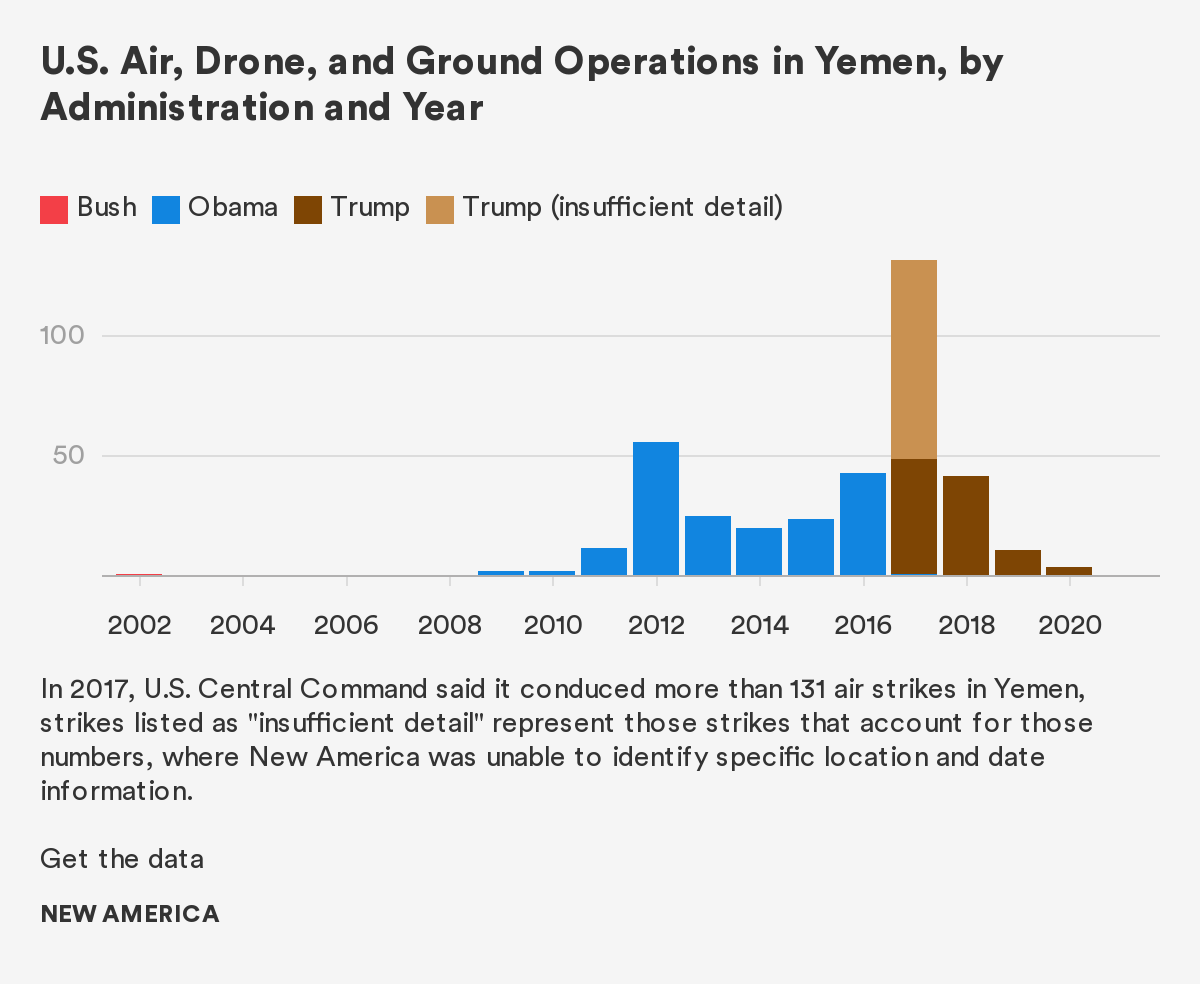
Importantly, it is particularly difficult to track the true extent of the U.S. war in Yemen because the United States appears to be conducting covert strikes in Yemen, and the Yemeni civil war has made it more difficult for the media to fully investigate reports of strikes and to attribute them when they occur.22 In 2020, of the four strikes that 国产视频 has recorded in the country, CENTCOM says it did not conduct any of them.23 However, government officials have been cited as saying at least some of the four strikes occurred, and the Department of Justice confirmed the existence of at least one strike, though it did not provide details, in its statement on the attack in Pensacola, Florida.24 This discrepancy strongly suggests the existence of continued covert strikes in Yemen.
In Pakistan, according to 国产视频鈥檚 tracking, the United States has not conducted a drone strike in more than two years with the last one being a strike in July 2018.25 This prolonged halt was preceded by another almost five-month pause in strikes in the country.26 Multiple factors may have fueled this halt, including a decline in the threat posed by jihadist groups in Pakistan鈥檚 Federally Administered Tribal Area, the reduction of U.S. forces in Afghanistan, and the role of domestic Pakistani politics.27 The long pause suggests that the U.S. war in Pakistan may be over, but given its covert nature, it is hard to be certain whether strikes have actually fully stopped, and whether the halt is an end or a temporary pause. This is one of the problems with America鈥檚 approach of waging covert counterterrorism wars without public statements of the objectives being sought and a vision of when those objectives would be achieved sufficiently to not require further military force.

Citations
- 鈥淐oalition, Partner Forces Liberate Last Territory Held by Daesh鈥� (U.S. Central Command, March 23, 2019),
- 鈥淩emarks by President Trump on the Death of ISIS Leader Abu Bakr Al-Baghdadi鈥� (The White House, October 27, 2019),
- 鈥淓uropean Union Terrorism Situation and Trend Report (TE-SAT) 2020鈥� (EUROPOL, June 23, 2020), 44,
- 鈥淭errorism Situation and Trend Report 2019 (TE-SAT)鈥� (EUROPOL, 2019),
- Bergen, Sterman, and Salyk-Virk, 鈥淭errorism in America 18 Years After 9/11鈥�; 鈥淭errorism Situation and Trend Report 2019 (TE-SAT).鈥�
- Nicholas Rasmussen, 鈥淒irector Rasmussen Opening Remarks CNAS Keynote Policy Address鈥� (National Counterterrorism Center, May 3, 2017),
- Hollie McKay, 鈥淎lmost All American ISIS Fighters Unaccounted for, Sparking Fears They Could Slip through Cracks and Return,鈥� Fox, October 26, 2017,
- Amarnath Amarasingam, 鈥淭errorism on the Teardrop Island: Understanding the Easter 2019 Attacks in Sri Lanka,鈥� CTC Sentinel 12, no. 5 (June 2019),
- Michael Knights and Alex Almeida, 鈥淩emaning and Expanding: The Recovery of Islamic State Operations in Iraq in 2019-2020,鈥� CTC Sentinel 13, no. 5 (May 2020),
- 鈥淐ENTCOM and the Shifting Sands of the Middle East: A Conversation with CENTCOM Commander Gen. Kenneth F. McKenzie Jr.,鈥� Middle East Institute, June 10, 2020,
- Eric Schmitt, 鈥淭op General in Middle East Says U.S. Troop Levels Will Drop in Iraq and Syria,鈥� New York Times, August 12, 2020,
- Brian Fishman, 鈥淏e Honest: ISIS Fight Will Be a Long One,鈥� CNN, May 23, 2015,
- Spencer Ackerman, 鈥淏aghdadi Is Dead. The War on Terror Will Create Another.,鈥� Daily Beast, October 28, 2019,
- 鈥淥peration Inherent Resolve Lead Inspector General Report to the United States Congress October 1, 2019 – December 31, 2019鈥� (Department of Defense Office of the Inspector General, January 31, 2020),
- David Sterman, 鈥淔or Effective Counterterrorism, Abandon the Language of Defeat,鈥� Responsible Statecraft, February 7, 2020,
- Melissa Salyk-Virk, 鈥淎irstrikes, Proxy Warfare, and Civilian Casualties in Libya鈥� (国产视频, May 26, 2020),
- Peter Bergen, Melissa Salyk-Virk, and David Sterman, 鈥淎merica鈥檚 Counterterrorism Wars: The War in Somalia鈥� (国产视频), accessed September 4, 2020, source
- 鈥淶ero Accountability as Civilian Deaths Mount in Somalia From U.S. Air Strikes鈥� (Amnesty International, March 30, 2020),
- 鈥淯.S. Africa Command Civilian Casualty Assessment Third Quarter Report鈥� (U.S. Africa Command Public Affairs, July 28, 2020),
- Peter Bergen, David Sterman, and Melissa Salyk-Virk, 鈥淎merica鈥檚 Counterterrorism Wars: The War in Yemen鈥� (国产视频), accessed September 4, 2020, source
- James Gordon Meek, Luis Martinez, and Elizabeth McLaughlin, 鈥淯S Tried to Kill Iranian Commander in Yemen Same Night as Soleimani Strike: Officials,鈥� ABC, January 10, 2020,
- For a discussion of early signs of the existence of a covert campaign as well as broader challenges to attribution see: David Sterman, 鈥淐ENTCOM Improves Transparency of Yemen War Civilian Casualties, But Gaps Remain,鈥� Just Security, January 28, 2019,
- Phone Conversation with CENTCOM Public Affairs, August 11, 2020.
- 鈥淎ttorney General William P. Barr and FBI Director Christopher Wray Announce Significant Developments in the Investigation of the Naval Air Station Pensacola Shooting.鈥�
- Peter Bergen, David Sterman, and Melissa Salyk-Virk, 鈥淎merica鈥檚 Counterterrorism Wars: The Drone War in Pakistan鈥� (国产视频, September 4, 2020), source
- David Sterman, 鈥淧akistan Set to Mark One Year with No U.S. Drone Strikes: Is the War Over?,鈥� 国产视频, July 3, 2019, source
- Farooq Yousaf, 鈥淯.S. Drone Campaign in Pakistan鈥檚 Pashtun 鈥楾ribal鈥� Region: Beginning of the End under President Trump?,鈥� Small Wars & Insurgencies 31, no. 4 (May 18, 2020): 751鈥�72, ; David Sterman, 鈥淧akistan Set to Mark One Year with No U.S. Drone Strikes: Is the War Over?,鈥� 国产视频, July 3, 2019, source ; David Sterman, 鈥淭he Drones in Pakistan Are Silent,鈥� 国产视频, June 13, 2018, source
Conclusion
Nineteen years after 9/11, the terrorist threat to the United States is far different from what it was on that day when Al Qaeda carried out an attack that killed almost 3,000 people in a matter of hours, using 19 men, trained in Al Qaeda鈥檚 Afghan camps, who entered the United States on temporary visas. Today, the threat to the homeland from jihadist groups is more limited and largely stems from lone actors living in the United States and inspired by jihadist ideology, but without direct support from foreign terrorist organizations. However, the Pensacola attack provides another reminder that 100 percent security from attacks involving foreign organizations is impossible.
At the same time, the past few years have shown that ideologies beyond jihadism, most notably far-right ideologies and movements, are likely to play a growing role in the terrorist threat to the homeland, perhaps eclipsing the threat from jihadism that predominated for years. This threat comes from a broad range of ideologies and movements, not just the far right, and is likely to be deeply shaped by the internet and generated in many cases by lone actors rather than mirroring a now outdated vision of the jihadist organizational threat.
Meanwhile, the United States has faced jihadist insurgencies like that of ISIS, which at one point ruled over territory the size of Britain, that would be difficult to imagine in 2001. In the case of ISIS, the United States once again demonstrated its ability to deny jihadist groups the ability to transition from insurgencies into sustainable quasi-state entities controlling large swaths of territory. At the same time, the United States has not demonstrated an ability to definitively defeat its jihadist enemies and continues to wage seemingly endless counterterrorism wars in multiple countries. Unable to fully extirpate jihadist insurgencies from the Middle East, the United States should focus on addressing specific threats and containing global jihadist organizing, rather than attempting to transform Middle Eastern politics as a whole.
Looking forward, American policymakers should urgently prioritize reviewing the current state of American counterterrorism, determining its effectiveness, and identifying the objectives the United States seeks, particularly in its wars abroad. This effort will have to address the fact that terrorism of all kinds has posed an extremely limited threat to the homeland, particularly in comparison to a pandemic that in less than a year has killed well over 600 times as many people as terrorism of all ideological stripes has killed in the 19 years since the 9/11 attacks. An approach attuned to today鈥檚 threats will also require efforts to address the systemic societal polarization and tensions that help make America vulnerable to terrorist violence.
More 国产视频 the Authors

David Sterman
Deputy Director, Future Security
Peter Bergen
Vice President, Global Studies & Fellows; Professor of Practice, Arizona State University

Melissa Salyk-Virk
Fellow, Future Security
Issues
Programs/Projects/Initiatives
Related