
Amanda LaTasha Armstrong
Research Fellow, Education Policy Program
A Research Brief

This brief summarizes a recent report that synthesizes more than 160 studies to explore the connection between culturally responsive materials and learning, and to assess the frequency and portrayal of different racial, ethnic, and gender groups within printed and digital educational media. Findings suggest there is disparity in representation of characters from different racial, ethnic, and gender groups. When portrayals of these groups are present, they tend to be affirming. However, stereotypes, limited roles, and inaccurate information are still present and tend to be unique to specific communities. The results of the synthesis indicate a need for educational materials that create a sense of belonging, develop cultural authenticity, and recognize nuanced identity in different characters. This brief concludes with questions to prompt reflection for three audiences: (1) education leaders, curriculum specialists, and coaches, (2) designers and developers of educational materials, and (3) families.
Culturally responsive education, when done well, is designed to (1) make all students feel they are a part of the educational community, (2) support all students in becoming engaged learners, (3) build students鈥� accurate knowledge of diverse people and their awareness of different perspectives, and (4) use students鈥� existing knowledge and experiences as bridges to new content.
Rudine Sims Bishop [1] established the concept of mirrors, windows, and sliding doors to describe children鈥檚 experiences with literature. 鈥淢irrors鈥� are materials that make connections with students鈥� own daily experiences and 鈥渨indows鈥� are materials that expose students to other contexts and cultures, and help them acknowledge and appreciate diverse cultures. The result is enhanced student engagement and more active and improved learning. Beverly Faircloth鈥檚 2012 study [2], for example, showed that when the educator included literature with characters that mirrored the students demographically, culturally, and experientially, students were more positively engaged with the content and more likely to complete their assignments.
In the 2015 book More Mirrors in the Classroom [3], the authors demonstrate how texts that are 鈥渕irrors鈥� allow students to use their existing cultural knowledge, which includes language, social contexts, and individuals鈥� responses. This can reduce cognitive load as students learn information and can improve reading comprehension. Additional studies indicate that culturally responsive materials enhance students鈥� participation, attentiveness to details and assignment qualities, and positive response to content.
Culturally responsive education uses "the cultural knowledge, prior experiences, frames of reference, and performance styles of ethnically diverse students to make learning encounters more relevant to and effective for them." – Geneva Gay
Culturally responsive education materials also expose students to new ideas and different perspectives, help develop their confidence as learners, and enable them to discover relevance to characters and experiences that may not be reflective of their daily circumstances. One study found that while high school students value having their culture and experiences reflected in the characters and stories of materials, they also want to learn about people who have different circumstances, perspectives, and cultures. [4]
Additionally, educational materials indirectly teach students about language, attitudes, beliefs, behaviors, and cross-cultural knowledge. They inform students about what society expects of them and others based on social identity markers and how society values them based on these markers. This aspect of materials is defined as 鈥渟ocietal curriculum鈥� and can influence children鈥檚 development of their own racial-ethnic and gender group identity as well as their understanding of different races, ethnicities, and genders.
In her 2018 book, Geneva Gay explains culturally responsive teaching in a asset-based approach that uses "the cultural knowledge, prior experiences, frames of reference, and performance styles of ethnically diverse students to make learning encounters more relevant to and effective for them." [5]
1. There are notable disparities in representation by race and ethnicity.
Several content analyses have indicated that, in children鈥檚 literature, White characters are presented in books significantly more than characters of BIPOC (Black, Indigenous, and People of Color) communities (i.e., African American, Asian American, Pacific Islanders, Hispanic, Latinx [6], Alaskan Native, American Indian, Native Hawaiian, and Middle Eastern).
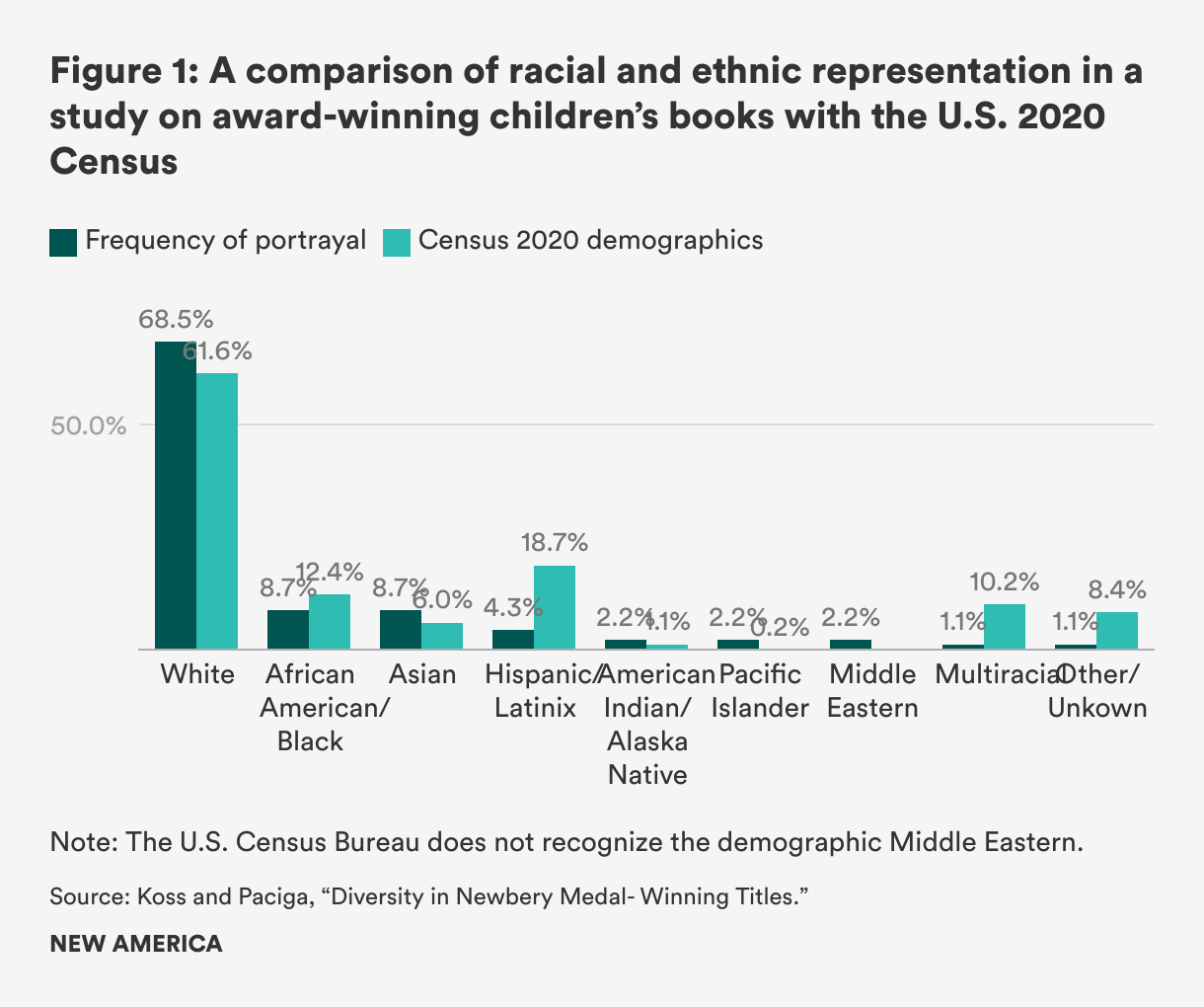
The Cooperative Children鈥檚 Book Center鈥檚 2019 examination [7] of the frequency of children鈥檚 books by and about BIPOC individuals published in the U.S. found that of the 3,717 books they received from U.S. publishers, 12 percent were about Black people or those of African descent; 8.8 percent were about Asians; 0.13 percent were about Pacific Islanders; 6.3 percent were about Latinx individuals; 1.2 percent were about Indigenous people; and 0.86 percent were about Arabs. Similarly, Melanie Koss and Kathleen Paciga鈥檚 2020 study [8] found that the percentage of primary race/ethnic groups in 70 percent of award-winning books were White, while the representation of BIPOC race/ethnicity in these books ranged from 9 to 1 percent. If Koss and Paciga鈥檚 findings are compared with entire population demographics from the 2020 U.S. Census population, there is a disparity in racial and ethnic representation, as indicated in Figure 1.
Studies of health and history textbooks have shown White people are featured in at least half or more (in some cases more than 80 percent) of images, pictorials, and illustrations. BIPOC representation made up the other half (or less than), with some racial/ethnic groups featured as infrequently as one percent.[9] A study of classroom and school posters [10] for purchase on websites found that only 13 percent of these were likely to be racially inclusive.
2. Gender representation has become more balanced but remains binary.
Many studies of educational materials typically examine gender from a female/male binary perspective, though there are a few studies that recognize gender diversity. Scholars have indicated a gender disparity in character representation and limited representation of female characters.
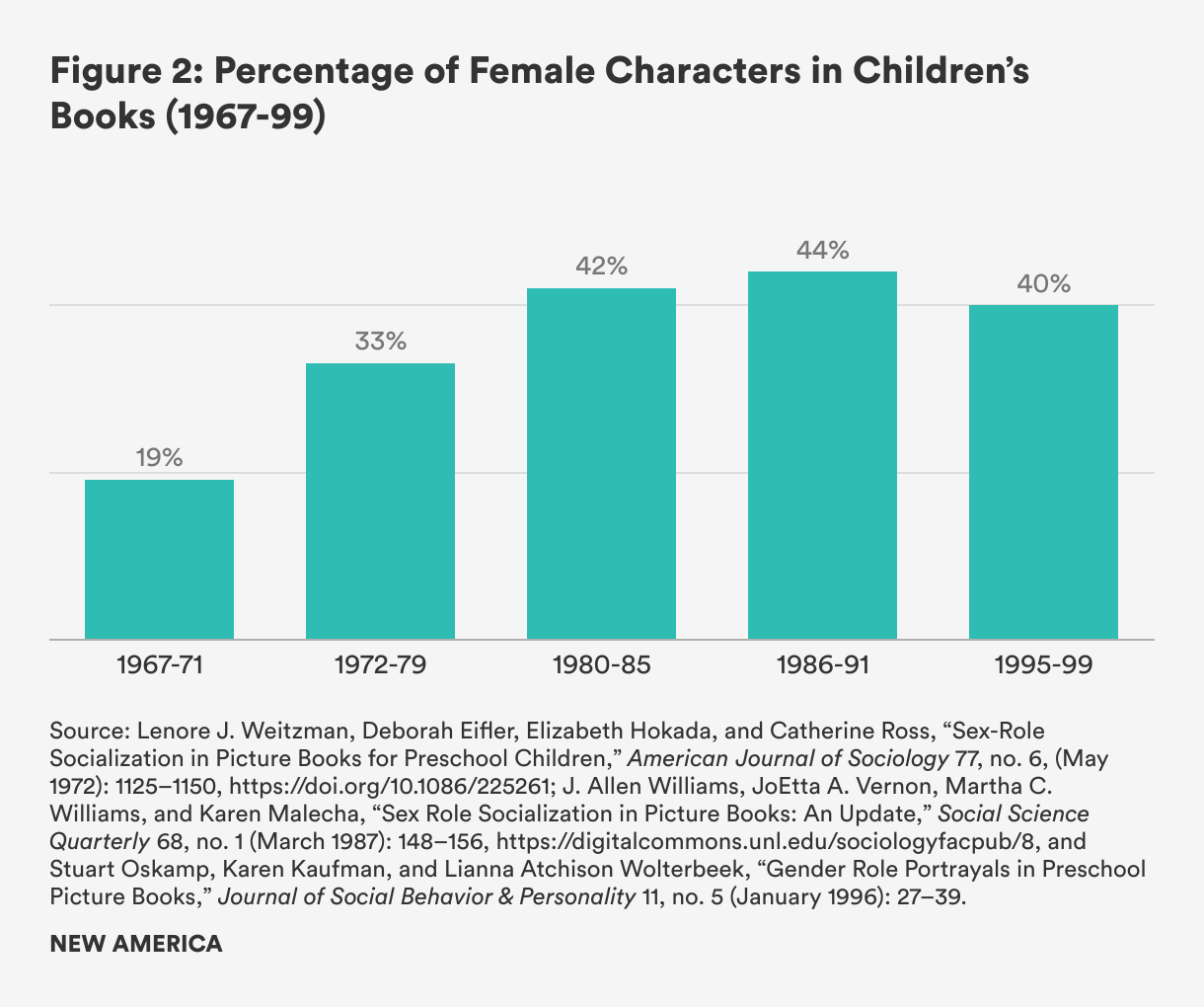
Lenore T. Weitzman and colleagues鈥� seminal study on 1967鈥�1971 [11] award-winning and runner-up children鈥檚 books revealed there were 11 times as many illustrated human males featured than females. Studies since then indicate an increase in female, human representation. Additional studies note the fluctuation of gender representation in books (Figure 2).
Koss and Paciga鈥檚 2020 study of award-winning books revealed 97 percent of them included male and female characters and no instances of nonbinary representation. [12] Scholars who have investigated LGBTQ-themed books found that 14 percent of primary characters in those books were transgender and 21 percent of secondary characters in those books were transgender people. [13]
A 2018 study of health textbooks found that women were represented slightly more than men, whereas a study of educational TV programs showed males were represented at a higher rate than females. Research of educational software conducted in the 1990s and early 2000s revealed that males are presented more often than females, with one finding showing that gender disparity increased from preschool to twelfth grade. [14]
3. When examining the intersection [15] of race, ethnicity, and gender, BIPOC characters are more likely to be male, and females are more likely to be White.
Research findings indicate it is more likely for intersectional characters to be racially and ethnically White than any other group. Studies of children鈥檚 texts found that BIPOC characters were more likely to be male than female.
1. Racial and ethnic stereotypes and limited portrayals are frequent.
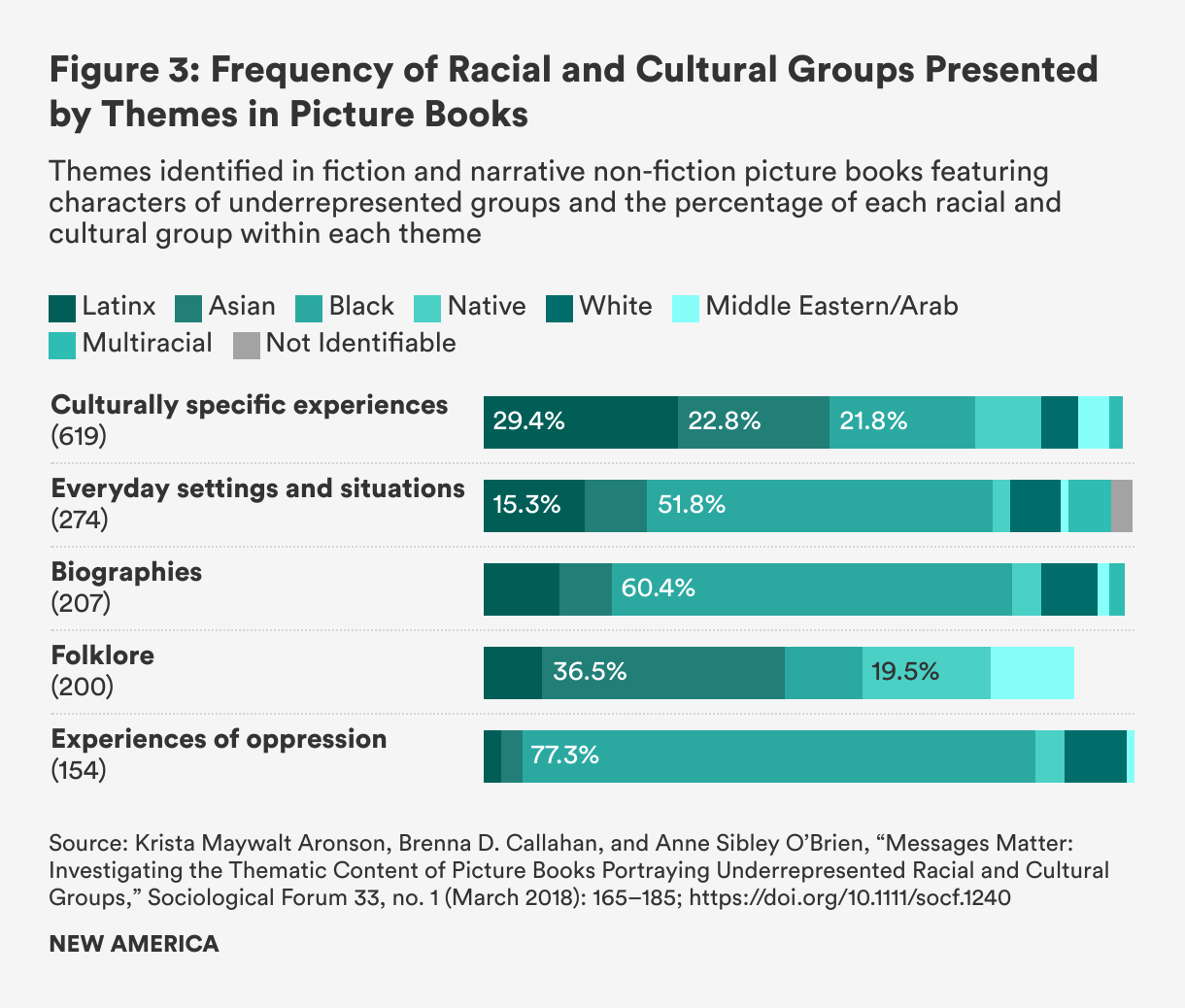
Several scholars examine depictions of characters from multiple racial and ethnic groups. In a 2018 study, Krista Aronson and colleagues analyzed 1,037 picture books that feature BIPOC characters and found five common themes in these books: (1) culturally specific experiences, (2) everyday settings and situation, (3) biographies, (4) folklore, and (5) experiences of oppression. [16] They analyzed the frequency of racial and ethnic representation within those themes as shown in Figure 3 and noted in some themes White characters were featured more often than Native American, Native Hawaiian and Pacific Islander, Middle Eastern, or biracial characters.
Studies of textbooks have identified problematic images of racial, ethnic and gender groups and a 鈥渉eroes and holiday鈥� cultural approach, focusing on celebration and historical figures. In analyses of educational games, some software feature diverse characters in a variety of roles while other software depict stereotypes.
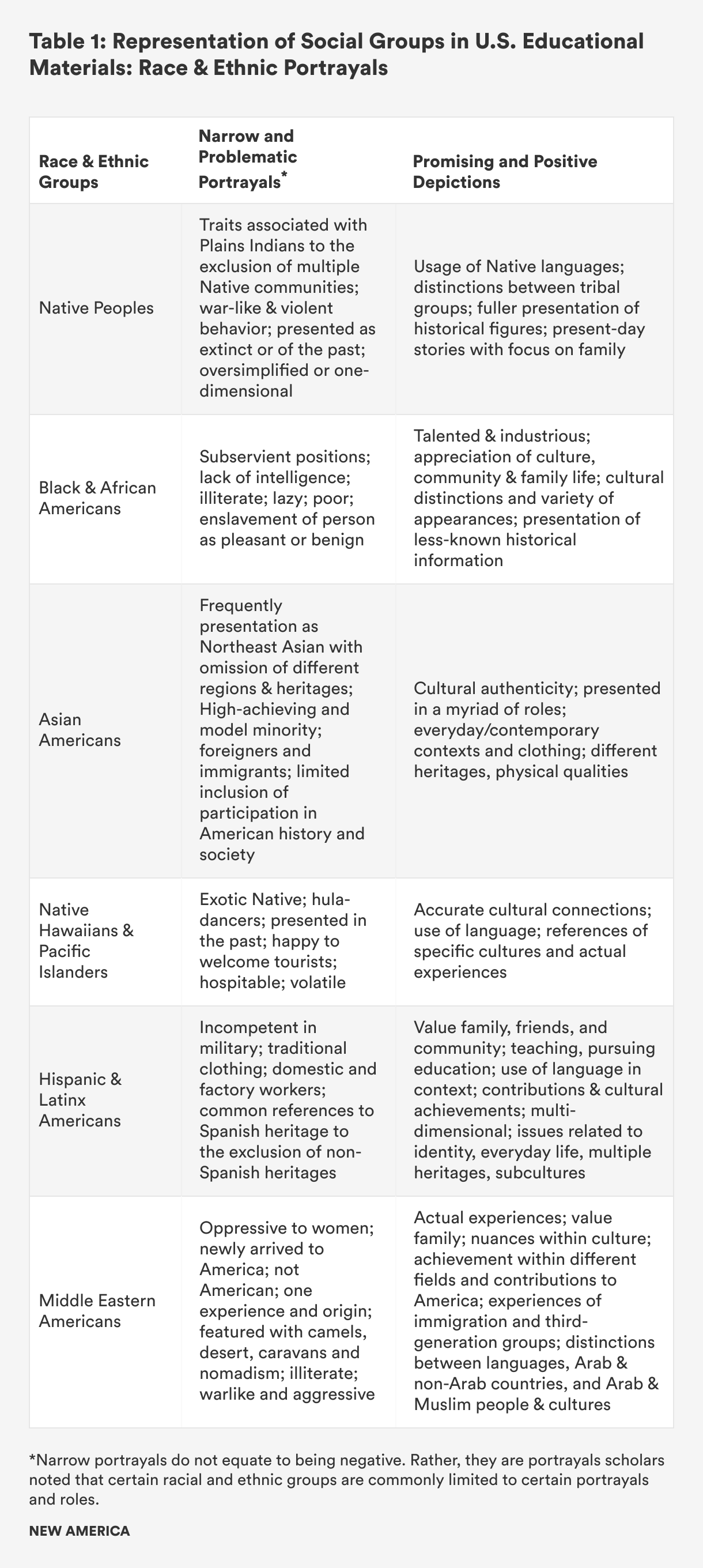
Other scholars analyzed portrayals of one racial/ethnic group in-depth and identified patterns of narrow [17] and problematic portrayals and recommendations of promising and positive depictions, summarized in Table 1.
Additionally, scholars have noted inaccurate or misleading portrayals and information about racial and ethnic groups, particularly in their inclusion in or exclusion from historical texts and stories of their social contributions. In some cases, they have been erased from events and stories.
2. While female portrayal is more varied, gender is still binary.
Early studies of children鈥檚 literature revealed that roles and portrayals of female characters were often limited to 鈥渢raditional鈥� activities, such as women preparing food, and girls helping mothers, pleasing or serving their brothers, shopping, or playing with dolls. Findings from research conducted in 2011, 2015, and 2020 indicate female characters in children鈥檚 books were likely to be portrayed as passive, dependent, submissive, and nurturing. As main characters, they may appear as a stay-at-home parent and housekeeper, but also a spunky person, or someone enjoying a career as a scientist, countering earlier portrayals. Nonbinary characters may perform a skill or action and be portrayed as a hero or valuable so that their gender identity becomes less problematic for the story鈥檚 characters.
Scholars have studied textbooks published from the 1950s to early 2000s and indicated that female portrayals have broadened over time, with an increase in mentions of their participation in and contributions to American history. At the same time, women may be presented in minor roles and excluded. Studies of educational software reveal a variation, with female characters depicted as dependent and with passive stereotype traits in some accounts and as adventurous, active, and dominant in others. And in subjects areas, like math, scholars have indicated the lack of diverse gender groups, such as transgender people and gender nonbinary people, and their contributions to the field.
3. More research is needed on intersection of gender, race and/or ethnicity.
Scholars who study characters who represent a combination of gender and racial or ethnic identities indicate they may reflect portrayals that are common to females or unique to a particular racial and ethnic group. In some cases, these portrayals may be limiting or problematic, such as Arab women being overweight or secondary in the scene and Latinx and Hispanic female characters defined by traditional female behavior. In other instances, portrayals may be affirming, such as countering the negativity often associated with Black hair and showing characters taking care of it. Studies indicate a lack of research and representation of intersectional characters whose gender identity is nonbinary.
This research review shows the need for educational materials to:
The research suggests that a lack of representation and narrow and stereotypical portrayals create missed opportunities for all students, preventing them from fully understanding how various racial, ethnic, and gender groups have been a part of and are a part of the American narrative. It creates missed opportunities to present mirrors to students as well as windows.
The incorporation of culturally responsive education materials not only supports students鈥� understanding of self and peers, but it enhances their connection to learning and expands their imagination and awareness of what is possible.
Questions for educators and education leaders, curriculum specialists, and coaches:
Questions for designers and developers of education materials:
Questions for families:
[1] Rudine Sims Bishop, 鈥淢irrors, Windows, and Sliding Glass Doors,鈥� Perspectives: Choosing and Using Books for the Classroom 6, no. 3 (Summer 1990),
[2] Beverly S. Faircloth, 鈥溾�榃earing a Mask鈥� vs. Connecting Identity with Learning,鈥� Contemporary Educational Psychology 37, no. 3 (July 2012): 186鈥�194, ;
[3] Jane Fleming, Susan Catapano, Candace M. Thompson, and Sandy Ruvalcaba Carrillo, More Mirrors in the Classroom: Using Urban Children鈥檚 Literature to Increase Literacy (Lanham: Rowman & Littlefield, 2015).
[4] Mary Amanda Stewart, Katie Walker, and Carol Revelle, 鈥淟earning from Students: What, Why, and How Adolescent English Learners Want to Read and Write,鈥� Texas Journal of Literacy Education 6, no. 1 (Summer 2018): 23鈥�40,
[5] Culturally Responsive Teaching: Theory, Research, and Practice, 3rd ed. (New York: Teachers College, 2018).
[6] Similar to the U.S. Census, this section uses both terms. Some scholars and organizations may use these terms interchangeably. Others note distinctions: Hispanics refer to people from Spain or Latin American Spanish-speaking countries and Latinx are from the Latin American region. For more information, see Mark Hugo Lopez, Jens Manuel Krogstad, and Jeffrey S. Passel, 鈥淲ho is Hispanic?鈥� September 23, 2021, Pew Research Center,
[7] Data set on books by and about Black, Indigenous and People of Color published for children and teens compiled by the Cooperative Children鈥檚 Book Center, School of Education, University of Wisconsin鈥揗adison, last updated April 16, 2021,
[8] Melanie D. Koss and Kathleen A. Paciga 鈥淒iversity in Newbery Medal-Winning Titles: A Content Analysis,鈥� Journal of Language & Literacy Education 16, no. 2 (Fall 2020): 1 – 38,
[9] Sherry L. Deckman, Ellie Fitts Fulmer, Keely Kirby, Katharine Hoover, and Abena Subira Mackall, 鈥淣umbers Are Just Not Enough: A Critical Analysis of Race, Gender, and Sexuality in Elementary and Middle School Health Textbooks,鈥� Educational Studies 54, no. 3 (January 2018): 285鈥�302, ; and B谩rbara C. Cruz, 鈥淒on Juan and Rebels under Palm Trees: Depictions of Latin Americans in US History,鈥� Critique of Anthropology 22, no. 3 (September 2002): 323鈥�342,
[10] Matthew C. Graham, Allison Ivey, Nicholette DeRosia, and Makseem Skorodinsky, 鈥淓ducation for Whom? The Writing Is on the Walls,鈥� Equity & Excellence in Education 53, no. 4 (November 2020): 551鈥�568,
[11] Lenore J. Weitzman, Deborah Eifler, Elizabeth Hokada, and Catherine Ross, 鈥淪ex-Role Socialization in Picture Books for Preschool Children,鈥� American Journal of Sociology 77, no. 6 (May 1972): 1125鈥�1150,
[12] Koss and Paciga, 鈥淒iversity in Newbery Medal-Winning Titles,鈥� 14.
[13] John H. Bickford III, 鈥淓xamining LGBTQ-Based Literature Intended for Primary and Intermediate Elementary Students,鈥� The Elementary School Journal 118, no. 3 (March 2018): 409鈥�425,
[14] Kelly K. Chappell, 鈥淢athematics Computer Software Characteristics with Possible Gender-Specific Impact: A Content Analysis,鈥� Journal of Educational Computing Research 15 no. 1 (July 1996): 25鈥�35, ; Deanne E. Drees and Gary D. Phye, 鈥淕ender Representation in Children鈥檚 Language Arts Computer Software,鈥� The Journal of Educational Research 95, no. 1 (September/October 2001): 49鈥� 55, ; and Jane P. Sheldon, 鈥淕ender Stereotypes in Educational Software for Young Children,鈥� Sex Roles 51, no. 7/8 (October 2004): 433鈥�444,
[15] 鈥淚ntersectionality鈥� is a term coined by Black Feminist scholars to describe the multiple identities of a person and how those identities are interconnected and impact a person鈥檚 experiences and oppressions based on race, gender, class, sexual orientation, etc. For further information, see Patricia H. Collins, Intersectionality as Critical Social Theory (Durham: Duke University Press, 2019); and Sumi Cho, Kimberl茅 Williams Crenshaw, and Leslie McCall, 鈥淚ntersectionality: Theorizing Power, Empowering Theory,鈥� Signs 38, no. 5 (Summer 2013), 785鈥�810
[16] Krista Maywalt Aronson, Brenna D. Callahan, and Anne Sibley O鈥橞rien, 鈥淢essages Matter: Investigating the Thematic Content of Picture Books Portraying Underrepresented Racial and Cultural Groups,鈥� Sociological Forum 33, no. 1 (March 2018): 165鈥�185,
[17] Narrow portrayals do not equate to being negative. Rather, they are portrayals scholars noted that certain racial and ethnic groups are commonly limited to certain portrayals and roles.
This report brief is a summary of a research overview, The Representation of Social Groups in U.S. Education Materials and Why it Matters. It is part of 国产视频鈥檚 Teaching, Learning & Tech鈥檚 efforts to understand how educators and other professionals can use new media and technologies to promote more equitable systems of learning, from pre-K through 12th grade and into the postsecondary years.
Other resources include 国产视频鈥檚 2020 guide to culturally responsive education and LGBTQ-inclusive teaching report which presents recommendations for practice.
You can stay engaged with us by contacting us at [email protected], subscribing to our newsletters, and following us on and .
Research Fellow, Education Policy Program


