Katie Lund
Intern, Future of Land and Housing
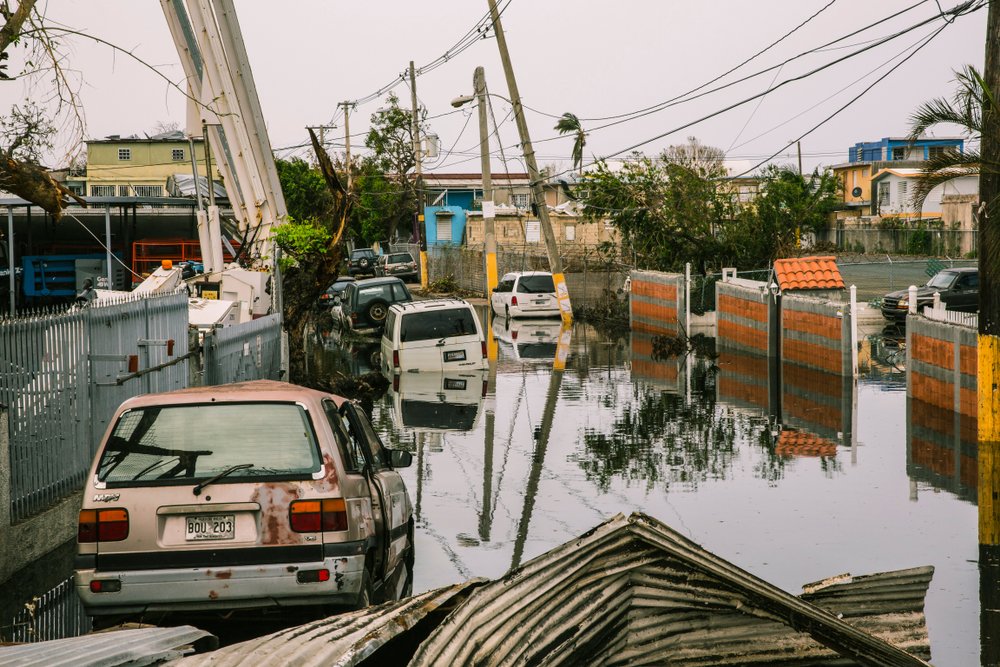

Denise Rodriguez crouched in terror in her bathroom, shielding herself from 155 mph winds. It was September 2017, and Hurricane Maria pounded trees and debris against the side of her house in Hatillo, Puerto Rico. Everything was dark.
When Rodriguez emerged from her bathroom, the rest of her home was gone. In the weeks that followed, she lived on the streets, where sex work became her primary means of income. She struggled to secure food and contact the rest of her family, who had moved to New Haven, Connecticut, years earlier. This was a life Rodriguez never imagined. As the hurricane鈥檚 devastation gave way to a federal and local response and , Rodriguez decided that leaving Puerto Rico was her only choice.
That choice is an increasingly common one. By 2050, climate change could force to leave their communities in search of a new home within their countries. In 2022 alone, an estimated , and this number is only expected to rise.
Numbers like these sketch out an urgent truth: Disasters are no longer confined to the geographic risk zones they tend to strike. Survival in the face of climate change will require not only focusing on the vulnerability of communities on the frontlines, but also on the preparedness of the places that stand on the other side of disaster鈥攖he places where displaced people will try to recover and rebuild.
For Rodriguez, this place was New Haven. A few weeks after Hurricane Maria destroyed her home, she found herself at the overcrowded public housing apartment where her father and stepmother lived in Connecticut. She was one of around who moved to the state from Puerto Rico in the six months following the hurricane, constituting approximately of those who moved stateside after Maria. In some ways, this figure was unsurprising: Connecticut is home to the . But New Haven was also unprepared to receive the thousands of displaced people who arrived in the wake of the 2017 hurricanes鈥攚hich meant the experience of disaster followed them far beyond Puerto Rico.
New arrivals faced barriers at almost every turn while trying to build a new life, and many receiving communities were left on their own to scramble resources together. New Haven is far from unique in this regard. Unlike disaster-struck communities, which are awarded inflows of government funding in the wake of an emergency, receiving communities are often left on their own to garner resources. The result, for hundreds of thousands of people like Rodriguez, is a years-long cycle of housing instability, food insecurity, and continued trauma.
In New Haven, many community-based organizations worked with local government agencies to respond to urgent needs with limited federal support and pooled resources in creative ways. Some organizations provided food, others provided winter coats and clothing for those trying to adapt to their first cold Connecticut winter, while others provided furniture to help displaced families feel more at home. These efforts were critical lifelines to displaced families, but they were often not enough to meet their burgeoning needs.
In New Haven, Rodriguez was one of countless people who struggled to access basic services such as food, housing, and medical care for months after arriving. These individuals faced the dual challenge of navigating the trauma of surviving a violent hurricane while also trying to acclimate to a new, seemingly foreign, place. Many faced language barriers and other challenges in finding jobs, building income, and settling in. Finding affordable and accessible housing was often the .
At the time of Maria, the waitlist for affordable housing through New Haven鈥檚 housing authority was years long, and housing affordability was at a crisis level. After the hurricane, approximately who were already living in New Haven sheltered loved ones. And many of these households were already overburdened. Accommodating additional people often led to overcrowding and added financial constraints. To make matters worse, some landlords imposed limits on the length of stay for visitors, leaving displaced families in fear of eviction.
Rodriguez slept on the floor of an overcrowded public housing apartment where her father and stepmother live in New Haven. When this proved untenable, she moved to a through its Transitional Shelter Assistance program. While the hotel was comfortable, this set-up wasn鈥檛 guaranteed for more than a few months, and Rodriguez and others experienced constant confusion and stress about how long FEMA would help out. In some cases, people were only given one or two days' notice that their stay would be extended, causing a near-constant state of fear and anxiety about being displaced again. Stability remained elusive.
After about four months in the FEMA hotel, Rodriguez was forced to leave, and she found herself with limited options. Shelters were a possibility, but she feared violence, theft, and other unsafe conditions. Lacking other options, she became unhoused, which was made worse by the brutally cold Connecticut winters. Rodriguez found herself in nearly the same situation as she had faced in Puerto Rico after Maria鈥攚ithout a place to call home.
Denise wasn鈥檛 alone in her struggle to find stable housing. Sofia, who was also displaced by Hurricane Maria, left Puerto Rico with two of her younger children and moved in with her eldest daughter, her husband, and his three relatives. The overcrowded conditions made living with her daughter difficult. The landlord also placed additional restrictions, limiting the length of stay for visitors. Knowing that she needed to find an alternative, Sofia contacted 211, a disaster social services helpline, and found temporary housing at a local hotel. Sofia and her children had to move multiple times to different hotels and shelters due to changing circumstances of FEMA support. It was in these hotel rooms that Sofia and her children celebrated Thanksgiving, Christmas, and New Year鈥檚 Eve in 2017, several months after Maria made landfall. Sofia watched her first snowfall from her window on the 7th floor.
At the hotel, Sofia learned to cook rice in a microwave and fried chicken cutlets on her electric hotplate. She relied on a free shuttle service to go to Walmart to buy groceries; her youngest daughter used the shuttle to get to and from school. While the hotel provided immediate relief, it was not the same as having a place of her own to call home. Before the hurricane, Sofia owned a car and worked as a nurse. Afterward, she wished her teenage son could have the space that he needed to mature into young adulthood and her daughter a place to make a mess with her toys.
Immediacy is often a frame for judging the success of disaster recovery, but New Haven鈥檚 experience shows that true support needs to be both immediate and continuous, responding to new needs while also anticipating future ones. In many cases, the proximate cause of climate migration isn鈥檛 the disaster itself, but the failures in the response to that disaster the days, weeks, and months after it strikes. Similarly, a receiving community鈥檚 ability to effectively resettle new arrivals depends on its long-term infrastructure and strong connection to culturally affirming support networks.
More than six years after Hurricane Maria, affordable housing is still a challenge in New Haven. The city needs an estimated by 2030 to begin to offset its affordable housing crisis; the city鈥檚 public housing agency has a looking for affordable housing.
After three years on the affordable housing waitlist, Rodriguez was finally able to move into her own apartment. Now that she secured long-term affordable housing, Denise calls New Haven her home and is charting a promising new path. 鈥淎qu铆 va hacer tu cambio鈥� / 鈥淗ere is your chance for change,鈥� she recalled.
Climate change is expected to increase migration and displacement worldwide, and many communities are unprepared. New Haven鈥檚 case study illustrates a stark reality: recipient cities with already burdened kin populations and under-resourced community-based organizations bear the brunt of burdens associated with climate migration. While bigger cities like New York and Orlando garner attention for resettling people, smaller destination cities like New Haven with strong kin networks play a vital role and require additional resources to support those seeking refuge.
If climate disaster is a matter of when not if, we need to operationalize culturally affirming strategies that can support intra- and transnational resettlement. People are on the move and the time is now to prepare for those who will be uprooted and searching for a new place to call home.
Intern, Future of Land and Housing
Director of Brand Strategy and Co-Founder, For La Di谩spora