
Hao Wu
International Security Program Fellow; National Fellow, 2015
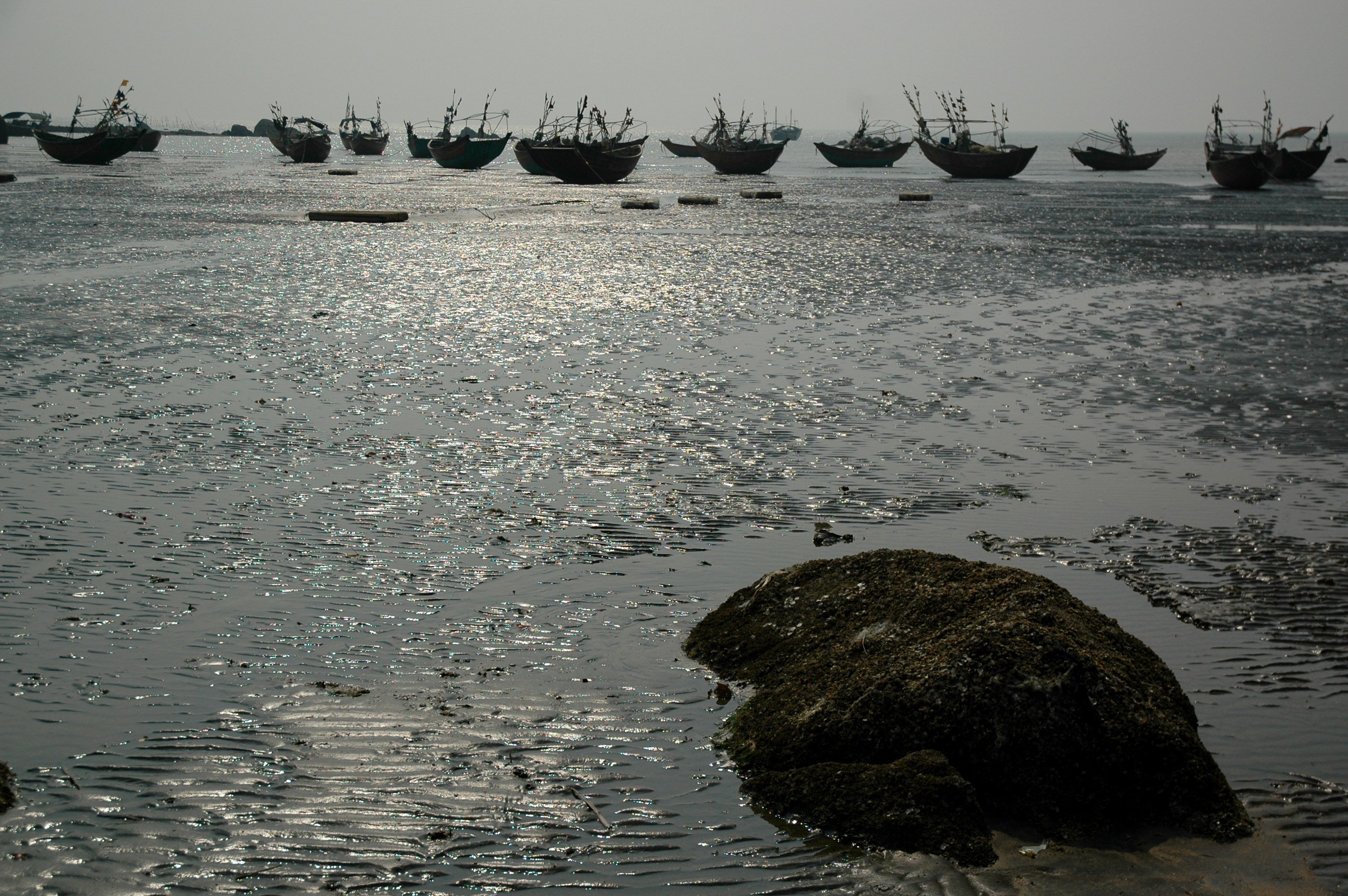
In recent years, China鈥檚 increasingly assertive territorial claim in the South China Sea has driven up tensions in the region. China and Taiwan each considers the entire area within the 鈥渘ine-dash line鈥� their territory while Brunei, Indonesia, Malaysia, the Philippines, Singapore and Vietnam all have partial claims. One of China鈥檚 latest moves is the expansion of the Hughes Reef into an artificial island, 200 times larger in size and equipped with a cement plant and a helipad. The incoming head of the U.S. Navy鈥檚 Pacific Command has said China鈥檚 aggressive behavior raises 鈥渟erious questions about Chinese intentions.鈥� In a recent letter to Secretary of Defense Ashton Carter, a group of influential Senators wrote that China鈥檚 non-military coercion 鈥渄emands a comprehensive response from the United States and our partners.鈥� But before determining its course of action, the United States ought to consider how China might be contemplating its own strategic moves.
For policy makers, it is wise to imagine what your counterparts are thinking. If China鈥檚 President Xi Jinping was keeping a personal journal, for instance, one of his recent entries might run something like this:
I would not lose any sleep over the ongoing debate on our nine-dashed line claim or the rising tensions in South China Sea. The region is valuable to China鈥檚 national interests: the area is very likely rich in oil and natural gas deposits, fishing is plentiful, and navigation is critical鈥揷urrently more than half of all goods in the world transported by sea goes through the area. As China鈥檚 growth generates demands for fossil fuels and fishery, I would not sacrifice our interests in the region to appease critics.
Plus, I know those critics鈥� legal and historical arguments are no better than China鈥檚 own. Historical claims are complex as history has been messy. For example, China and Vietnam can both produce evidence attesting to historical exploitation and administration of the . France once claimed those islands too. Japan occupied the region during World War II. Republic of China (1911-1949) inherited the territory claims over the entire region from the Qing Dynasty. In 1947 after taking control of the islands once occupied by the now-defeated Japan, the government drew an eleven-dashed line in the region, which the People鈥檚 Republic of China (1949-present) changed to nine dashes. In 1958, North Vietnamese Premier Pham Van Dong sent his Chinese counterpart a formal diplomatic letter agreeing with China鈥檚 nine-dash line claim, though 鈥渓egally鈥� France had transferred its own claims to South Vietnam and in 1975 the newly unified Vietnamese government restated their longstanding claims in the region. And these are just some of the conflicting arguments between China and Vietnam alone.
Moreover, I understand that the true reasons the area has attracted so much attention and dispute lately are: 1) The United Nations Convention on the Law of the Sea (UNCLOS), which came effect in 1994, has established the concept of Exclusive Economic Zones (EEZs). Any country that has claim on any inhabited island has exclusive exploitation rights in a 200-nautical-mile surrounding region. 2) The ASEAN countries and China are all becoming stronger and have both the incentives and the resources now to defend their claims. But clearly China is much stronger than all its Southeast Asian neighbors, so I won鈥檛 hesitate to flex my muscles.
After all, international laws and politics are often a distracting chatter; power, especially military power, and national interests are what truly matters. Just look at what Britain did in the Falklands, and what the U.S. did in the Middle East. And the U.S. had the nerve to criticize us. They did not even ratify the UNCLOS because it conflicts with its own interests.
So I would not care much for the criticisms from outside. Let the Foreign Ministry handle the squabbles over diplomatic niceties and political hypocrisies. I have to flex my muscles to defend our interests, to appease the hawks both in the military and the government. They already consider the Foreign Ministry traitorous for having not taken a stronger stand in these conflicts. I need their support for the major reforms I鈥檓 envisioning for China.
I need the support from the population who is increasingly nationalistic and believes it鈥檚 China鈥檚 turn to have a major say in Asian affairs, in our own territory. People outside China naively think that I鈥檓 in total control of the government, that I have absolute power. They don鈥檛 understand how power works鈥攃ompromise and balance are as necessary as coercion. China has ten million public servants and almost seven million military, reserve and paramilitary personnel. If some want to show some muscles, I let them.
But I will only flex the muscles and not use them. Our military, though it鈥檚 making loud noises, is not ready for major combats. Just look at all the big corruption cases that recent investigations have uncovered. The house needs tidying and my focus remains on the economy. China needs to transform its economy in order to grow, to get people employed, to buy into my promise of the 鈥淐hinese Dream.鈥� That鈥檚 the only way for the Communist Party to hold on to power. Presently the economy is too dependent on trading with the U.S. and our Asian neighbors. Any war in the South China Sea would disrupt the economic growth and derail my reforms, which is not the legacy I鈥檇 like to leave behind.
So I鈥檒l be assertive, but only for real if I absolutely have to. When would I have to? Not unless the economy goes into a nose dive and I have an unhappy group of 1.3 billion citizens at my doorstep. Then I鈥檒l need some way to divert their attention, to vent their frustrations at some other monsters lurking in the South China Sea鈥攐r beyond.
International Security Program Fellow; National Fellow, 2015


